
What this page answers
A heat resistant crosslinking agent for rubber is bought for hot parts, and most of the conversation around one is about ageing ovens and service temperatures. Two of the largest applications for this grade are not hot at all in service, and the reason it works in them says more about the chemistry than any ageing table does.
A non-pneumatic hollow tire fails because its web flexes several hundred thousand times and cracks. A windshield wiper blade fails because it is dipped in a hydrochloric acid and hypochlorite bath at 46 C for thirty minutes and the rubber is attacked below the surface. Neither part is hot when it fails, and in both cases the thing that decides the outcome was built during vulcanisation.
This page covers both applications with the measured results, and sets out what the mechanism can and cannot explain, including the part of the wiper blade story that remains an observation rather than a proven mechanism.
The product, and the two numbers on its data sheet
RT88 is a white powder, an anti-reversion and crosslinking additive for natural rubber and synthetic rubber compounds. Its initial melting point measures 90.8 C against a minimum of 89.0, its weight loss on heating is 0.46 percent against a limit of 1.0, and it is added in the final mixing stage with the sulphur and accelerators.
| Propiedad | Especificación | Measured |
| Apariencia | Polvo blanco | Polvo blanco |
| Initial melting point, C | 89.0 minimum | 90.8 |
| Weight loss on heating, percent | 1.0 maximum | 0.46 |
| Dosage with sulphur and accelerators | 0.5 to 3.0 phr | – |
| Dosage used alone, without sulphur | 7,0 phr | – |
| Addition point | Final stage, with the cure system | – |
The application list on the data sheet runs across tires, shock absorbers, conveyor belts, transmission belts, wipers, rubber rollers and motor brackets. That list is wider than the phrase “heat resistance” suggests, and the two applications below explain why.
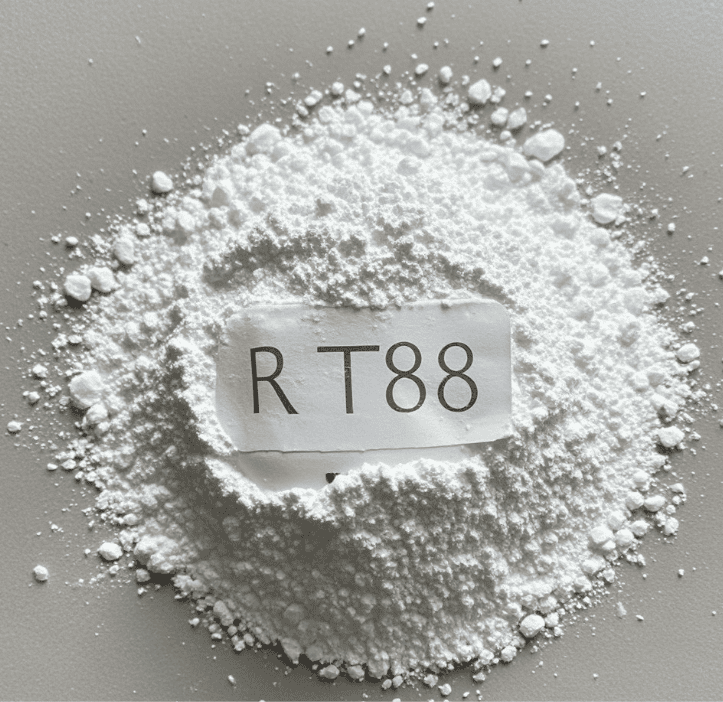
Figure 1. The grade as supplied, a white powder with an initial melting point of 90.8 C.
Why a cure additive fixes parts that run cool
Sulphur vulcanisation builds bridges with different numbers of sulphur atoms in them. The ones with several atoms are flexible and give the compound its elongation and fatigue life. The ones with one or two atoms are stiffer and more stable at temperature.
During cure, and especially in a thick section where the core stays hot longer than the skin, the polysulphide bridges lose sulphur atoms. The network loses crosslinks, and the part that comes out of the press has a different network in its core than at its surface. That is reversion, and it is a curing problem before it is a service problem.
Como Agente anticorrosivo para caucho natural, the grade is unusual in that it both participates in building the network and continues to work while the network is degrading. RT88 participates in forming carbon-sulphur bonds that combine the thermal stability of mono and disulphide bridges with the flexibility of polysulphide ones, and it continues to build stable bridges as the polysulphide ones lose sulphur. The practical expression is a compound whose network is defined by how it was cured rather than by how long it was left in the press, which is the definition of an over cure protection additive that works by compensation rather than by slowing the cure down.
Como crosslinking agent for NR compound it changes what the network is made of rather than how much of it there is, which is why hardness barely moves while fatigue life does. That matters for a part that never gets hot, because the network decides how the part behaves mechanically and chemically for the rest of its life. A rubber additive for flex fatigue resistance y un rubber additive for chlorination resistance are therefore the same purchase described in two different failure languages.
Case one: a non-pneumatic hollow tire
A hollow tire carries the vehicle on a structure of flexible webs instead of on air pressure. There is no inflation to distribute load, so each web is bent, straightened and bent again on every revolution, at an amplitude an inflated tire never sees.
What is a non-pneumatic hollow tire in compounding terms is a part with three simultaneous requirements that fight each other, and it is the hardest case for a rubber additive for hollow tire work because softening solves one requirement and loses another. It has to be stiff enough to carry load without the support of pressure. It has to be fatigue resistant because the strain cycles are large and frequent. And it has to generate little heat, because the web is thick and the heat has nowhere to go.
The industry complaint behind this trial was specific: tires were fracturing. That complaint is what a non pneumatic tire compound additive has to answer, and it is a fatigue complaint rather than a heat complaint. A fracture in a web is a fatigue crack that grew to a critical size, and it usually starts in the region where the strain amplitude is highest.
| Material, phr | Level |
| Caucho natural | 60 |
| Butadiene rubber | 30 |
| SBR, low styrene | 10 |
| Carbon black N330 | 30 |
| Sílice | 30 |
| Heat resistant crosslinking agent RT88 | 1.5 |
| Result | Without RT88 | With 1.5 phr |
| Flex life | 100,000 cycles | over 300,000 cycles |
| Heat build-up, index | 24 | 22 |
| Ageing change rate after 100 C for 72 h | reference | improved by 20 to 30 percent |
| Rigidity | reference | maintained or higher |
The flex result is the largest single effect: 100,000 cycles to more than 300,000, a step change of at least a factor of three. How to improve flex life of a hollow tire web is normally answered by reducing strain amplitude through geometry, which is expensive, or by softening the compound, which loses the stiffness the tire needs. Here the flex life moved by a factor of three at maintained or higher rigidity, which is the combination the application actually requires.
Two cautions belong with that number. The flex life is reported as a band, 100,000 against more than 300,000, rather than as an exact count, so it should be read as a step change in service life and not as a precise ratio. And a flex test on a test piece is not the same as a web on a running tire, so the result justifies a tire trial rather than a specification change on its own.
Como additive to reduce heat build up in rubber, the effect here is small in absolute terms and worth understanding in context. The heat build-up index fell from 24 to 22. That is a small absolute change and a real one in a part that runs continuously, because the index is not linear in temperature and a two point move at the top of the scale represents a meaningful reduction in the rate of fatigue damage.
Case two: a wiper blade and a chlorination bath
A wiper blade rubber additive is normally bought to change friction or noise, and this one is bought to change what the bath does below the surface. A wiper blade strip is natural rubber, and after moulding it is surface treated. The treatment makes the surface slide quietly against glass and prepares it for assembly, and it is aggressive.
| Process step | Condición |
| Chlorination bath | 30 percent hydrochloric acid plus calcium hypochlorite at 40 percent content |
| Customer bath recipe per 400 kg water | 1.2 kg hydrochloric acid plus 1.63 kg calcium hypochlorite |
| Immersion | 46 C for 30 minutes, strips tumbled in a roller surrounded by solution |
| Rinsing | clean water for 30 minutes at ambient temperature |
| Pre-drying | about 10 minutes |
| Coating | aqueous graphite emulsion with adhesive by spraying, or molybdenum disulphide by roller |
| Curing and cutting | as per the existing process |
The failure mode is internal attack. The chlorinating solution penetrates the rubber, the network is attacked below the surface, and the strip develops fine cracks. Those cracks are not visible when the part comes out of the bath. They appear a few days later when the strip is flexed, which is why the process is controlled by exactly that check rather than by an inspection at the bath.
Why does a wiper blade crack after chlorination is therefore a question about how far the oxidising solution can travel into the rubber and what it finds when it gets there. A surface that has been attacked is a surface with a different network: the double bonds at the surface have reacted, the crosslink density near the surface has changed, and the region below it is under a different stress state than the bulk.
At 1.5 phr, the compound resisted internal attack during the chlorination step, the aged properties held better, the tested service life improved, and the finished strip produced less noise against glass.
Why does a wiper blade need a chlorination bath in the first place is worth stating, because it explains why the additive is being asked to survive a process that is deliberately destructive. The bath lowers the friction of the surface so the strip passes over glass without squealing, and it prepares the surface for the graphite or molybdenum disulphide coating that follows. The process is not a mistake to be engineered out; it is the function.
The honest limitation of this case is that the mechanism is not established. A network with more thermally and chemically stable bridges has fewer accessible polysulphide sites and a tighter structure, and both would be expected to slow the penetration of an oxidising solution. That is a plausible explanation and it is not the same as a demonstrated one, and this trial measured the outcome rather than the penetration depth. A customer who needs the mechanism should ask for a cross-section analysis after treatment rather than an assurance.
The third application, in one table
The same grade is also used in anti-vibration parts, where the requirement is dynamic rather than chemical. That data has been reported separately and is summarised here only so that the three applications can be seen together.
| Aplicación | Dosage | Requisito | Measured result |
| Hollow tire web | 1.5 phr | Flex life at maintained rigidity | 100,000 to over 300,000 cycles |
| Wiper blade strip | 1.5 phr | Resistance to chlorination, noise | Internal attack resisted, noise reduced |
| Anti-vibration mount | 0.8 phr | Stiffness ratio, adhesion | Ratio 1.49 to 1.34, adhesion unchanged |
The three rows are three different products of the same chemistry. In the first the benefit is mechanical, in the second it is chemical, and in the third it is dynamic. None of them is a service temperature result, which is the point of the page.
Dosage and addition
| Artículo | Recommendation |
| Dosage with sulphur and accelerators | 0.5 to 3.0 phr |
| Dosage alone, without sulphur | 7.0 phr, which changes the economics and the cure |
| Addition point | Final mixing stage, with the sulphur and accelerators |
| Effect on cure | Cure behaviour changes, so the cycle has to be re-verified |
| Embalaje | 20 kg per bag |
| Storage | Dry, cool, sealed, around 25 C |
Anti reversion additive dosage is the question that decides the cost of the programme, and how much anti reversion agent to add with sulphur depends on what is being protected. In the two applications here the answer was 1.5 phr, which is above the middle of the range, because both parts had a specific failure to prevent. In a compound that is merely being future-proofed against a long cure, the bottom of the range is enough.
Can an anti reversion agent be used without sulphur is a question the data sheet answers with a number that should stop most projects: 7.0 phr. At that level the additive is doing the crosslinking rather than participating in a sulphur cure, and the compound becomes a different material with a different cost and a different cure. It is a legitimate route but it is a formulation project, not a dosage change.
The addition point is the one instruction that cannot be relaxed. The additive has to be present when the cure system is present, which is the final stage. Added at the start of the mix, it is dispersed in the polymer but it is not where the crosslinking chemistry happens, and the effect is reduced.
What the rheometer shows, and why the cure length matters
A reversion problem is invisible in a normal cure curve, because a normal cure curve stops at t90. The evidence appears after that point, and the way to see it is to keep running.
| What the curve does | What it means | What to do |
| Rises to a plateau and stays flat | The network has stopped changing | Nothing; this is the reference behaviour |
| Rises, plateaus, then turns over | Reversion is under way and the cure is time dependent | Run to the full cycle before setting a cure time |
| Rises and never plateaus | The network is still being built when the test ends | Extend the test; a compound that never plateaus cannot be cured to a defined state |
| Plateau lower with the additive | The additive changed the cure as well as the network | Re-verify the cycle rather than assuming the old one |
The second row is the one that costs money in a plant. A press operator who sees a variable part and extends the cycle to be safe makes a reverting compound worse, because the state of cure is then determined by how long the part was left in the press rather than by the compound. That is the reason an anti-reversion additive is worth having even in a part that never gets hot in service: it makes the cure time a decision rather than a guess.
Failure analysis: what the two parts look like when it goes wrong
| Symptom | Usual cause | What to check |
| Web cracks at the highest strain region | Fatigue crack growth in a network that lost flexibility | Flex test to failure, and the rheometer curve run past the plateau |
| Web is stiff enough but fractures early | The compound was cured for rigidity and lost fatigue life doing it | Compare flex life at the actual cure, not at a standard one |
| Core of a thick section softer than the skin | Temperature gradient plus reversion, so the two zones finished differently | Cure a slab at the production thickness and cut it |
| Wiper strip cracks two to five days after the bath | Internal attack that was not visible at inspection | Flex the strips at the same interval as the customer’s control check |
| Crack appears only on one side of the strip | Uneven immersion, or strips touching in the roller | Check the loading pattern in the basket, not the compound |
| Noise returns on a treated strip | Surface coating failure rather than a rubber failure | Check the graphite or MoS2 layer before changing the compound |
| Heat build-up rises after a cure change | The network is dissipating more, usually because the cure ran long | Run the rheometer to plateau and compare torque fall |
The third row is the one that connects the two cases. A thick part cures unevenly, and the core is where the network is worst. A curing agent for thick rubber section is bought to reduce that difference, and the way to see whether it did is to cut the part rather than to test its surface.
What it does not do
It does not make a general purpose natural rubber compound behave like a high temperature polymer. The base polymer and the antioxidant package still set the ceiling.
It does not replace the antioxidant package. Ageing resistance is a system property and this additive is one part of it.
It does not fix a compound whose cure system is wrong, or one that is under-cured because the press is too cold.
And it does not come without a cost in compression set measured at the cure temperature. In the anti-vibration work reported separately, compression set at 160 C for 12 minutes rose from 54.0 to 58.5 percent, while compression set at 70 C for 24 hours improved from 18.09 to 16.09 percent. Why does compression set get worse when adding an anti reversion agent has a specific answer: the network is tighter at short times and at the cure temperature, which is exactly where the first test is measured. The two numbers are asking different questions and a specification that contains only the first will reject the better compound.
Preguntas frecuentes
How to stop reversion in a thick natural rubber part
Add a compensating crosslink rather than changing the cure system, and verify it on a slab at the production thickness. In the hollow tire work here, 1.5 phr took flex life from 100,000 to over 300,000 cycles and improved the ageing change rate by 20 to 30 percent after 72 hours at 100 C. Cutting the cured part is the way to see whether the core was protected, because a surface measurement will not show a gradient.
Why does a wiper blade crack after chlorination
Because the chlorinating solution penetrates below the surface and attacks the network there, and the resulting cracks only open when the strip is flexed. That is why the process is controlled by flexing strips a few days after treatment rather than by inspecting them at the bath. The cracks are a delayed failure of the region under the surface, not a surface defect.
How to resist hydrochloric acid attack in a rubber compound
Build a network that is tighter and more chemically stable, so there are fewer accessible sites for an oxidising solution and a longer path for it to travel. In this work 1.5 phr of the additive resisted internal attack during a 30 percent hydrochloric acid and hypochlorite bath at 46 C for 30 minutes. The mechanism is plausible rather than proven, and a cross-section analysis after treatment is the way to confirm it.
What is a non-pneumatic hollow tire
A tire that carries load on a structure of flexible webs instead of on inflation pressure, so each web is bent through a large amplitude on every revolution. For a compounder it means three requirements at once: rigidity without pressure, fatigue resistance at large strain, and low heat generation in a thick section.
How to improve flex life of a hollow tire web
Protect the flexible part of the network rather than softening the compound. Softening raises flex life and loses the rigidity the tire needs, which is why the result here matters: flex life moved from 100,000 to over 300,000 cycles at maintained or higher rigidity with 1.5 phr of the additive. Confirm on a tire, because a test piece is not a web.
Why does the core of a thick part cure differently from the skin
Because heat reaches the core later and the core then stays hot longer, so the two zones accumulate different times at temperature. If the compound reverts, the core is either under-cured or reverted relative to the skin, and the part has two different networks. It shows up first in heavy sections and in parts with metal inserts.
How to reduce heat build up in a non-pneumatic tire
Reduce hysteresis per cycle and keep the geometry from concentrating strain. The heat build-up index fell from 24 to 22 with 1.5 phr here, which is a small absolute move and a real one in a part that runs continuously. A two point move at the top of an index scale is not the same as a two point move at the bottom.
How much anti reversion agent to add with sulphur
Between 0.5 and 3.0 phr, and the applications on this page both used 1.5 phr because each had a specific failure to prevent. A compound that is only being protected against a long cure needs less. Start at the bottom of the range and add only against a measured failure rather than against a feeling.
Can an anti reversion agent be used without sulphur
This one can, at 7.0 phr, but the economics and the cure behaviour change enough that it becomes a different formulation project. At that level the additive is the crosslinking system rather than a participant in a sulphur cure. Treat it as a new compound, not as a dosage adjustment.
Why does a wiper blade need a chlorination bath
To lower the surface friction so the strip passes over glass without squealing, and to prepare the surface for the graphite or molybdenum disulphide coating. The treatment is functional, which is why the additive has to survive it rather than the process being removed.
How to keep adhesion to metal while raising heat resistance
Choose an additive that does not damage the bond, and measure the bond before and after ageing. In the anti-vibration work on this grade, adhesion to metal measured 6.54 without the additive and 6.56 with it, which is no change within measurement variation. A heat resistance additive that weakened the bond would be a poor trade.
How to test reversion on a rheometer
Run the cure to well past the plateau and watch the torque. A compound with good reversion resistance flattens, and a compound with poor resistance turns over and falls. The amount of the fall is a direct measure of the reversion the additive is there to prevent, and a cure stopped at t90 never shows it.
Why does compression set get worse when adding an anti reversion agent
Because the network is tighter at short times, which is what a set measurement at the cure temperature sees. In the anti-vibration work here, set at 160 C for 12 minutes rose from 54.0 to 58.5 percent while set at 70 C for 24 hours improved from 18.09 to 16.09. If your specification only contains the first measurement, include the second before rejecting the compound.
How to improve ageing resistance of a natural rubber compound
Protect the polysulphide bridges and anchor the network. Here the ageing change rate after 72 hours at 100 C improved by 20 to 30 percent in the hollow tire compound, and the same chemistry improved aged tensile and elongation in the anti-vibration compound. The range is stated as a range because it varied between the properties measured.
How to choose an anti reversion agent for a conveyor belt
Start from the three failure routes a belt has: loss of mechanical properties after heat ageing, fatigue cracking, and loss of adhesion to the cord where the belt is reinforced. A rubber additive for conveyor belt compound should be assessed on all three, at the belt’s actual thickness, because reversion is a section thickness effect as much as a temperature effect.
Why Choose Us
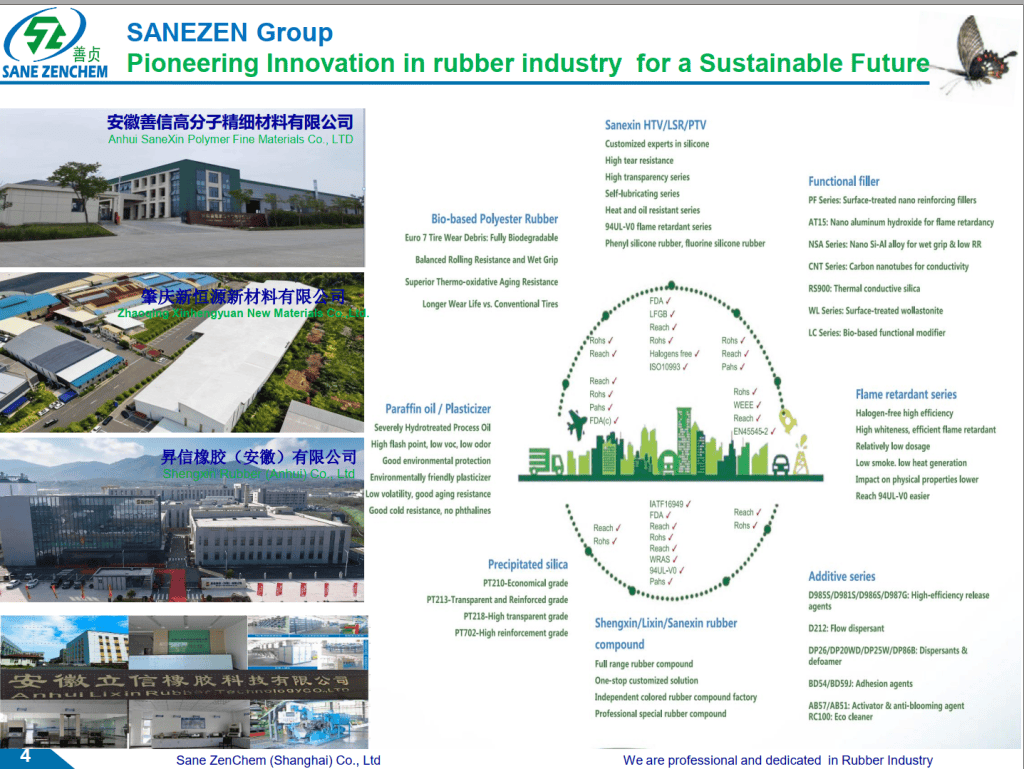
Choosing a functional filler supplier is not only about purchasing a mineral powder. It is about selecting a technical partner that understands polymer compounding, physical failure mechanisms, and long-term product performance. As a leading specialty functional filler and performance additives manufacturer, we bring decades of compounding expertise to every customer collaboration.
SaneZenChem operates five manufacturing facilities specialising in:
• Rubber Compounds
• Silicone Rubber Compounds
• Specialty Functional Fillers
• Flame Retardants
• Polymer Performance Additives
Because we formulate and manufacture rubber and silicone compounds ourselves, every specialty product we develop originates from solving real production challenges rather than laboratory concepts alone. This application-driven approach allows us to deliver practical solutions that create measurable improvements in customer products – from eliminating processing viscosity spikes and preventing micro cracking, to ensuring high dielectric strength in harsh electrical environments. Our unique dual position as both a direct compounder and a premier specialty functional filler manufacturer means we are uniquely equipped to support rubber, epoxy, and electrical insulation manufacturers in achieving longer service life, processing efficiency, and ultimate reliability.

 Spanish
 English
 Russian