Introduction
The global push for sustainability has reshaped the materials science landscape, particularly in the realm of flame retardancy. With increasingly stringent environmental regulations such as RoHS, REACH, and WEEE, the industry is rapidly moving away from halogenated compounds. This shift has increased the importance of partnering with a reliable halogen free flame retardant factory or a professional halogen free flame retardant manufacturer who can deliver consistent, high-quality solutions. While the market offers a variety of halogen-free alternatives, a critical gap remains: achieving a balance between high flame retardant efficiency, superior physical-mechanical properties, and ease of processing. Many standard solutions compromise one aspect to achieve another. For those seeking a flame retardant rubber compounds manufacturer with deep technical expertise, the challenge is often finding a single solution that meets all requirements.
In this article, we explore the current landscape of halogen-free flame retardants, particularly the widely used Ammonium Polyphosphate (APP), and introduce a paradigm shift: GreenThinking® FR99RP. As a product of advanced super-refinement, activation, functionalization, and compounding technology, FR99RP is not just an additive—it is a comprehensive solution designed to meet the most demanding technical requirements of the rubber and plastics industry. Whether you are looking for a UL94 V0 flame retardant manufacturer China or seeking halogen free environmentally friendly flame retardant Suppliers China, FR99RP represents the next generation of flame retardant technology.
Part 1: The Landscape of Halogen-Free Flame Retardants
The market for halogen-free flame retardants is diverse, typically falling into several categories including metal hydroxides, phosphorus-based compounds, nitrogen-based compounds, and intumescent systems. Each has distinct limitations. Many halogen free environmentally friendly flame retardant Manufacturers offer a range of these options, but few have solved the core trade-off between efficiency and physical properties.
1. Metal Hydroxides (ATH & MDH)
Aluminum Trihydrate (ATH) and Magnesium Hydroxide (MDH) are among the most common halogen-free options. They function via endothermic decomposition, releasing water vapor to cool the substrate and dilute combustible gases.
- Limitations: To achieve a V-0 rating, loading levels often exceed 60% of the compound. This severely compromises mechanical properties, drastically reduces elongation at break, increases specific gravity, and makes processing difficult due to high viscosity.
2. Phosphorus-Based Flame Retardants (Including APP)
Phosphorus-based retardants, such as organic phosphates and inorganic polyphosphates, are highly effective. The most common is Ammonium Polyphosphate (APP) .
- Standard APP Mechanism: APP acts as an “acid source” in intumescent systems. Upon heating, it decomposes to release phosphoric and pyrophosphoric acids, which catalyze polymer dehydration. This forms a charred crust that insulates the underlying material from oxygen and heat.
- Limitations of Regular APP:
- Surface Quality: When loaded at high levels (80-100 phr) in rubber, APP often leads to rough surfaces, blooming (migration to the surface), and a gritty texture.
- Mechanical Degradation: It typically reduces tensile strength and elasticity. As highlighted in the test data, standard APP (FR98 in the provided documents) tends to prolong cure time (TC90) and lower the crosslink density (MH-ML), resulting in a softer but mechanically weaker vulcanizate.
- Intumescence Control: While APP promotes charring, it often results in uncontrolled “strong intumescence” (excessive swelling) and significant soot/ash formation, which can be undesirable for certain applications.
3. Nitrogen-Based and Other Systems
Compounds like melamine derivatives also exist. While they offer good gas-phase activity, they often lack the char-forming capability needed for robust barrier formation and require complex synergistic combinations to be effective.
The common denominator across these standard products is a trade-off. Manufacturers often have to sacrifice physical properties, surface aesthetics, or processing efficiency to achieve the required flame retardancy. This is precisely where GreenThinking® FR99RP demonstrates its superiority, offering a high performance halogen free flame retardant for rubber that overcomes these traditional limitations.
Part 2: Introducing GreenThinking® FR99RP — A New Generation of Compounded Flame Retardant
Developed by Sanexin Polymer (SaneZen Group), GreenThinking® FR99RP is not a single-component additive but a highly efficient, functionalized composite. It represents a shift from simple additive incorporation to engineered material design. As a leading UL94 V0 flame retardant manufacturer China, Sanexin has engineered FR99RP to be the ultimate solution for demanding applications.
2.1 A Synergistic Flame Retardant Mechanism
Unlike conventional APP, which relies almost exclusively on char formation (condensed phase), FR99RP employs a multi-pronged approach:
- Insulating Barrier Formation: Like APP, FR99RP decomposes upon heating to form a viscous, ceramic-like char layer. However, the structure of this char is distinct. Data from EPDM and NBR tests indicate that FR99RP promotes a stable, ceramic-like char that does not over-expand into a weak, sooty ash. This provides a robust physical barrier against oxygen, heat, and volatile fuel diffusion. It functions exceptionally well as a halogen free flame retardant for EPDM rubber, maintaining the polymer’s integrity.
- Free Radical Scavenging (Gas Phase): FR99RP goes beyond condensed-phase action. It releases specific free radicals that actively capture and neutralize the highly reactive H· and OH· radicals in the gas phase. This effectively terminates the combustion chain reaction.
- Heat Absorption: The decomposition process of FR99RP is endothermic, efficiently absorbing a significant amount of heat generated during combustion, further suppressing the flame.
This multi-modal mechanism allows FR99RP to achieve high flame retardant efficiency at lower or comparable loading levels, without the drawbacks of single-mode retardants. It truly functions as a UL94 V0 flame retardant with high tensile strength, a combination rarely seen in the industry.
2.2 Designed for Performance: Key Product Benefits
Based on the technical data sheet and comparative analysis, the core advantages of FR99RP are:
- Uncompromised Physical Properties: FR99RP maintains, and in some cases improves, the mechanical integrity of the polymer matrix. Unlike standard APP, it preserves high tensile strength and exceptional elongation at break. This makes it an ideal halogen free flame retardant for NBR rubber parts, where elasticity and strength are critical.
- Superior Surface Quality: Specifically designed for applications requiring a smooth surface, FR99RP ensures excellent dimensional stability and a high-quality finish, free from the blooming or roughness associated with conventional additives.
- Processing Efficiency: Its excellent dispersibility and good fluidity reduce mixing energy consumption and shorten the optimal cure time, enabling faster production cycles.
- Relatively Low Density: This allows for lighter end-products, a critical advantage in industries like automotive and rail transportation.
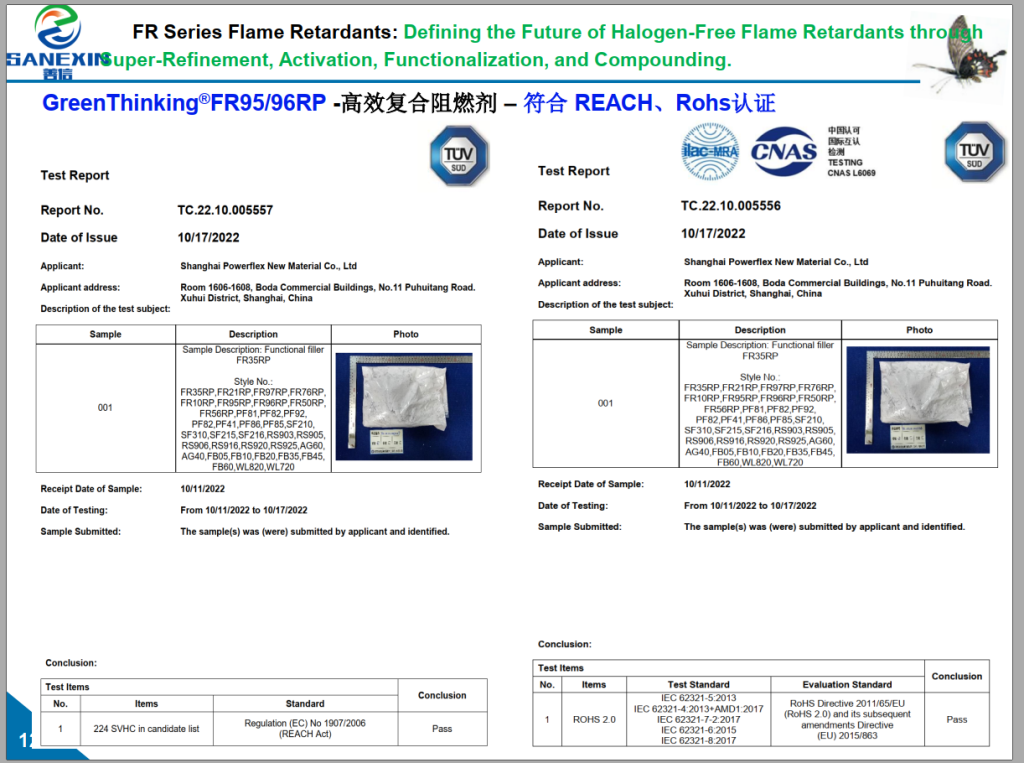
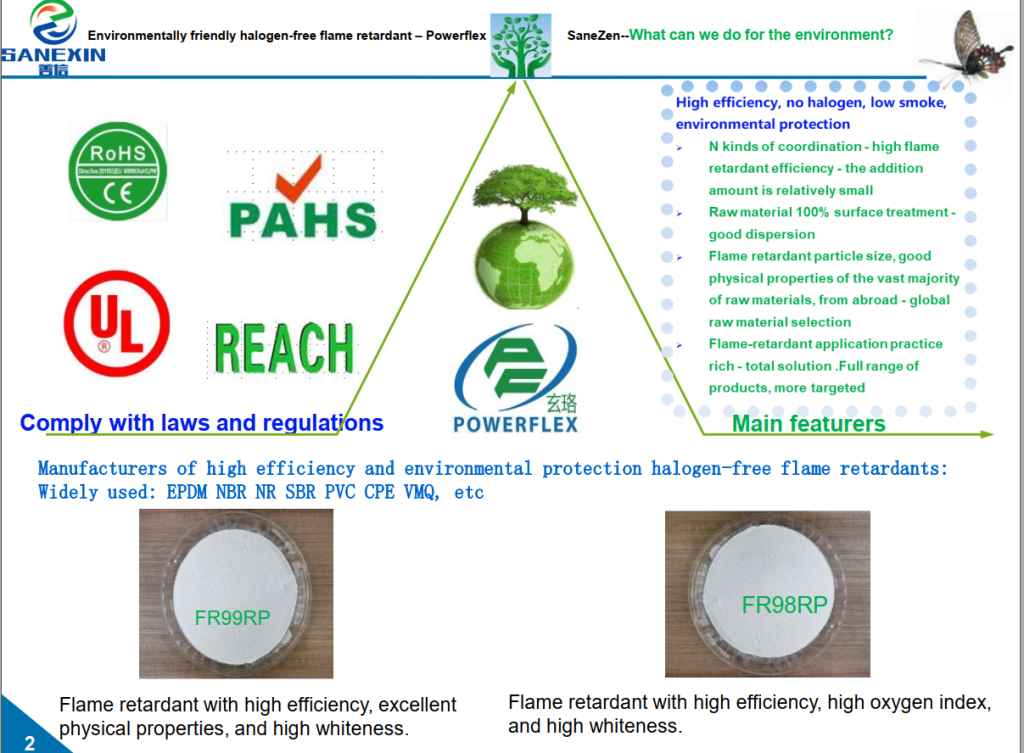
- Full Environmental Compliance: It is completely halogen-free, containing no polybrominated biphenyls (PBBs), polybrominated diphenyl ethers (PBDEs), chlorine, fluorine, or antimony trioxide. It fully complies with EU Reach, RoHS, and WEEE directives.
Part 3: Performance Validation — FR99RP vs. Conventional Systems
The performance superiority of FR99RP is not merely theoretical; it is validated by extensive comparative testing. The following data from internal reports compares FR99RP against a standard, high-performance APP-based system (referred to as FR98 in the documentation) across various rubber matrices.
3.1 In EPDM 70 Shore A Formulation
This comparison highlights how FR99RP fundamentally changes the compound’s behavior. For manufacturers requiring a flame retardant rubber compound for wire and cable or for automotive seals, these results are particularly compelling.
| Test Item | Unit | FR98 (100 phr) | FR99RP (100 phr) | Advantage |
| Tensile Strength | MPa | 6.35 | 9.32 | +46.8% |
| Elongation at Break | % | 417 | 497 | +19.2% |
| Modulus (M100) | MPa | 2.59 | 2.69 | Comparable |
| Compression Set (120°C×24h) | % | 52.94 | 31.43 | Superior |
| Resilience | % | 37 | 47 | +27% |
| Oxygen Index (LOI) | % | 42.3 | 35.4 | Higher LOI for FR98 |
Analysis: While FR98 yields a higher Limiting Oxygen Index (LOI), FR99RP provides a significantly better balance of properties. The FR99RP vulcanizate exhibits dramatically higher tensile strength and elongation at break, crucial for durable seals and gaskets. Most notably, the compression set—a measure of a material’s ability to return to its original thickness after prolonged compressive stress at high temperatures—is vastly superior for FR99RP (31.43% vs. 52.94%). This makes FR99RP the clear choice for demanding applications like automotive seals and gaskets that must maintain integrity under heat and pressure. Furthermore, the conclusion notes that FR98 causes “strong intumescence” and soot, whereas FR99RP forms a “ceramic-like char,” indicating a more stable and predictable fire barrier. Its performance as a halogen free flame retardant for railway gaskets is therefore unmatched.
3.2 In EPDM 50 Shore A Formulation
Even at a lower hardness, the benefits are consistent.
| Test Item | Unit | FR98 (100 phr) | FR99RP (100 phr) |
| Tensile Strength | MPa | 8.03 | 9.31 |
| Elongation at Break | % | 550 | 553 |
| Resilience | % | 44 | 51 |
| Oxygen Index (LOI) | % | 41.5 | 30.5 |
Here again, FR99RP delivers higher tensile strength and superior resilience, confirming its ability to maintain the inherent elasticity of the rubber compound, a property often destroyed by high loadings of conventional flame retardants. It serves as a reliable environmentally friendly flame retardant for industrial rubber, ensuring that safety does not come at the expense of performance.
3.3 In NBR 70 Shore A Formulation
The advantages are also evident in polar rubbers like NBR.
| Test Item | Unit | FR98 (100 phr) | FR99RP (100 phr) |
| Tensile Strength | MPa | 9.43 | 9.23 |
| Elongation at Break | % | 522 | 455 |
| Modulus (M100) | MPa | 2.55 | 2.94 |
| Resilience | % | 24 | 33 |
Analysis: In NBR, FR98 offers a higher elongation, but FR99RP provides a higher modulus (stiffness) and significantly better resilience. The test conclusion emphasizes that FR98 offers “better flame retardancy” (likely referring to the higher LOI) but “inferior mechanical elasticity,” whereas FR99RP provides a “valuable balance of physical properties and resilience.” This balance is the key differentiator for applications requiring both safety and long-term dynamic performance.
Part 4: The Sanexin Advantage — Technology, Scale, and Commitment
The superior performance of GreenThinking® FR99RP is the result of a dedicated R&D philosophy centered on “Super-Refinement, Activation, Functionalization, and Compounding.” This isn’t just a marketing slogan; it is a technical reality. By operating as both an innovative developer and a large-scale halogen free flame retardant factory, Sanexin ensures that this advanced technology is delivered reliably.
- Super-Refinement: The raw materials undergo processes to achieve a small particle size with a narrow, optimized distribution. This enhances dispersibility and ensures a smooth surface finish.
- Activation & Functionalization: Surface treatments are applied to the platelet-like particles. This improves compatibility with various polymer matrices (EPDM, NBR, NR, SBR, CR, etc.), reducing the tendency for blooming and enhancing mechanical properties.
- Compounding: FR99RP is a masterful blend of synergistic components. It is a ready-to-use system that eliminates the need for complex and often unreliable in-house mixing of multiple additives.
From a manufacturing perspective, Sanexin Polymer operates a state-of-the-art facility.
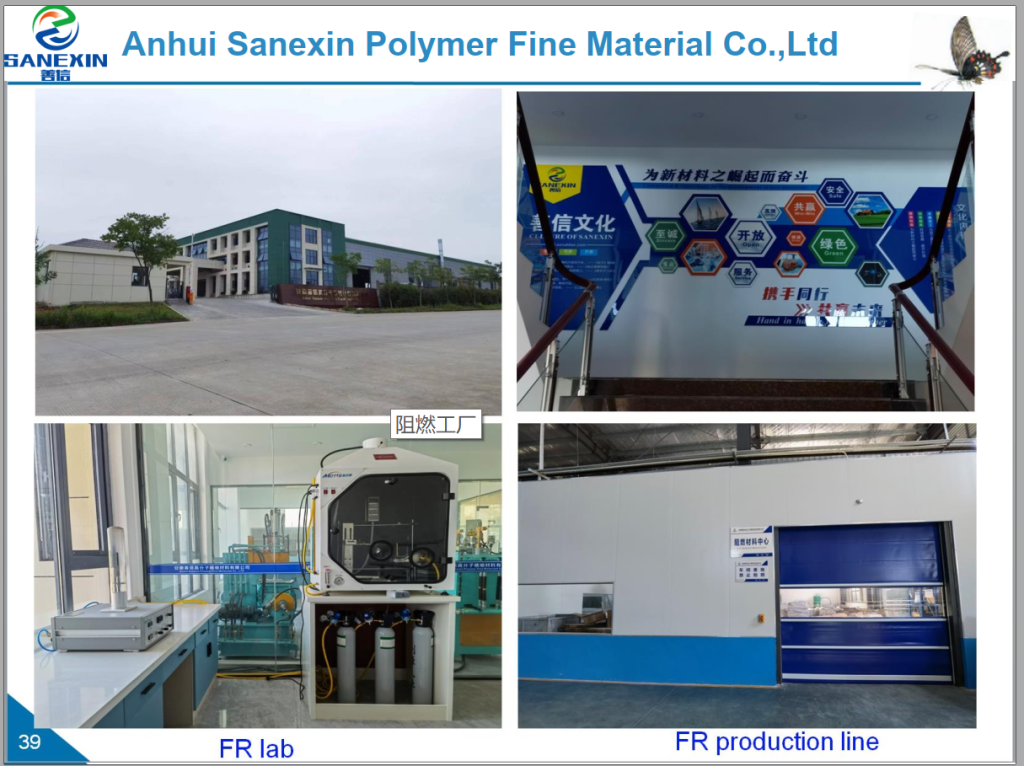
This facility adheres to strict quality control protocols, ensuring batch-to-batch consistency—a critical requirement for large-scale industrial applications. As one of the premier halogen free environmentally friendly flame retardant Manufacturers, Sanexin is committed to supplying materials that meet the highest global standards.
Conclusion: Defining the Future of Flame Retardancy
The transition to halogen-free materials is not just a regulatory requirement; it is an opportunity to innovate. While conventional APP and other standard flame retardants serve a purpose, they often fall short in delivering the comprehensive performance profile required by modern engineering applications.
GreenThinking® FR99RP represents a significant evolution. It successfully bridges the gap between high flame retardancy and superior physical-mechanical properties. The data consistently shows that FR99RP offers:
- Superior Tensile Strength and Elongation: Maintaining the integrity of the rubber matrix.
- Excellent Resilience and Compression Set: Ensuring long-term performance in dynamic sealing applications.
- Smooth Surface Quality: Meeting the aesthetic and functional demands of finished goods.
- Optimized Processing: For efficient manufacturing.
- Multi-Modal Flame Retardancy: Combining char formation, radical scavenging, and heat absorption for robust safety.
- Full Environmental Compliance: Aligning with global sustainability goals.
For manufacturers of railway transportation components, electronic and electrical parts, automotive seals, and industrial rubber goods, the choice is clear. Whether you need a halogen free flame retardant for railway gaskets, a flame retardant rubber compound for wire and cable, or a halogen free flame retardant for NBR rubber parts, GreenThinking® FR99RP is not just another flame retardant; it is a high-performance solution engineered for the demands of the future. Partner with Sanexin, a trusted UL94 V0 flame retardant manufacturer China, to elevate your products.
Frequently Asked Questions (FAQs)
1. What is the fundamental difference between GreenThinking® FR99RP and standard Ammonium Polyphosphate (APP)?
A: Standard APP is a single-component, inorganic salt that primarily functions as an “acid source” to form a char layer (condensed-phase mechanism). In contrast, FR99RP is a highly efficient, compounded system. It utilizes a multi-modal mechanism: it not only forms a superior ceramic-like char barrier but also actively interrupts the combustion chain reaction by scavenging H· and OH· free radicals (gas-phase mechanism) and absorbs significant heat. This synergy allows FR99RP to achieve V-0 ratings without the severe trade-offs in mechanical properties, surface quality, or processing efficiency often seen with conventional APP. It is the ideal high performance halogen free flame retardant for rubber for those seeking a ready-to-use solution.
2. Does the high loading required for V-0 certification compromise the rubber’s mechanical properties, such as tensile strength or compression set?
A: This is precisely where FR99RP excels. Unlike many conventional flame retardants that drastically reduce mechanical performance at high loadings (80-120 phr), FR99RP is engineered to maintain—and in some cases enhance—the physical properties of the compound. As evidenced in our EPDM 70 Shore A test data, compared to standard APP-based systems, FR99RP delivers 46.8% higher tensile strength and significantly better compression set resistance (31.43% vs. 52.94%). It preserves the inherent elasticity of the rubber, making it ideal for dynamic sealing applications where long-term durability is critical. This makes it a true UL94 V0 flame retardant with high tensile strength.
3. In which applications and rubber types is FR99RP most effective?
A: FR99RP is designed as a versatile, ready-to-use solution for high-performance applications requiring both stringent flame retardancy (UL94 V-0) and excellent physical properties. It demonstrates exceptional dispersion and compatibility across a wide range of polymers, including EPDM, NBR, NR, SBR, CR (Neoprene), IIR, and HCR. Common applications include:
- Railway Transportation: Seals, gaskets, and vibration dampers. As a specialized halogen free flame retardant for railway gaskets, it provides unmatched safety and durability.
- Automotive: Under-the-hood components, wire and cable, and sealing systems. It functions perfectly as a flame retardant rubber compound for wire and cable.
- Electronic & Electrical: Enclosures and insulating parts.
- Industrial Rubber Goods: Conveyor belts, hoses, and molded goods requiring a smooth surface and low specific gravity. It serves as a premier environmentally friendly flame retardant for industrial rubber.
Contact Us
Ready to elevate your products with high-performance, halogen-free flame retardancy? Our team of technical specialists is ready to help you integrate GreenThinking® FR99RP into your formulations for optimal results.
Why Partner with Sanexin Polymer?
- Technical Expertise: Benefit from our years of R&D in super-refinement, activation, and compounding. We don’t just sell products; we provide formulation support and solutions.
- Quality Assurance: Our state-of-the-art manufacturing facility in Anhui Province ensures consistent, high-quality supply with batch-to-batch reliability, fully compliant with REACH, RoHS, and WEEE directives.
- Global Reach: With a commercial office in Shanghai, we are strategically positioned to serve clients worldwide with efficient logistics and responsive communication.
Get in touch with us today to request a sample, technical data sheet, or to discuss your specific application requirements.
Email: yorichen@sanezen.com
Website: www.sanezenrubber.com\
Phone: 86 — 136 7164 1995