Введение: Challenges and Opportunities in the Rubber Industry
Against the backdrop of the rapid development of the global automotive industry and continuously growing transportation demand, tires, as the sole component of vehicle-ground contact, have their performance directly related to driving safety, energy efficiency, and environmental impact. In recent years, the rubber materials industry has faced multiple challenges: it must meet increasingly stringent environmental regulations (such as EU REACH, RoHS standards), maintain excellent performance under extreme operating conditions, and simultaneously cope with pressure from raw material cost fluctuations and production process optimization.
In this context, tire manufacturers have placed higher demands on rubber materials: longer service life, better fatigue resistance, stronger metal adhesion, superior thermal aging performance, and lower rolling resistance. Traditional rubber additive systems often struggle to meet all these requirements simultaneously, frequently forcing compromises between different performance attributes.
GreenThinking® RT56 Adhesion & Fatigue Resistant Agent, developed by Shanghai Powerflex New Material Co., Ltd. (a subsidiary of SaneZen Group), is an innovative solution born precisely to address this industry pain point. This multifunctional additive not only redefines the performance boundaries of rubber materials but also brings technological innovation to the tire manufacturing industry through its unique mechanism of action. As a tire rubber chemical additive, it represents a significant advancement in high performance tire chemicals.
Market Pain Point Analysis: Technical Challenges Facing the Tire Industry
1. Insufficient Dynamic Fatigue Life
Tires are subjected to complex cyclic stresses during operation. Rubber materials are prone to developing microcracks that gradually propagate, ultimately leading to material failure. Especially under conditions of high-speed driving, heavy-load transportation, and complex road conditions, the fatigue resistance of traditional rubber formulations often fails to meet the design requirements of modern tires. Statistics indicate that approximately 30% of premature tire failures are directly related to fatigue damage of the rubber material. This creates a critical need for a reliable rubber fatigue resistance additive.
2. Degradation of Metal-Rubber Interface Adhesion
The adhesion performance between steel cords and rubber is a key factor determining the structural integrity of a tire. Under the long-term effects of environmental factors such as heat, oxygen, and humidity, the bonding interface is susceptible to aging, oxidation, and degradation, leading to a decrease in steel cord pull-out force and seriously affecting the safety performance and service life of the tire. This issue is particularly pronounced in regions with high temperatures and humidity. Finding an Additive to improve steel cord rubber adhesion is therefore a primary concern for manufacturers.
3. Performance Degradation Due to Thermal Aging
During prolonged use, rubber materials are affected by thermo-oxidative aging, causing changes in the crosslinked network structure, which leads to increased hardness, decreased elasticity, and degradation of mechanical properties. This phenomenon is especially noticeable in tires that operate under conditions of frequent braking, high-speed driving, and high temperatures. An effective heat resistant rubber additive for tires is essential to mitigate this.
4. Performance Fluctuations Due to Uneven Filler Dispersion
The dispersion state of reinforcing fillers like carbon black directly affects the homogeneity and performance stability of rubber materials. Poor dispersion can lead to local stress concentration, aggravated heat buildup , accelerated material aging, and affect the consistency of the finished product. This underscores the need for a specialized carbon black dispersion additive for rubber.
5. The Dilemma of Balancing Environmental Protection and Performance
As environmental regulations become increasingly strict, traditional rubber auxiliaries containing harmful substances such as nitrosamines and polycyclic aromatic hydrocarbons are gradually being restricted. Manufacturers need to ensure material environmental friendliness without sacrificing or even while enhancing product performance.
RT56 Technological Innovation: Performance Breakthrough through Molecular Design
Revolutionary Molecular Structure and Mechanism of Action
The core innovation of RT56 lies in its unique molecular design. The presence of multiple active benzene ring structures in its molecule allows it to directly participate in the rubber vulcanization and crosslinking process, reconstructing the three-dimensional network structure. This characteristic endows RT56 with multiple functions:
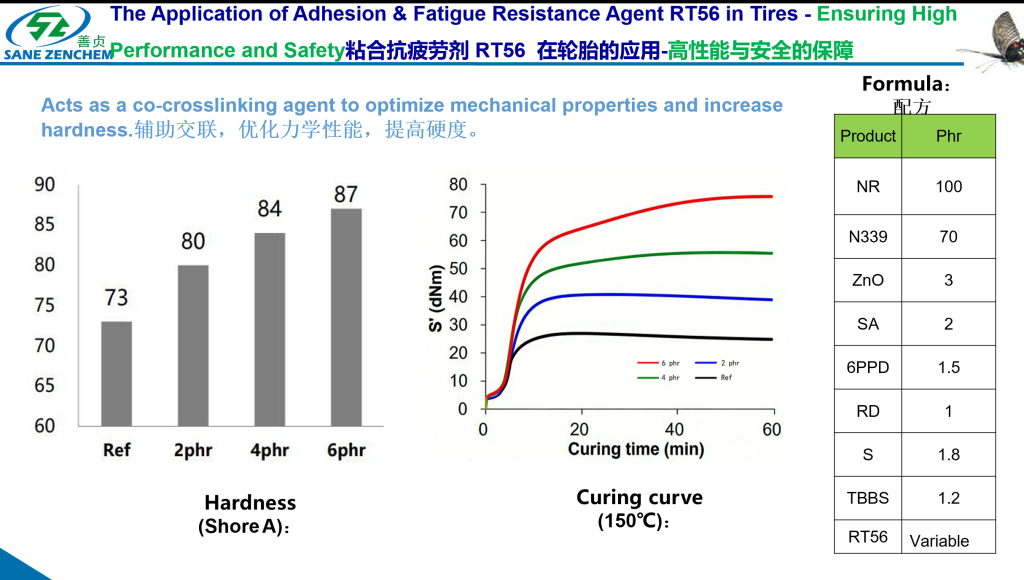
As a co-crosslinking agent, RT56 can:
- Increase crosslink density, improve rubber modulus and hardness
- Form more thermally stable crosslinks, inhibit vulcanization reversion
- Improve the retention of mechanical properties after thermo-oxidative aging
As an interfacial modifier, RT56 can:
- Enhance the chemical bonding between rubber and metal (especially steel cords)
- Form a more stable interfacial transition layer, resisting environmental aging
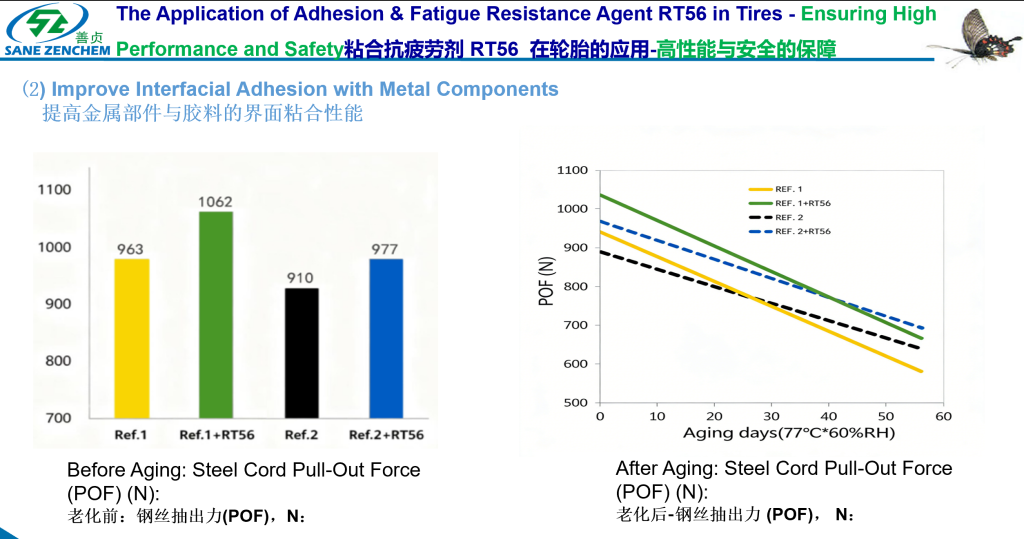
- Increase steel cord pull-out force, with optimization ranging from 15-25% before and after
As a filler dispersion agent, RT56 can:
- Improve filler-rubber compatibility through π-π interactions between its benzene ring structure and the carbon black surface
- Reduce filler agglomeration, improve dispersion uniformity
- Reduce mixing energy consumption, improve processing performance
Performance Data Verification: Bridging the Laboratory and Application
In the standard test formulation (NR 100, N339 70, ZnO 3, SA 2, PPD 1.5, RD 1, S 1.8, TBBS 1.2), RT56 demonstrates excellent performance modulation capabilities:
Hardness Control: By adjusting the RT56 dosage (1-8 phr), precise control within the Shore A hardness range can be achieved, meeting the hardness requirements of different tire components (tread, sidewall, apex, etc.). This makes it an Additive increasing rubber hardness without sacrificing elasticity.
Steel Cord Pull-Out Force Enhancement: Test data for steel cord pull-out force before and after aging show that after adding RT56, both the initial adhesion and the retention rate after aging are significantly improved. The performance advantages of the RT56 formulation are even more pronounced, especially under damp-heat aging conditions.
Fatigue Life Extension: Dynamic fatigue tests indicate that RT56 can effectively inhibit crack initiation and propagation , extending the service life of rubber materials under cyclic loading. Under equivalent stress conditions, fatigue life can be increased by 20-40%. This confirms its role as a potent anti fatigue rubber agent for tires and more broadly as an anti fatigue agent for dynamic rubber parts.
The Dual Advantage of SaneZen Group: Both a Top-Tier Compound Producer and an Innovative Raw Material Developer
A Unique Perspective: From User to Creator
SaneZen Group’s unique positioning within the rubber industry gives it unparalleled advantages in understanding customer needs and developing solutions. As a top-tier rubber compound producer in China, the Group owns multiple production bases such as Anhui Lixin Rubber Technology, Anhui Shanxin Polymer Fine Material, and Anhui Shengxin Rubber Technology, with annual compound capacity reaching industry leading levels .
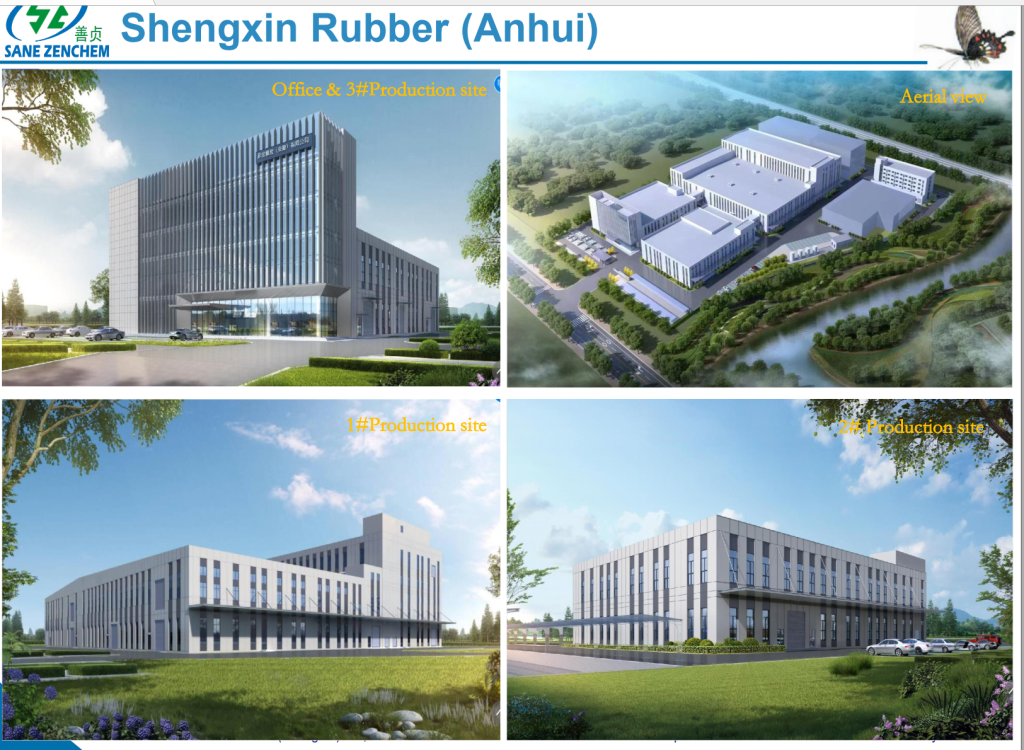
It is precisely because of its long-term engagement in the production and application of rubber compounds that SaneZen Group’s technical team has a deep understanding of:
- The differentiated performance requirements of different tire components for rubber materials
- The influence laws of mixing process parameters on final product performance
- The specific problems and challenges customers encounter in actual production
- How to balance the complex relationship between cost, performance, and processability
This “user-centric” R&D philosophy ensured that RT56 was closely aligned with practical application needs from its inception, avoiding the common issue of “excellent lab performance but difficult industrial application.” This hands-on experience positions SaneZen as a knowledgeable tire compound additive manufacturer.
Integrated Industrial Chain Collaborative Innovation System
SaneZen Group has built a complete rubber industry chain innovation system, establishing three major technical centers in Shanghai, Anhui, and Changzhou, forming a full-chain innovation capability encompassing “basic research – application development – process optimization – industrialization.”
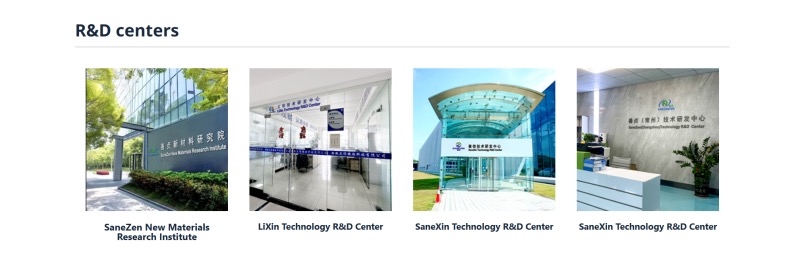
The specific advantages brought by this integrated industrial chain layout include:
Rapid Response Capability: When customers raise specific performance requirements , SaneZen Group can conduct collaborative optimization simultaneously at both the raw material formulation and mixing process levels, greatly shortening the development cycle.
Cost Control Advantage: Through in-house raw material production and process optimization, it is possible to provide customers with more cost-competitive solutions without sacrificing performance.
Quality Stability Assurance: A full-process quality control system from raw material synthesis to compound production ensures consistency between product batches, reducing customers’ production fluctuation risks.
Customized Service Capability: Based on a deep understanding of tire manufacturing processes, SaneZen Group can provide customers with overall solutions ranging from material selection and formula design to process optimization, rather than just product sales. This comprehensive approach establishes SaneZen as a reliable tire durability additive supplier and a leading Tire additive manufacturer China.
Application Value of RT56 in Various Tire Components
1. Tread Compound: Enhancing Wear Resistance and Durability
Adding RT56 to the tread compound can effectively improve carbon black dispersion, reduce localized wear caused by uneven dispersion, and increase tire wear life . Simultaneously, its anti-fatigue characteristics can delay the initiation and propagation of cracks at the base of tread grooves, making it particularly suitable for long-haul freight and demanding road conditions . This directly translates to a Rubber additive to enhance tire durability.
2. Sidewall Compound: Enhancing Flex Fatigue Resistance
The sidewall area undergoes the most significant flexural deformation, placing extremely high demands on the material’s fatigue resistance. By optimizing the crosslinked network structure, RT56 significantly improves the dynamic fatigue life of the sidewall compound, reducing the occurrence of sidewall cracking. This makes it an effective anti aging rubber additive for tire sidewall, directly addressing the query for a chemical to reduce cracking in tire sidewall.
3. Steel Cord Adhesion Compound: Ensuring Structural Integrity
The significant enhancement RT56 provides to steel-rubber adhesion performance makes it an ideal choice for high-performance radial tires. Especially in the support rubber of run-flat tires, RT56 can both increase hardness to provide sufficient support and ensure the firm bonding of steel cords to rubber, guaranteeing safe driving of the tire in a zero-pressure state. It is therefore a strong candidate for the best additive for run flat tire performance.
4. Apex and Chafer: Optimizing Stiffness Transition
Areas of stiffness transition between different tire components are prone to stress concentration. RT56 can optimize the stiffness gradient by precisely controlling local hardness, reducing interfacial stress, and improving the overall durability of the tire.
Sustainable Development and Environmental Value
SaneZen Group consistently adheres to ESG principles and is committed to driving the green transformation of the rubber industry. The development and application of RT56 fully align with the Group’s sustainable development strategic direction:
Environmental Formula Compatibility: RT56 does not contain harmful substances such as nitrosamines or polycyclic aromatic hydrocarbons, complies with international environmental standards such as EU REACH and RoHS, and can be safely used in global markets.
Energy Saving and Carbon Reduction Contribution: By improving tire durability and fatigue resistance, RT56 indirectly extends tire service life, reducing resource consumption and waste generation. simultaneously, optimized filler dispersion reduces mixing energy consumption , lowering carbon emissions during the production process.
Material Efficiency Improvement: The high efficiency of RT56 allows for significant effects even at lower addition levels, reducing the amount of auxiliary materials used and improving resource utilization efficiency.
Application Case and Customer Value Demonstration
A renowned international tire manufacturer faced the technical challenge of balancing tread wear resistance with wet grip when developing a new generation of high-performance all-season tires. In traditional approaches, increasing carbon black content enhances wear resistance but reduces wet performance; increasing silica content improves wet grip but sacrifices wear resistance.
The SaneZen Group technical team achieved synergistic enhancement between carbon black and silica by adding RT56 (4 phr) and optimizing the formulation system:
- Carbon black dispersion improved by 15%, wear resistance increased by 20%
- Silica-rubber interaction enhanced, wet grip score improved by 8%
- Overall rolling resistance reduced by 5%
- Steel cord pull-out force increased by 18%, ensuring high-speed driving safety
This solution not only helped the customer break through the technical bottleneck but also reduced the total manufacturing cost by optimizing the material ratio, achieving multiple improvements in performance, cost, and sustainability. It served as a comprehensive solution for rubber to metal bond failure and demonstrated an effective Additive to improve carbon black dispersion in NR compound.
Technical Support and Service System
SaneZen Group deeply understands that excellent products require professional services to fully realize their value. To this end, the Group has built a comprehensive technical support system:
Formula Development Support: With an experienced technical team, it can provide customers with customized formula design plans, optimizing the usage method and dosage of RT56 for specific application scenarios. This expertise answers the common industry question of how to improve steel cord adhesion in tires.
Process Optimization Guidance: Based on extensive experience in compound production, it provides full-process optimization suggestions from raw material feeding sequence and mixing temperature control to vulcanization process parameters.
Application Problem Solving: When customers encounter problems during production or application, the technical team can respond quickly, providing targeted solutions through on-site support or remote diagnosis.
Continuous Innovation Cooperation: Establish long-term technical cooperation relationships with customers, jointly carry out R&D on new materials and processes, and share innovation achievements .
Future Outlook: Smart Materials and Digital Transformation
As the automotive industry moves towards electrification and intelligence , tire materials are also facing new transformation demands . SaneZen Group is expanding the RT56 technology platform into broader application areas:
Electric Vehicle-specific Tire Materials: Develop rubber formulation systems with low heat generation, high load-bearing capacity, and low noise, tailored to the characteristics of electric vehicles such as heavy weight, high torque, and noise sensitivity.
Smart Tire Sensor Integration: Research and develop rubber materials with better compatibility with sensors, ensuring firm bonding and long-term stability between the sensor and the tire body.
Sustainable Material Innovation: Leveraging the Group’s technical accumulation in bio-based materials (such as the LG series lignin nanoparticles), develop synergistic formulations of RT56 with renewable materials to further reduce the carbon footprint of tires.
Digital Formula Design: Utilize artificial intelligence and big data technologies to establish predictive models for material-structure-performance, realizing intelligent and precise formula design.
Conclusion: Reshaping Tire Performance Boundaries, Driving Industry Sustainable Development
The successful development and application of GreenThinking® RT56 Adhesion & Fatigue Resistant Agent is a vivid reflection of SaneZen Group’s dual-engine strategy of “Material Innovation + Process Refinement.” This product not only addresses long-standing technical pain points in tire manufacturing but also provides new avenues for performance breakthroughs across the rubber materials industry.
As an enterprise that is both a top-tier compound producer and an innovative raw material developer, SaneZen Group, relying on its deep understanding of customer needs and professional mastery of materials science), has truly realized a “problem-driven, solution-oriented” R&D model. The success of RT56 is not merely the success of a single product but the success of this innovative model itself.
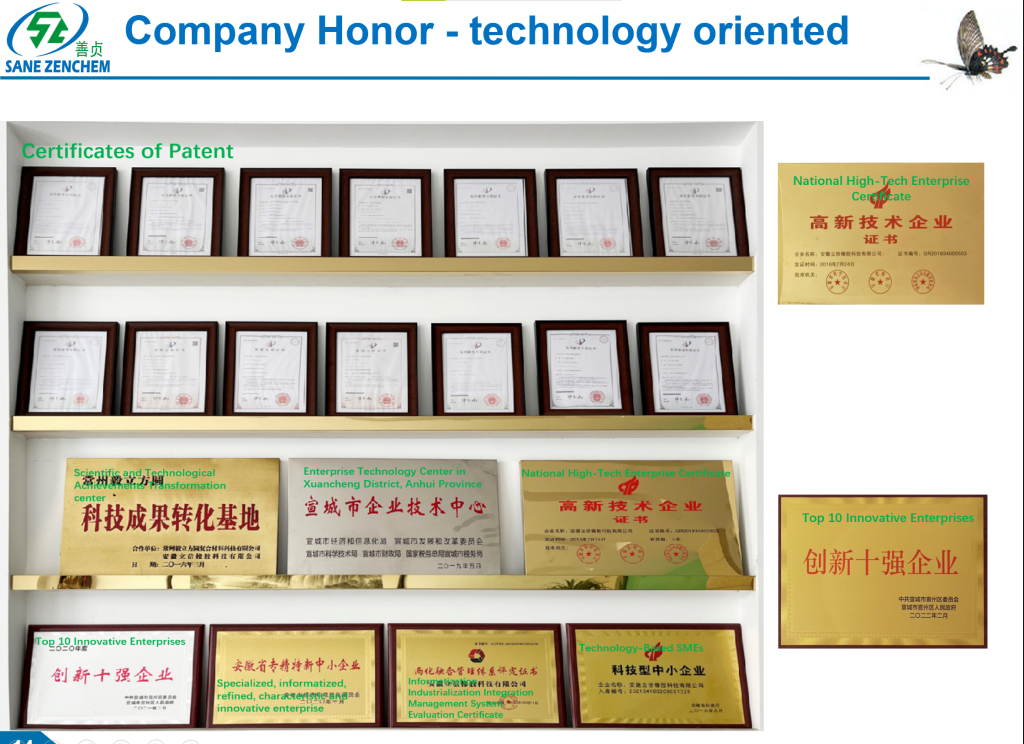
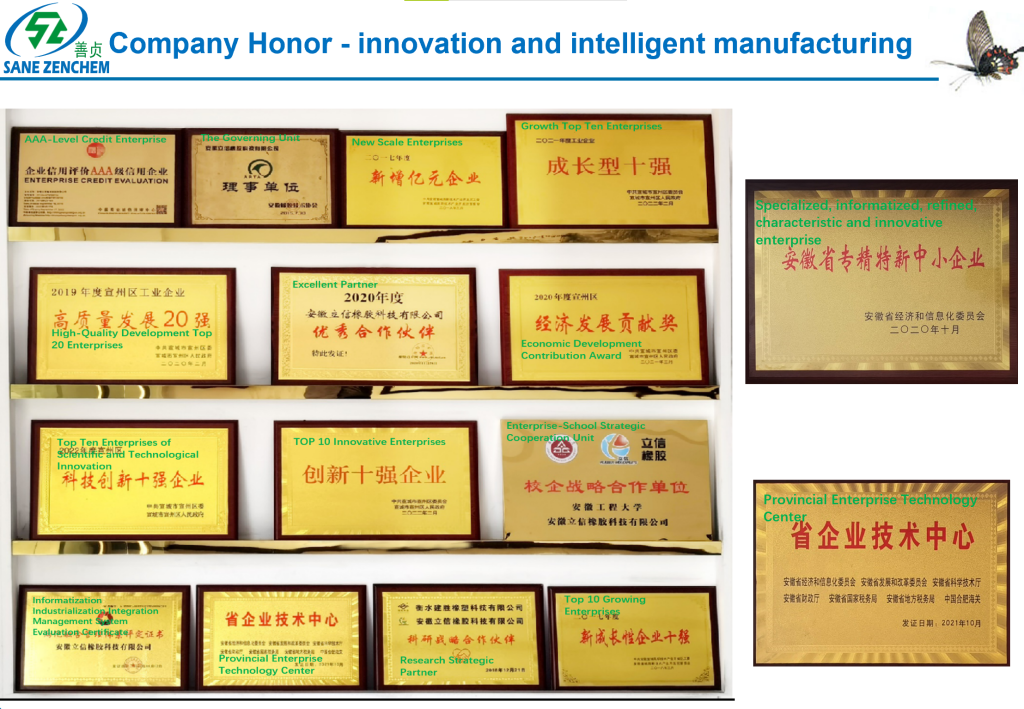
Looking ahead, SaneZen Group will continue to uphold the corporate philosophy of “Enterprising, Efficient, Win-Win,” with the core values of “善” (Benevolence) and “贞” (Integrity), driving the progress of rubber materials technology through continuous technological innovation and excellent customer service, in cooperation with global tire manufacturers. This joint contribution aims to create a safer, more efficient, and more sustainable future for transportation.
In today’s rapidly evolving field of materials science, SaneZen Group and its GreenThinking® RT56 are at the forefront of rubber material innovation, writing a new chapter in the high-quality development of China’s rubber materials industry with professionalism and dedication.
 English
  Español
  Русский