
What this page covers
A peroxide-cured EPDM compound that sails through a 150 °C oven ageing test can still lose most of its elongation at 175 °C. We took one base formulation, built seven compounds that differed only in the antioxidant, and aged all of them at both temperatures. This page gives you the measured numbers, explains why the two temperatures tell such different stories, and describes a mistake we ran into ourselves: at 4 phr the compound came out worse than at 1.5 phr, and the antioxidant was not the reason. The additive is a heat resistant antioxidant for peroxide cured EPDM, so most of what follows applies to any peroxide system that has to hold its properties above 150 °C.
If you are specifying a part that runs at 150 °C or above, the sections on the test results, the dosage trap, and dosage selection are the ones worth reading.
Why peroxide-cured EPDM ages in a way sulfur-cured rubber does not
If you came up through sulfur-cured compounds, your instinct about heat failure is probably wrong for EPDM. A sulfur-cured network fails at the polysulfidic crosslink. Heat breaks it, the network reverts, and the part goes soft. EPDM crosslinked with peroxide does not have that weak point. Its crosslink is a direct carbon to carbon bond, which is why the material is used in the first place.
So the failure moves somewhere else. It moves into the polymer backbone and into the antioxidant. Both get consumed, and when the antioxidant runs out the backbone starts oxidising and the part embrittles. Anyone who has cut open a hose after a few years of hot service has seen this: the rubber is not soft and gummy, it is hard and it cracks when you bend it.
That distinction matters for how you test and how you choose. A 100 °C ageing result tells you about a mechanism that may not be the one governing your part. It also matters because under-hood duty cycles have moved up, not down. Charge-air circuits with 170 °C excursions, coolant circuits that sit above 130 °C in summer traffic, and warranty periods measured in years rather than months are normal. In those applications the antioxidant package is often what decides whether the part survives, not the polymer. Peroxide cured EPDM high temperature aging resistance therefore depends on the antioxidant package as much as on the polymer, which is what the seven compounds in this study were built to measure.
How the test was run
Seven compounds came off one base formulation. The only variable between them was the antioxidant.
| Base formulation | фраза | Role |
| EPDM 5601 | 50 | base polymer (E% 69, ML(1+4)@125 °C 72, ENB 5.0) |
| EPDM 2504 | 50 | base polymer (E% 56, ML(1+4)@125 °C 25, ENB 3.8) |
| N550 carbon black | 23 | reinforcing filler |
| PF87 | 23 | функциональный наполнитель |
| N774 carbon black | 27 | semi-reinforcing filler |
| PE wax | 6 | processing aid |
| 100# paraffin oil | 26 | plasticiser |
| Light MgO | 12 | acid acceptor |
| BIPB-40 | 7 | peroxide curing agent |
| TAIC-70 | 1.6 | co-agent |
| Antioxidant | variable | see the compound list below |
Mixing: masterbatch stage at 115 °C, final stage at 90 °C, three tight-nip passes on the mill, one sheeting pass.
| № | Antioxidant system | Total antioxidant, phr |
| 1 | RD 1.5 phr | 1.5 |
| 2 | RD 0.75 + ZMMBI 0.75 phr | 1.5 |
| 3 | RD 1.0 + ZMMBI 1.0 phr | 2.0 |
| 4 | RD 2.0 + ZMMBI 2.0 phr | 4.0 |
| 5 | HT01 1.5 phr | 1.5 |
| 6 | HT01 2.0 phr | 2.0 |
| 7 | HT01 4.0 phr | 4.0 |
Compounds 1 to 4 take the conventional route. Compounds 5 to 7 use GreenThinking® HT01, a composite non-staining heat resistant antioxidant. The loadings are matched on purpose: compounds 1 and 2 sit at the same 1.5 phr total as compound 5, and compound 4 sits at the same 4.0 phr as compound 7. That makes the comparison like for like at two dosage levels.
| Тест | Стандарт | Состояние |
| Cure characteristics | ASTM D5289-2019 | MDR, 180 °C × 5 min |
| Твердость, Шор А | ASTM D2240-2025 | cured 180 °C × 360 s |
| Tensile strength and elongation at break | ASTM D412-2002 | cured 180 °C × 360 s |
| Прочность на разрыв | ASTM D624-2002 | cured 180 °C × 360 s |
| Плотность | ASTM D297-2002 | cured 180 °C × 360 s |
| Набор для сжатия | ASTM D395-2003 | button specimen, 150 °C × 72 h |
| Heat ageing | ASTM D573-2004 | air oven, 150 °C × 72 h and 175 °C × 72 h |
| Low temperature brittleness | ASTM D2137-2005 | -35 °C |
| Ozone ageing | ASTM D1171-1999 | static, 100 pphm, 40 °C × 72 h |
Four entries in the source record need checking before publication, and all four relate to the table above. The elongation row did not carry its own reference standard in the source table, so it is grouped here under ASTM D412-2002, which covers elongation at break. The compression set row reads “HT -150℃*72h” in the original record and is read here as 150 °C × 72 h. The 175 °C ageing block had no reference standard column at all, so ASTM D573-2004 is inferred from the matching 150 °C ageing test. The ozone concentration appears as “100pp” in the test row and as “100ppm” in the summary on the same page, so the ASTM D1171 convention of pphm has been used. Confirm all four against the original laboratory record.
One dataset, one blend. The trends are clean and they line up with the chemistry, but re-run the comparison in your own compound before you change anything in production.
What the numbers say
Here is the whole story in one table. Retention is the aged value divided by the unaged value, as a percentage.
| Смесь | Antioxidant | TS retention 150 °C | EB retention 150 °C | TS retention 175 °C | EB retention 175 °C |
| 1 | RD 1.5 phr | 86.5% | 77.5% | 41.4% | 32.2% |
| 2 | RD 0.75 + ZMMBI 0.75 | 68.2% | 75.1% | 33.5% | 36.2% |
| 3 | RD 1.0 + ZMMBI 1.0 | 107.5% | 105.7% | 89.4% | 88.6% |
| 4 | RD 2.0 + ZMMBI 2.0 | 118.8% | 114.4% | 99.0% | 94.2% |
| 5 | HT01 1.5 phr | 105.5% | 99.2% | 97.4% | 96.5% |
| 6 | HT01 2.0 phr | 103.9% | 97.9% | 90.5% | 83.8% |
| 7 | HT01 4.0 phr | 108.6% | 93.7% | 83.0% | 62.7% |
At 150 °C, everything passes. The worst compound still holds 68% of its tensile strength and 75% of its elongation. If you only test at 150 °C, you cannot choose between these antioxidant strategies, because the test has no resolution. We have seen technical data sheets that compare antioxidants on a single 150 °C result. That comparison carries no information.
At 175 °C the same seven compounds spread from 33.5% to 99.0% tensile retention. RD on its own, at a loading a lot of people would consider normal, keeps 41% tensile and 32% elongation. For a part that flexes in service, 32% elongation retention is a failure, not a warning. Two of the RD based compounds hold up far better once ZMMBI is added, which tells you that a second mechanism is doing real work at this temperature. If you are evaluating an EPDM antioxidant for 175C long term aging, this is the number to ask for: retention at the excursion temperature, not at a comfortable one.
The composite at 1.5 phr comes out at 97.4% and 96.5%. That is the highest in the set, and it gets there at the lowest loading in the set. Read as an RD antioxidant versus HT01 comparison in peroxide cured EPDM, the table is unambiguous: at equal loading the composite route wins on retention, and it wins at a lower total additive content.
That last point is the commercial one. To reach roughly 90% retention at 175 °C, the conventional route needed somewhere between 2 and 4 phr of total antioxidant. HT01 reached a higher number at 1.5 phr. If your compound has a limit on total additive content, whether from blooming risk, extractables or a customer specification, halving the loading while improving the result is worth more than the price difference.
One more thing worth flagging: compression set and ageing retention do not rank these compounds the same way. The best compression set in the study, 7.12%, belongs to compound 3, not to compound 5. Compression set follows crosslink density. Ageing retention follows oxidative protection. Two different mechanisms, so you need to decide which one your part actually fails on before you pick.
The dosage trap: why 4 phr came out worse than 1.5 phr
Compound 7 is the one we want to talk about, because it is the result people misread.
At 4 phr of HT01, retention at 175 °C fell to 83.0% tensile and 62.7% elongation, both below the 1.5 phr compound. The obvious conclusion is that composite antioxidants hurt you at high loading. That conclusion is wrong, and the rheometer data shows why.
| Недвижимость | 1 (RD 1.5) | 5 (HT01 1.5) | 6 (HT01 2.0) | 7 (HT01 4.0) |
| TS2, s | 37 | 57 | 63 | 76 |
| TC10, s | 27 | 40 | 41 | 126 |
| TC90, s | 216 | 231 | 234 | 253 |
| MH, dN·m | 11.91 | 9.89 | 9.15 | 5.23 |
| Unaged hardness, Shore A | 65 | 61 | 60 | 57 |
| Compression set, 150 °C, % | 16.00 | 21.76 | 12.08 | 27.08 |
Maximum torque fell from 11.91 dN·m in compound 1 to 5.23 dN·m in compound 7. Hardness dropped from Shore A 65 to 57. Elongation at break went up to 585%, which sounds good until you realise it is the signature of a loose network, not a tough one. Compression set, the most sensitive of all these properties to crosslink density, went from 16% to 27%.
Compound 7 was undercured. Not slightly. It lost more than half its crosslink density.
The cause is that a composite antioxidant contains radical-active chemistry. During peroxide cure, peroxide radicals are what build the network. An additive that scavenges radicals will scavenge some of those as well. At 1.5 phr the effect is small enough to live with. At 4 phr, with the co-agent left at 1.6 phr, it takes the network down with it.
This is not a discovery. The product data sheet for HT01 recommends raising the co-agent by roughly 0.5 phr for every additional 1 phr of antioxidant, precisely to hold initial hardness. We deliberately kept TAIC flat in all seven compounds to see how large the effect was. It was larger than we expected.
So the practical rule is not “use less antioxidant”. It is that antioxidant dosage and co-agent dosage are one decision, not two. TAIC co-agent adjustment when increasing antioxidant dosage is the second half of that decision, and it is the half most formulators skip. If you add 2 phr of a composite antioxidant without touching your co-agent, you have changed your cure system whether you meant to or not. Run the rheometer afterwards. Every time.
Choosing a dosage, and the co-agent that goes with it
Recommended antioxidant dosage for EPDM in 150C service starts at 1 to 2.5 phr of a composite system, and for peroxide-cured EPDM we would start like this. Under 120 °C continuous service, a conventional single antioxidant is fine and there is no measured reason to pay for more. Between 120 °C and 150 °C, a conventional combination will usually do the job; it also gave us the best compression set in this study. Above 150 °C, or anywhere the part sees excursions past 170 °C, move to a composite system. Antioxidant selection for EPDM coolant hose and turbocharger hose follows the same rule, because both of those parts sit in that band.
On loading, 1.0 to 2.5 phr of a composite antioxidant covers 150 °C continuous service. Going to 3.0 to 5.0 phr is reasonable when the part must survive extreme temperature or a very long life, but only if you bring the co-agent up with it using the 0.5 to 1 ratio as a starting point and then confirm by rheometer and compression set. The 4 phr result above is what happens when you skip that step.
For static seals, check compression set early. If your specification is tight on set, the conventional route may suit you better, or you will need to raise the co-agent enough to restore the network. For hoses and mounts that flex, watch elongation retention instead, because it drops first and it is what starts the crack.
В качестве rubber antioxidant to replace TMQ and ZMTI, or any other single antioxidant used on its own, it has to be judged on retention at the service temperature rather than on price. A note on scope: HT01 is intended mainly for peroxide-cured EPDM, HNBR and resin-cured butyl systems. It also makes sense in other peroxide-cured diene rubbers, but you should trial it before committing. Ozone protection is separate. All seven compounds passed the static ozone test at 100 pphm, 40 °C for 72 h, and all seven passed low temperature brittleness at -35 °C, so those two properties came from the polymer and cure system rather than the antioxidant. If your part fails by dynamic ozone cracking, you still need an antiozonant or a wax. Non staining antioxidant for black EPDM seals and gaskets is a separate requirement again, and it is the one that decides whether a part is rejected on appearance rather than on measured properties.
| Service condition | What we would use |
| Below 120 °C, cost driven | Conventional single antioxidant |
| 120 to 150 °C, appearance not critical | Conventional antioxidant combination |
| 150 °C with excursions above 170 °C | Composite heat resistant antioxidant, 1.5 to 2.5 phr, co-agent adjusted |
| Long life specification | Composite, dosage optimised against the real ageing temperature |
| Static seal, tight compression set limit | Conventional combination, or composite with co-agent raised |
| Appearance critical black part | Non-staining composite system |
| Flexing part such as hose or mount | Composite, with elongation retention as the acceptance criterion |
| Wire or metal reinforced | System with metal deactivating capability |
| Coolant or hot oil contact | Higher molecular weight system, tested in the actual fluid |
| Dynamic ozone cracking | Heat resistant antioxidant plus a dedicated antizonant |
These are the parts the product data sheet lists:
- turbocharger charge-air hoses
- coolant hoses, EPDM and HNBR
- high temperature seals and gaskets
- rubber rollers, especially heat resistant rollers
- cable insulation and sheathing
- engine mounts and vibration dampers
- any rubber part specified to work above 150 °C for long periods
Different parts, same question: does the antioxidant still have anything left to give after two years at temperature. The same question applies to an HNBR heat resistant antioxidant for turbocharger hose, or to an antioxidant for EPDM coolant hose high temperature: the answer has to come from retention measured at the excursion temperature, not from a headline claim.
Reading a heat ageing failure
Six symptoms come up again and again. Find yours in the table before you touch the formulation.
| What you see | What it usually means | What to do |
| Hardness up by more than 10 Shore A, elongation falling faster than tensile strength | The antioxidant is exhausted and the backbone is oxidising | Move to a system that covers more than one stage of the oxidation chain. More of the same antioxidant will not help. |
| Low hardness and unusually high elongation on a part that never saw much heat | Undercure, not ageing | Check maximum torque against your reference compound before you blame the antioxidant. |
| Dry oven ageing passes, but the part fails in coolant or hot oil | The antioxidant is being extracted faster than it is consumed | Test in the actual fluid, not in air. |
| Degradation concentrated at wire contacts or around brass fittings | Copper and iron ions are breaking down hydroperoxides locally | Use metal deactivating chemistry, or remove the ion source. |
| Powdery film on the surface after storage | Antioxidant loading has passed its solubility limit | Check dispersion first, then dosage. |
| Purple to brown discolouration on a black part with no mechanical loss | Amine antioxidant oxidation | Switch to a non-staining system. |
Why Choose Us
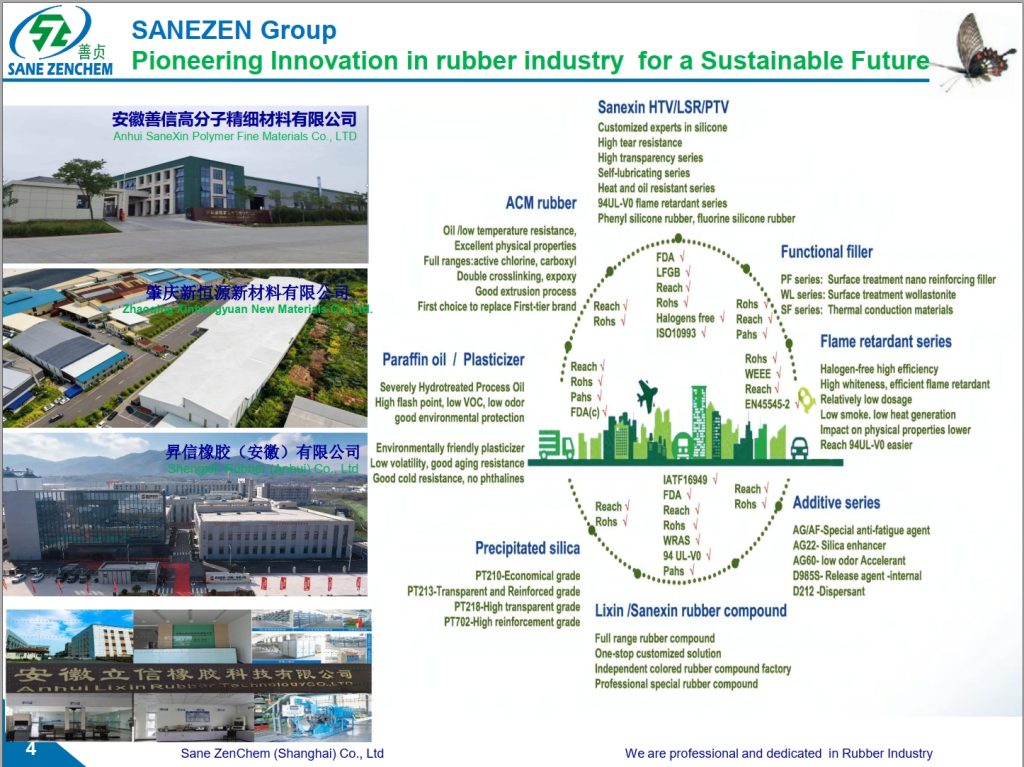
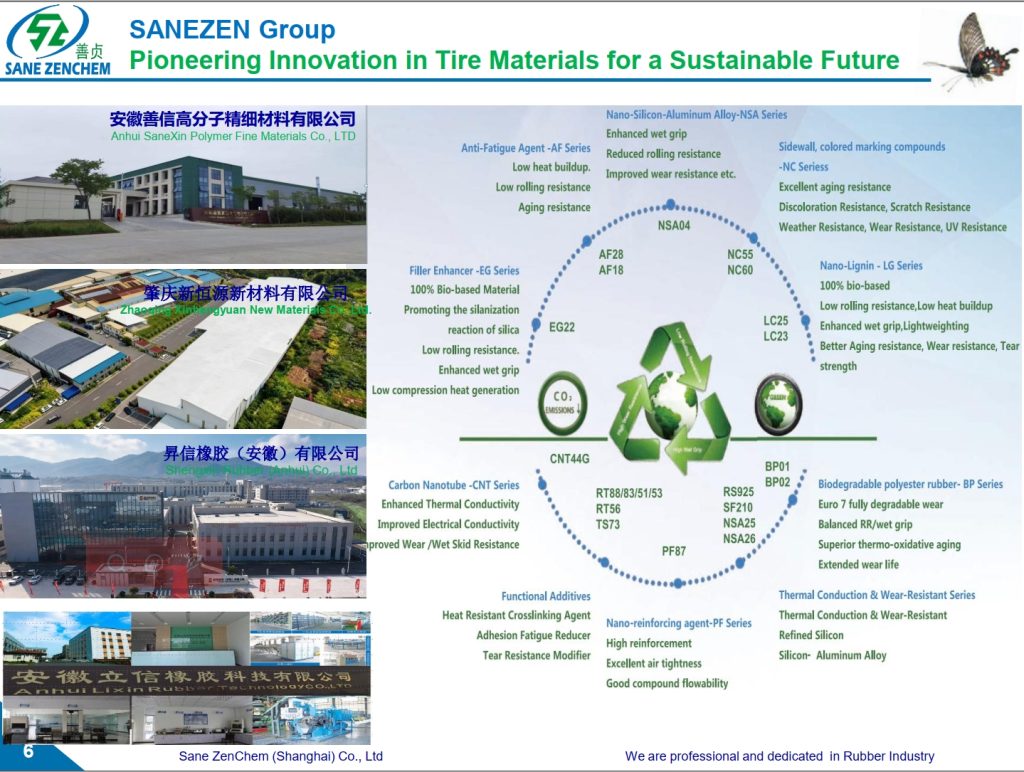
Choosing a functional filler supplier is not only about purchasing a mineral powder. It is about selecting a technical partner that understands polymer compounding, physical failure mechanisms, and long-term product performance. As a leading specialty functional filler and performance additives manufacturer, we bring decades of compounding expertise to every customer collaboration.
SaneZenChem operates five manufacturing facilities specialising in:
• Rubber Compounds
• Silicone Rubber Compounds
• Specialty Functional Fillers
• Flame Retardants
• Polymer Performance Additives
Because we formulate and manufacture rubber and silicone compounds ourselves, every specialty product we develop originates from solving real production challenges rather than laboratory concepts alone. This application-driven approach allows us to deliver practical solutions that create measurable improvements in customer products – from eliminating processing viscosity spikes and preventing micro cracking, to ensuring high dielectric strength in harsh electrical environments. Our unique dual position as both a direct compounder and a premier specialty functional filler manufacturer means we are uniquely equipped to support rubber, epoxy, and electrical insulation manufacturers in achieving longer service life, processing efficiency, and ultimate reliability.
Часто задаваемые вопросы
How to improve heat aging resistance of peroxide cured EPDM
Test at the temperature the part will actually see, then change the chemistry rather than the dosage. At 150 °C all seven compounds held between 68% and 119% tensile retention. The same compounds ranged from 33.5% to 99.0% at 175 °C. If your qualification only covers 150 °C, it cannot rank antioxidant options for a part that sees excursions above 170 °C. Add the higher temperature point to the protocol, even if it is a shorter duration.
Why does EPDM lose tensile strength after 175C aging
Because the antioxidant runs out. A radical scavenger is consumed stoichiometrically, and its consumption rate climbs steeply with temperature. RD at 1.5 phr kept 86.5% tensile at 150 °C and only 41.4% at 175 °C. The cure data rules out undercure as the explanation, since maximum torque was a healthy 11.91 dN·m. What RD does not do is break down hydroperoxides, and above roughly 150 °C that pathway starts to matter a great deal.
Is a non-staining antioxidant weaker than an amine antioxidant?
In this test it was stronger. HT01 at 1.5 phr beat RD at 1.5 phr on both tensile and elongation retention at 175 °C, and it did so without staining. The old assumption that you trade protection for appearance does not hold for this composite chemistry. It may still hold for simpler non-staining additives, so ask for data at your service temperature rather than accepting the general claim.
How much heat resistant antioxidant should I use in EPDM?
1.5 to 2.5 phr covers most 150 °C work. Push to 3.0 to 5.0 phr for 170 °C plus service or very long life, but only with the co-agent raised at the same time. In our data, retention peaked at 1.5 phr and declined at 4.0 phr, and the decline was entirely a cure effect. The optimum is specific to your compound, so treat these as starting points and confirm with your own rheometer and ageing data.
How to prevent hardness drop when increasing antioxidant dosage
Raise the co-agent at the same time as the antioxidant. About 0.5 phr of additional TAIC per additional 1 phr of composite antioxidant, as a starting point for holding initial hardness. Compound 7 in our study was run at 4.0 phr antioxidant with the TAIC left at 1.6 phr, and maximum torque halved. If you are increasing antioxidant dosage and your hardness or compression set specification has any margin at all, you do not want to skip this.
Why does compression set get worse with more antioxidant
Compression set is governed by crosslink density, not by oxidative protection. A composite antioxidant that interferes slightly with peroxide cure will reduce crosslink density, and compression set will rise. In our series, set at 150 °C ranged from 7.12% in an RD and ZMMBI combination to 27.08% in the 4 phr compound that was undercured. Fix the cure balance first, then re-measure.
Should I judge an antioxidant on tensile retention or elongation retention?
It depends what kills your part. For hoses, mounts, belts and diaphragms that flex, elongation retention is the number that matters, and it can fall faster than tensile retention. For static seals and load bearing parts, tensile retention and compression set matter more. Report both, and pick the acceptance criterion from the failure mode of the specific part rather than from habit.
Will swapping the antioxidant change my cure cycle?
Yes, if it is a composite product in a peroxide system. In our data, moving to HT01 at 1.5 phr took TS2 from 37 s to 57 s, TC90 from 216 s to 231 s, and MH from 11.91 to 9.89 dN·m. Those are the kind of changes that turn a good production part into a marginal one if nobody re-runs the rheometer. Treat any antioxidant change as a cure change.
Can a heat resistant antioxidant replace an antiozonant?
No. Ozone attack is a surface reaction driven by atmospheric ozone and strain, while thermo-oxidative ageing is a bulk reaction driven by heat and oxygen. All seven compounds passed static ozone ageing regardless of antioxidant choice, which tells you ozone resistance was coming from the polymer. Dynamic ozone cracking needs its own solution.
Does it work in sulfur-cured rubber?
The chemistry it addresses is not exclusive to peroxide systems. But scorch behaviour and cure interference depend heavily on the cure system, and our data is peroxide-cured EPDM only. Trial it in your own compound before you change a sulfur-cured recipe.
Will it bloom or stain?
Non-staining composite antioxidants are built with moderate molecular weight and good compatibility with non-polar rubbers, so blooming is a dosage and dispersion question rather than an inherent property. Stain resistance is a different matter, and it is a genuine advantage over 6PPD and IPPD, whose oxidation products are what turn black parts purple and then brown.
What happens at low temperature and under ozone?
Nothing changed. All seven compounds passed -35 °C brittleness to ASTM D2137-2005 and static ozone ageing at 100 pphm, 40 °C for 72 h to ASTM D1171-1999. Antioxidant choice did not affect either property, which is what you would expect from a saturated backbone polymer.
How to test a heat resistant antioxidant in your own compound
Run a controlled comparison in your own compound. Take your current formulation and add the additive at two or three dosages, keeping the sulfur and accelerator levels constant, then age all of them at your service temperature and at the excursion peak and compare retention rather than absolute values. Four things are also worth asking a supplier for: the ageing standard and the exact temperature and time, the loading used for each compound, the unaged reference values as well as the aged values so that retention can be calculated, and the specimen geometry and oven type. Ageing results are sensitive to air exchange rate, so two labs running the same nominal condition can land on different absolute numbers. A claim quoted only as an aged absolute value cannot be checked.
Which temperature should I qualify at?
The one the part will actually see, including the excursion peak. Testing at a convenient round number below your service temperature gives you a result that is technically true and commercially useless. If the part sees 175 °C even briefly, put 175 °C in the protocol.
Can I compare antioxidant prices directly?
Not usefully. The additive cost per kilogram is small next to the cost of replacing a hose buried under a cab or a seal inside a pump. Compare on retention at your service temperature and on total additive loading, then look at what a field failure would cost you. That is the number that decides whether the additive was expensive.
How to choose a supplier
Most suppliers can quote a price per kilogram. Far fewer can tell you what happens to elongation retention at 175 °C. When you compare a non staining heat resistant rubber antioxidant manufacturer with whatever you are running now, ask for aged retention at your service temperature, the ageing standard used, and whether the comparison was made at equal loading. A specialty rubber antioxidant manufacturer China or anywhere else should be able to answer all three from its own test records rather than from a datasheet summary, and the two questions that separate them are whether the unaged reference values are supplied and whether the ageing temperature matches your excursion peak.
If you want a sample to test
Do not order a sample first. Send us two things instead: the compound you are running now, or its ageing result, and the temperature profile of the part, including any excursion peaks and how long they last.
If your current compound retains 80% or more of its elongation at your service temperature, we will tell you so, and you can save the trial. If it drops off a cliff somewhere between your qualification temperature and your excursion temperature, we will tell you that too, and we will send a sample of HT01 along with the co-agent adjustment numbers for your specific formulation, so that your first trial does not repeat the mistake in compound 7.
Sample size, minimum order quantity and lead time are confirmed on request. We will not quote them here, because they depend on the grade and the destination.
Связаться с
Factory: No. 22 Meizigang Road, North District, Economic Development Zone, Xuanzhou District, Anhui Province, China
Business office: Room 1606-1608, Boda Business Building, No. 11 Puhuitang Road, Xuhui District, Shanghai 200030, China
Telephone: +86-21-6487 9251
Fax: +86-21-5106 2693
Электронная почта: yorichen@sanezen.com
Веб-сайт: www.sanezenrubber.com
Packaging: 20 kg bags. Storage: dry, cool and sealed at around 25 °C. Shelf life approximately 2 years.
Note for the publishing team: articles published earlier in this series carry a different contact block, with mobile +86-136 7164 1995, yorichen@sanezen.com and www.sanezenrubber.com. Confirm which set is current before publishing.
About the data on this page
The measurements come from one compounding study run 20 to 27 May 2026 on a single EPDM base blend, with the antioxidant as the only variable. Test methods are named in the section on how the test was run. Anything on this page that goes beyond those measurements is marked as engineering judgement, and you should check it against your own service condition. No regulatory status is claimed for any product here; ask us for the current declaration for the specific grade.
 Russian
  English
  Spanish