
What this page answers
A filler that improves wet grip and lowers rolling resistance at the same time sounds like the end of the magic triangle. It is not, and the reason is dosage: the same material behaves differently depending on whether it is added on top of the existing filler or used to replace part of it.
This page reports three trials on a nano silica alumina alloy with an average particle size around 500 nm. In the first, 12.5 and 15 phr were added to an SSBR and BR tread compound with 80 phr of silica and the silane level unchanged. In the second, 11 phr replaced 11 phr of silica in an NR and SSBR tread compound. In the third, 10, 12.5 and 17.5 phr were used in a high performance motorcycle tire tread with a fixed 4 phr of a second additive.
The three together answer a question that one trial cannot: whether you are buying a performance additive or an inorganic filler for a silica compound, and what each choice costs in hardness and in shrinkage.
What the material is, and what the naming hides
The product is described as a nano silica-alumina alloy, a functional mineral with an average particle size of about 500 nanometres, designed to act on wet grip, abrasion resistance and rolling resistance at the same time.
A nano mineral additive for rubber at this particle size sits between a reinforcing black, which is an order of magnitude finer, and a conventional kaolin, which is coarser and much less surface active. Three different formulae appear in our own documents for the same product: Al2SiO5.nH2O in the application file, AlSiO3.H2O in the data sheet, and the phrase “nano-silicon aluminum alloy” in the title of several files. A hydrated aluminium silicate is the right family, and the two formulae are not the same compound. This should be fixed at source, because a customer’s regulatory department will ask for the CAS number and a formula that changes between documents invites a delay.
In compounding terms it is an inorganic filler for silica compound rather than a replacement for silica, and the two trials below treat it both ways so that the difference is visible. The name “alloy” is also worth explaining. This is not a metal alloy in the metallurgical sense and it does not behave like aluminium powder. It is a mineral in which aluminium and silicon are distributed through the same particle at a scale fine enough that the two elements are in contact with the rubber at the same surface. That is what makes the next section possible.
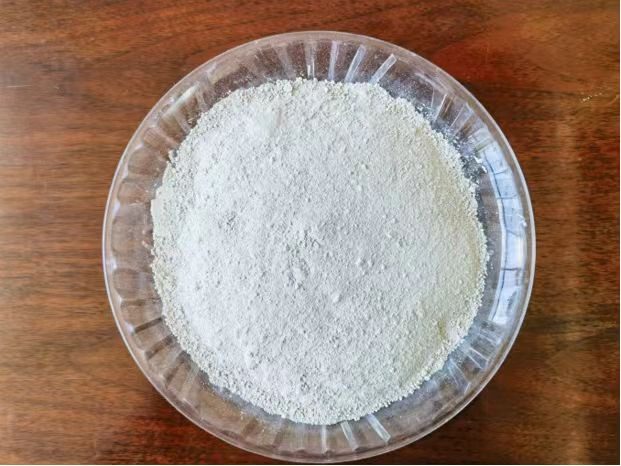
Figure 1. The nano silica-alumina alloy as supplied, a pale mineral powder with an average particle size of about 500 nm.
The mechanism, and the evidence for it
The claimed mechanism is that the material, combined with a silane coupling agent, forms Al-O-Si bonds which allow the particle to pierce the water film between the tire and the road. A hard particle standing proud of a water film is a plausible route to wet friction, and it is the same physical argument used for any hard filler at a tread surface. As a rubber additive for wet traction the claim is therefore mechanical as well as chemical, and that is why the effect survives a change of polymer.
The evidence behind it is not mechanical but spectroscopic, and it is the most interesting part of the file. A scanning electron micrograph at 20,000 times shows the outline of the original particle transforming as the batch temperature rises during mixing: the sharp outline of the mineral becomes a diffuse region of alumina or aluminosilicate. X-ray photoelectron spectroscopy of the same system shows that the aluminosilicate bonds form once the temperature passes about 165 C, and not at 120 C.
В качестве silane coupling agent co additive the material only works while the silane is still available to react, which is what the temperature threshold means in practice. That single fact explains the processing requirement. The material has to be present while the batch is above 165 C, and it has to be present with the silane, or the bond that does the work is never formed. A compound mixed cool, or a compound where the additive is added in the final stage after the silane has already reacted, will contain the mineral but not the chemistry.
How does an Al-O-Si bond form during mixing is therefore a temperature question before it is a dosage question, and it is the one thing a customer should check before blaming the additive for a disappointing result.
Trial one: added on top, silane unchanged
The first compound is a passenger car tread built on solution polymerised SSBR and butadiene rubber with 80 phr of precipitated silica, 5 phr of N234 and 6.8 phr of a silane. This is the standard trial for an additive for silica filled tread compound: the silica and the silane are held, and the additive is the single variable.
| Material, phr | Blank | 15 phr | 12.5 phr |
| SSBR | 70 | 70 | 70 |
| Butadiene rubber | 30 | 30 | 30 |
| Carbon black N234 | 5 | 5 | 5 |
| Осажденный диоксид кремния | 80 | 80 | 80 |
| Zinc oxide | 2 | 2 | 2 |
| Stearic acid | 2 | 2 | 2 |
| Silane Si 75 | 6.8 | 6.8 | 6.8 |
| 6PPD | 2 | 2 | 2 |
| Antioxidant | 4 | 4 | 4 |
| Microcrystalline wax | 1.3 | 1.3 | 1.3 |
| TMQ | 0.5 | 0.5 | 0.5 |
| Environmental oil | 1 | 1 | 1 |
| Styrene resin | 8.8 | 8.8 | 8.8 |
| Сера | 1.8 | 1.8 | 1.8 |
| CBS | 2 | 2 | 2 |
| DPG | 2 | 2 | 2 |
| Nano silica-alumina alloy | – | 15 | 12.5 |
| Всего | 219.2 | 234.2 | 231.7 |
| Property, cure 160 C | Blank | 15 phr | 12.5 phr |
| Вязкость по Муни | 59.8 | 55.9 | 55.5 |
| ML, dN.m | 1.92 | 1.76 | 1.70 |
| MH, dN.m | 14.05 | 14.59 | 15.06 |
| ts1, min | 2.44 | 2.27 | 2.22 |
| ts2, min | 2.83 | 2.60 | 2.55 |
| t10, min | 2.55 | 2.40 | 2.37 |
| t50, min | 3.54 | 3.22 | 3.16 |
| t90, min | 6.66 | 6.27 | 6.04 |
The cure moves in one direction and the viscosity moves in another, and both are what a factory wants.
Mooney viscosity falls from 59.8 to 55.5 at 12.5 phr, a 7 percent reduction at a higher filler loading. Why does Mooney viscosity fall when adding a mineral filler is the question this raises, and the answer is that a hard, low aspect ratio mineral with a surface that does not adsorb curatives reduces the effective filler network rather than adding to it. The compound flows better because the network is less connected, not because the medium is thinner.
The cure accelerates: t90 falls from 6.66 to 6.04 minutes, and MH rises from 14.05 to 15.06 dN.m at the same time. A faster cure and a higher state of cure together are unusual, and they are consistent with a filler that does not hold curatives on its surface. How to keep cure time short in a silica compound is normally answered by adding a cure activator, and here a filler did part of the job.
What the two dosages did to the properties
| Property, cured 160 C for 30 min | Blank | 15 phr | 12.5 phr |
| Твердость, Шор А | 64.2 | 64.8 | 64.7 |
| Удельный вес | 1.208 | 1.202 | 1.205 |
| Прочность на разрыв, МПа | 24.8 | 27.9 | 25.3 |
| Elongation at break, percent | 420.6 | 433.4 | 436.0 |
| Stress at 50 percent, MPa | 2.1 | 2.4 | 2.5 |
| Modulus at 100 percent, MPa | 3.5 | 3.9 | 4.2 |
| Modulus at 300 percent, MPa | 15.5 | 17.4 | 17.8 |
| Tear strength, kN/m | 18.1 | 18.0 | 21.9 |
| DIN abrasion loss, cm3 | 0.163 | 0.156 | 0.154 |
| DIN abrasion index | 100 | 104 | 106 |
| tan delta at 0 C | 0.303 | 0.315 | 0.328 |
| tan delta at 20 C | 0.172 | 0.170 | 0.166 |
| tan delta at 60 C | 0.106 | 0.097 | 0.095 |
Hardness is essentially unchanged at both dosages, 64.7 and 64.8 against 64.2. That is the first thing to notice: 12.5 or 15 phr of a mineral filler added on top of 80 phr of silica did not move hardness, which is not what a filler model predicts and is consistent with the lower Mooney viscosity and the different network.
Modulus rises sharply: M100 from 3.5 to 4.2 MPa, a 20 percent increase, and M300 from 15.5 to 17.8 MPa. Tensile strength improves at 15 phr to 27.9 MPa and barely at 12.5 phr to 25.3, while elongation improves at both.
Tear strength is where the two dosages separate most clearly: 18.0 at 15 phr and 21.9 at 12.5 phr, against 18.1 for the blank. How to improve tear strength of a silica tread is normally answered with polymer or with a different silane, and here the answer depended on the dosage: 15 phr did nothing and 12.5 phr gained 21 percent.
DIN abrasion loss falls from 0.163 to 0.154 cm3 at 12.5 phr, an index of 106. A 6 percent improvement in abrasion resistance is a small effect in absolute terms and a real one across a tread life, and it is the basis of the additive to improve DIN abrasion resistance claim.
The dynamic result, and why the lower dosage wins
| Blank | 15 phr | 12.5 phr | |
| tan delta at 0 C, wet grip indicator | 0.303 | 0.315 | 0.328 |
| Change at 0 C | – | +4.0 percent | +8.3 percent |
| tan delta at 60 C, rolling resistance indicator | 0.106 | 0.097 | 0.095 |
| Change at 60 C | – | -8.5 percent | -10.4 percent |
В качестве wet grip additive for tire tread the effect is the 0 C end of the curve, and as a rolling resistance reduction additive it is the 60 C end, and both improved at the same dosage. Both ends of the loss factor curve move in the wanted direction, which is the wet grip without rolling resistance penalty claim made concrete: 8.3 percent more loss factor at 0 C and 10.4 percent less at 60 C, in the same compound, at 12.5 phr.
The important finding is that 15 phr is worse than 12.5 phr on both. More additive gave less wet grip and less rolling resistance benefit, which contradicts the assumption that dosage response is monotonic. How to compare two dosages of the same additive should therefore always include a point below and a point above the expected optimum, because the curve turns over, and a single point trial will land on whichever side of the peak it happens to hit.
Why does wet grip improve when tan delta at 0 C rises is a fair question from a compounder who knows that a lower glass transition usually helps wet grip and a higher loss factor at low temperature can be either good or bad. The mechanism here is not a change in the polymer but an increase in the fraction of polymer immobilised at the filler surface, plus the harder particle at the surface. The glass transition temperature was not reported for this trial, which is a gap: the same measurement in the second trial showed the Tg moving down by 2.3 C, and a lower Tg would normally work against wet grip. The loss factor rose anyway, which is why the mechanical argument about the particle at the road surface matters as well as the polymer argument.
Trial two: substituting silica changes the answer
The second compound is a different tread: natural rubber and SSBR with 70 phr of silica and 5.6 phr of silane, comparing 2 and 4 phr of one additive and 11 phr of the silica-alumina alloy.
| Material, phr | Blank | 2 phr | 4 phr | Alloy 11 | Alloy 11 + 2 phr |
| Натуральный каучук | 25 | 25 | 25 | 25 | 25 |
| SSBR NS612 | 75 | 75 | 75 | 75 | 75 |
| Carbon black N330 | 4 | 4 | 4 | 4 | 4 |
| Silica HD165MP | 70 | 70 | 70 | 59 | 59 |
| Silane Si75 | 5.6 | 5.6 | 5.6 | 5.6 | 5.6 |
| Process oil | 10 | 10 | 10 | 10 | 10 |
| Resin | 15 | 15 | 15 | 15 | 15 |
| Additive A | – | 2 | 4 | – | 2 |
| Nano silica-alumina alloy | – | – | – | 11 | 11 |
| Всего | 216.3 | 216.3 | 220.3 | 205.3 | 205.3 |
| Недвижимость | Blank | 2 phr | 4 phr | Alloy 11 | Alloy 11 + 2 phr |
| Mooney ML(1+4) at 100 C | 74.18 | 68.35 | 63.10 | 65.26 | 62.31 |
| Scorch at 130 C, min | 37.4 | 43.7 | 40.0 | 47.6 | 40.3 |
| T90, min | 24.6 | 27.6 | 29.1 | 26.6 | 28.5 |
| Твердость, Шор А | 63.4 | 61.4 | 62.7 | 58.44 | 60.5 |
| Modulus at 300 percent, MPa | 8.68 | 8.57 | 9.15 | 8.52 | 8.83 |
| Прочность на разрыв, МПа | 21.6 | 23.2 | 21.5 | 23.8 | 21.5 |
| Elongation at break, percent | 600 | 646 | 606 | 653 | 608 |
| Resilience, percent | 49 | 50 | 46 | 55 | 51 |
| Tg, C | -33.6 | -32.9 | -33.6 | -35.9 | -35.2 |
| tan delta at 0 C | 0.284 | 0.304 | 0.299 | 0.322 | 0.311 |
| tan delta at 25 C | 0.170 | 0.165 | 0.166 | 0.156 | 0.160 |
| tan delta at 60 C | 0.133 | 0.129 | 0.130 | 0.120 | 0.124 |
Here 11 phr of silica was removed and 11 phr of the alloy added, so this is a substitution at equal weight and the compound got softer: hardness fell from 63.4 to 58.44, five points, and the total phr fell by 11.
The dynamic result is better than in the first trial: loss factor at 0 C rose from 0.284 to 0.322, up 13.4 percent, and at 60 C fell from 0.133 to 0.120, down 9.8 percent. Tensile strength rose from 21.6 to 23.8 MPa and elongation from 600 to 653 percent, and resilience rose from 49 to 55.
So which is better, adding or substituting? Neither, because they are different products.
Adding 12.5 phr on top of the silica gives a hardness neutral compound with a modest dynamic gain and a tear benefit, and it costs the price of 12.5 phr of additive. Substituting 11 phr of silica gives a five point hardness drop, a larger dynamic gain, a stronger and more extensible compound, and it costs the price difference between 11 phr of silica and 11 phr of the alloy.
The five point hardness drop is the problem with the substitution. How to avoid hardness loss when adding an inorganic additive is the question a formulator will ask at this point, and the answer is that you do not avoid it; you compensate for it, by reducing the plasticiser or by adding carbon black or resin, and then you re-measure the dynamic properties because the compensation changes them.
The scorch result in this trial is worth a line. It moved from 37.4 to 47.6 minutes with 11 phr of the alloy, a 27 percent longer safety window, which is the opposite direction from what a filler usually does and is consistent with a surface that does not hold accelerators.
Trial three: a motorcycle tread, and the problem that has no numbers
The third trial moves to a different regime. A high performance tire compound additive is judged on grip and on consistency at temperature, and the compound is built differently: a high performance motorcycle tire tread with SSBR, natural rubber and butadiene rubber, 55 phr of silica, and a fixed 4 phr of a second additive. Three dosages of the alloy were compared.
| Недвижимость | Исходное | 10 phr | 12.5 phr | 17.5 phr |
| MH, dN.m | 10.5 | 9.6 | 9.7 | 9.4 |
| ML, dN.m | 1.6 | 1.6 | 1.7 | 1.7 |
| TS1, seconds | 51 | 39 | 40 | 38 |
| TC50, seconds | 63 | 48 | 48 | 46 |
| TC90, seconds | 98 | 64 | 64 | 60 |
| Stress at 100 percent, MPa | 1.6 | 1.7 | 1.6 | 1.6 |
| Stress at 300 percent, MPa | 8.6 | 9.5 | 8.9 | 9.6 |
| Прочность на разрыв, МПа | 16.5 | 16.5 | 14.8 | 15.7 |
| Elongation at break, percent | 471 | 453 | 426 | 419 |
| Right angle tear, kN/m | 43.48 | 44.83 | 42.88 | 46.4 |
| Trouser tear, kN/m | 15.5 | 15.8 | 13.7 | 19.2 |
| Удельный вес | 1.164 | 1.155 | 1.155 | 1.159 |
| Hardness, JIS A | 55 | 52 | 52 | 55 |
The cure time collapses: TC90 from 98 seconds to 64 at 10 phr, and to 60 at 17.5 phr. On a tread line that is a capacity change, and it is large enough that the cure system has to be rebalanced rather than simply accepted, because a 35 percent shorter cure at the same temperature changes the state of cure in a thick tread.
Hardness falls two points at 10 and 12.5 phr and returns to 55 at 17.5. Tensile strength is flat at 10 phr and lower at the two higher dosages. Tear strength improves at 17.5 phr on both measures, and drops at 12.5.
And then the finding that decides the project, which the source states without a number: all three formulations showed high compound shrinkage, which made the compound difficult to use in the application.
Why does a tread compound shrink after adding a mineral filler is a question about the filler’s contribution to the compound’s thermal expansion and to the relaxation of the polymer after the tread is extruded. A mineral with a different expansion coefficient from the polymer, at 10 to 17.5 phr, changes the shrinkage, and on a tread profile the extrusion die and the cooling tunnel are set for a known shrinkage. Getting shrinkage wrong is not a property problem that a data sheet shows; it is a production stop.
That single sentence in the source is worth more to a customer than any of the columns above, and it is the reason the file’s own conclusion recommends 10 phr rather than the higher dosages that looked better on paper.
What the numbers across the three trials mean
| Question | Trial | Answer from the data |
| Does it improve wet grip and rolling resistance at once | 1 and 2 | Yes, in both, at 12.5 and 11 phr |
| Does it cost hardness | 1 | No, added on top at 12.5 or 15 phr |
| Does it cost hardness | 2 | Yes, five points when 11 phr of silica is removed |
| Does it improve abrasion | 1 | Yes, index 100 to 106 at 12.5 phr |
| Does it shorten cure | 1, 2 and 3 | Yes, consistently, from 6.66 to 6.04 min, and 98 to 64 s |
| Does it lower Mooney viscosity | 1 and 2 | Yes, 59.8 to 55.5 and 74.18 to 65.26 |
| Is the response monotonic | 1 | No, 12.5 phr beat 15 phr on both loss factors |
| Does it affect shrinkage | 3 | Yes, at all three dosages tested |
That table is the honest summary of the programme, and it contains one item no supplier would put on a data sheet: the shrinkage.
Dosage, and the two numbers our own documents disagree on
The recommended dosage is 10 to 30 phr, added in the first mixing stage together with the silane and the other additives.
Two inconsistencies need fixing before this page goes public. One of our application documents carries a leftover sentence from a different product, recommending 2 to 8 phr in a paragraph that still says “EG22”, which is a copy and paste error and directly contradicts the 10 to 30 phr on the data sheet. And the two formulae in the introduction are not the same hydrate.
How much additive to add to a tread compound is answered by the shape of the curve rather than by the range. The first trial shows a peak between 12.5 and 15 phr on the dynamic properties, the second used 11 phr as a silica replacement, and the third found 10 phr to be the practical limit because of shrinkage. A trial at 8, 12 and 16 phr will locate the peak in one day of mixing; going straight to 20 phr will find only the shrinkage.
What is the optimum dosage of a nano alumina additive therefore has three different answers depending on the intent: around 12.5 phr as an additive, around 11 phr as a silica replacement, and around 10 phr where shrinkage is the constraint.
Where this belongs, and where it does not
The strongest case is a silica filled tread where rolling resistance and wet grip both need to improve and the formulator cannot change the polymer. That covers tread grip additive for passenger car tire work, and it covers the racing and high performance end where the shrinkage constraint is less severe because the batches are smaller and the dies are cut per project.
The case is weaker where hardness is fixed and there is no room to compensate, which is the substitution route in a mature tread specification. It is also weaker where the process is already at the shrinkage limit, which is the motorcycle result, and where the cure is already short enough that a 35 percent reduction forces a new cure system.
В качестве tread compound additive for racing tire development it has a further attraction, because a racing compound is mixed in small batches and the shrinkage that stops a production tread can be solved with a project specific die. It is not a replacement for silane. The silane dosage was held constant in all three trials, and the mechanism depends on the silane being there to form the Al-O-Si bond. A customer who reduces silane to pay for the additive is doing a different experiment.
Часто задаваемые вопросы
How to improve wet grip without increasing rolling resistance
Move the dispersion and interfacial state rather than the whole loss factor curve. A change that increases filler-polymer interaction raises the loss factor at 0 C and lowers it at 60 C, and the additive here did that in two different compounds: 0.303 to 0.328 and 0.106 to 0.095 in the first, 0.284 to 0.322 and 0.133 to 0.120 in the second.
What is the difference between silica and a silica alumina alloy
Precipitated silica is nearly pure silicon dioxide and reinforces only after a silane has coupled it to the polymer. The alloy is a hydrated aluminium silicate in which aluminium is present in the same particle, so an Al-O-Si bond can form as well as a Si-O-Si bond. The spectroscopy in our file shows those aluminosilicate bonds appearing above 165 C during mixing.
How much additive to add to a tread compound
Around 12.5 phr as an additive on top of the silica, around 11 phr as a replacement for silica, and around 10 phr where shrinkage limits the process. A trial at 8, 12 and 16 phr locates the peak, and the peak is real: 12.5 phr beat 15 phr on both loss factors in the first trial.
Why does wet grip improve when tan delta at 0 C rises
Because the loss factor at 0 C measures how much energy the compound absorbs in the temperature region where a tread is working on a wet road, and a higher value means more hysteretic friction. The rise here came with no polymer change, so it is a filler effect: more immobilised polymer at the surface plus the mechanical contribution of a hard particle.
How to reduce DIN abrasion loss in a tread compound
Increase the volume of well dispersed hard phase and keep the network from over-tightening. In the first trial, DIN loss fell from 0.163 to 0.154 cm3 at 12.5 phr, an index of 106, while Mooney viscosity fell and modulus rose. The improvement is modest and it is in the direction a tread needs.
Why does a tread compound shrink after adding a mineral filler
Because a mineral phase with a different thermal expansion coefficient from the polymer changes how much the extruded profile relaxes as it cools. In the motorcycle trial all three dosages produced excessive shrinkage, which stopped the compound being usable regardless of its properties. It is a die and cooling question as much as a formulation one.
How to keep cure time short in a silica compound
Remove whatever is holding the accelerators on the filler surface, or add something that does not. In these trials the alloy shortened cure consistently: 6.66 to 6.04 minutes in the first compound, and 98 to 64 seconds in the motorcycle compound. A 35 percent reduction is large enough that the cure system needs rebalancing rather than accepting.
What is the optimum dosage of a nano alumina additive
It depends on the intent. The dynamic properties peaked between 12.5 and 15 phr in the first compound with 12.5 better than 15, the silica replacement route used 11 phr, and the process limit was 10 phr where shrinkage mattered. A single point trial will not find a peak that turns over.
How to improve tear strength of a silica tread
Change the dosage before changing the material. In the first trial, 15 phr gave 18.0 kN/m, essentially the blank’s 18.1, and 12.5 phr gave 21.9, a 21 percent gain. In the motorcycle trial the highest dosage gave the highest tear, 46.4 kN/m against 43.48. The response is compound specific and worth mapping.
How does an Al-O-Si bond form during mixing
By reaction at the filler surface above about 165 C, in the presence of a silane. XPS measurements in our file show the aluminosilicate signal appearing above 165 C and not at 120 C, and the micrograph shows the particle outline transforming as the batch heats. Add it in the first stage with the silane, and check the dump temperature.
Why does Mooney viscosity fall when adding a mineral filler
Because the network is less connected, not because the medium is thinner. A hard mineral with a surface that does not adsorb curatives reduces the filler-filler interaction, which lowers the low shear viscosity that Mooney measures. Here it fell from 59.8 to 55.5 at a higher total filler loading.
How to test wet grip in the laboratory with DMA
Run a temperature sweep at a defined frequency and strain, and read the loss factor at 0 C and at 60 C. Ours was 10 Hz with a 0.5 percent static and 0.2 percent dynamic strain. Report the conditions with the numbers, because the loss factor at 60 C moves with strain amplitude and a comparison at a different condition is not comparable.
Additive for a motorcycle tire tread compound
Use 10 phr and expect a large cure change. In the motorcycle trial, 10 phr took TC90 from 98 to 64 seconds, held tensile strength at 16.5 MPa and raised the 300 percent modulus from 8.6 to 9.5 MPa, while all three dosages tested produced excessive shrinkage. The dosage was set by the process, not by the properties.
How to avoid hardness loss when adding an inorganic additive
Compensate rather than avoid. The substitution route here lost five points of hardness at 11 phr, and the compensation is less plasticiser or more reinforcing black, followed by a re-measurement of the dynamic properties because the compensation changes them too. The addition route, at 12.5 phr on top of the silica, held hardness within half a point.
How to compare two dosages of the same additive
Use three points, not two, and put one below the expected optimum. The first trial’s peak sat between 12.5 and 15 phr, and a two point comparison at 15 and 20 phr would have concluded that more is worse and that the additive does not work. Three points at 8, 12 and 16 phr cost one extra mix and settle the question.
Техническая поддержка
Tread work with a mineral additive fails on one of three things: the silane was not present when the bond had to form, the dosage was chosen without mapping the peak, or the shrinkage was never checked before the die was cut. Send us the compound, the silane level, the dump temperature and the property you need to move, and we will tell you which of the three you are likely to hit.
Why Choose Us
Choosing a functional filler supplier is not only about purchasing a mineral powder. It is about selecting a technical partner that understands polymer compounding, physical failure mechanisms, and long-term product performance. As a leading specialty functional filler and performance additives manufacturer, we bring decades of compounding expertise to every customer collaboration.
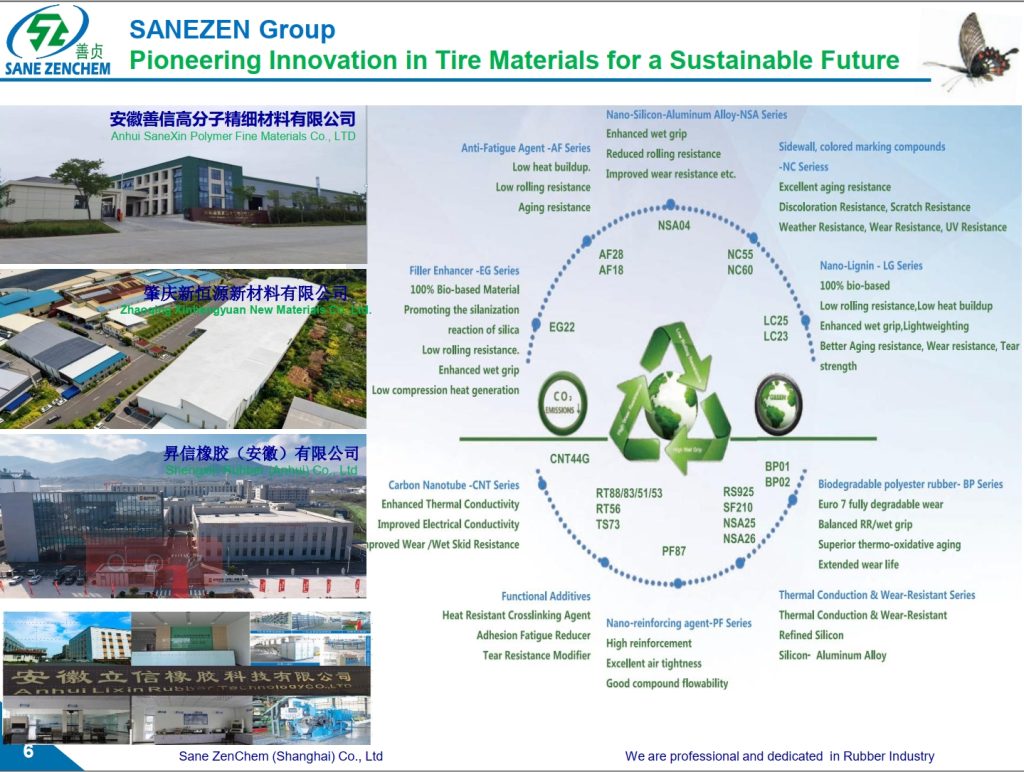
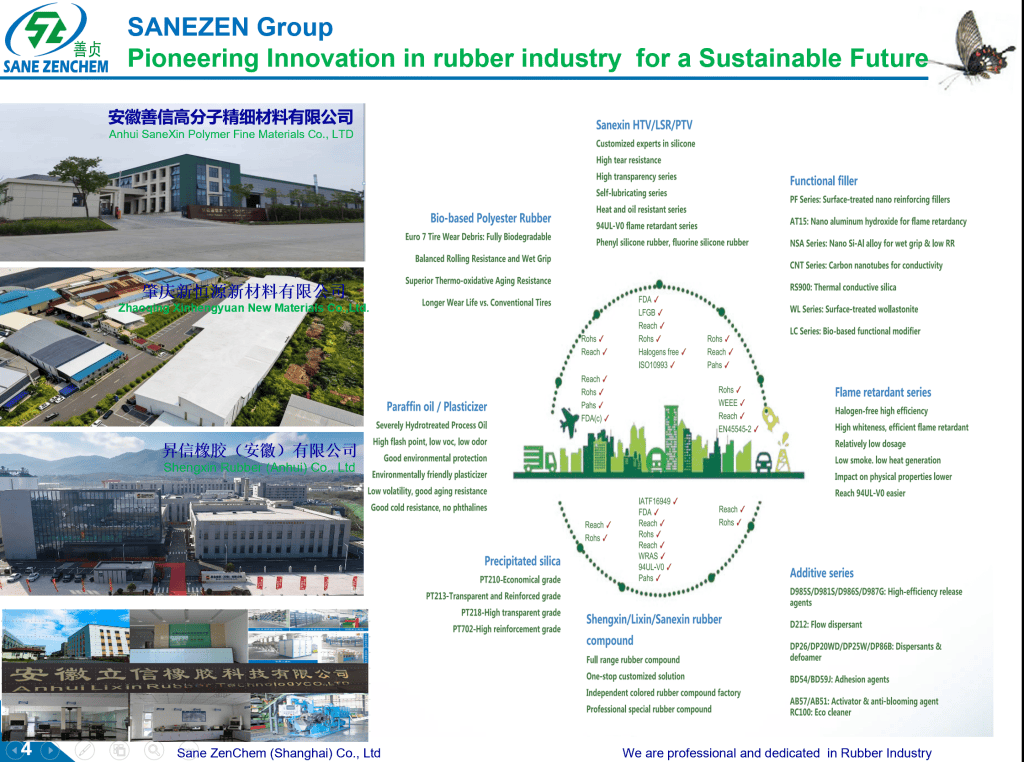
SaneZenChem operates five manufacturing facilities specialising in:
• Rubber Compounds
• Silicone Rubber Compounds
• Specialty Functional Fillers
• Flame Retardants
• Polymer Performance Additives
Because we formulate and manufacture rubber and silicone compounds ourselves, every specialty product we develop originates from solving real production challenges rather than laboratory concepts alone. This application-driven approach allows us to deliver practical solutions that create measurable improvements in customer products – from eliminating processing viscosity spikes and preventing micro cracking, to ensuring high dielectric strength in harsh electrical environments. Our unique dual position as both a direct compounder and a premier specialty functional filler manufacturer means we are uniquely equipped to support rubber, epoxy, and electrical insulation manufacturers in achieving longer service life, processing efficiency, and ultimate reliability.
Связаться с
Адрес завода:
ул. Байшоу, Северный район зоны экономического развития Сюаньчжоу
Xuan Cheng City, Anhui Province, China
Коммерческий адрес:
Room 503, Building 1, Huixin International Edifice, No. 150 Puhuitang Road, Xuhui District, Shanghai, China 200030
Tel: +86 136 7164 1995
Электронная почта: yorichen@sanezen.com
Веб-сайт: www.sanezenrubber.com
 Russian
 English
 Spanish