
What this page covers
A tire compound runs into a wall that is not about the polymer. You want more hardness and modulus in a support compound, and you get them by raising crosslink density. Then the adhesion to steel cord starts to suffer, the heat build-up goes up, and the fatigue life drops. The three requirements pull against each other.
GreenThinking® RT56 is a rubber adhesion and fatigue resistance agent that goes into the sulfur cure rather than sitting alongside it. As a rubber adhesion and fatigue resistant agent it works on the crosslink network rather than on the surface, which is why hardness and adhesion move at the same time. This page walks through the measured data on one natural rubber compound: hardness from 0 to 6 phr, the curing curve at 150 °C, and steel cord pull-out force before and after ageing. No claims beyond what the tests showed.
If you are juggling hardness, adhesion and fatigue in the same compound, the hardness and pull-out force sections are the ones to read.
Why the problem sits at the rubber-to-steel interface
A tire is a composite, and composites fail at interfaces. Belt layers, bead areas and run-flat support compounds all rely on a bond between rubber and brass-plated steel cord that has to survive millions of load cycles and years of heat.
Three things make that bond hard to keep. First, rubber and steel have very different stiffness, so every load cycle concentrates stress at the boundary. Second, the bond itself is a chemical and physical system that degrades: heat breaks down the interfacial layer, and once it starts to go, water and oxygen follow. Third, most of the usual ways to strengthen a compound work against the interface. More carbon black raises stiffness but can leave agglomerates that become crack initiation points. Higher crosslink density raises modulus but reduces the ability of the matrix to distribute strain, so more of the load lands on the interface.
That is why the compound in our test was not improved by adding more of anything. RT56 works on the crosslink network itself and on the carbon black surface, which is a different lever.
What RT56 is
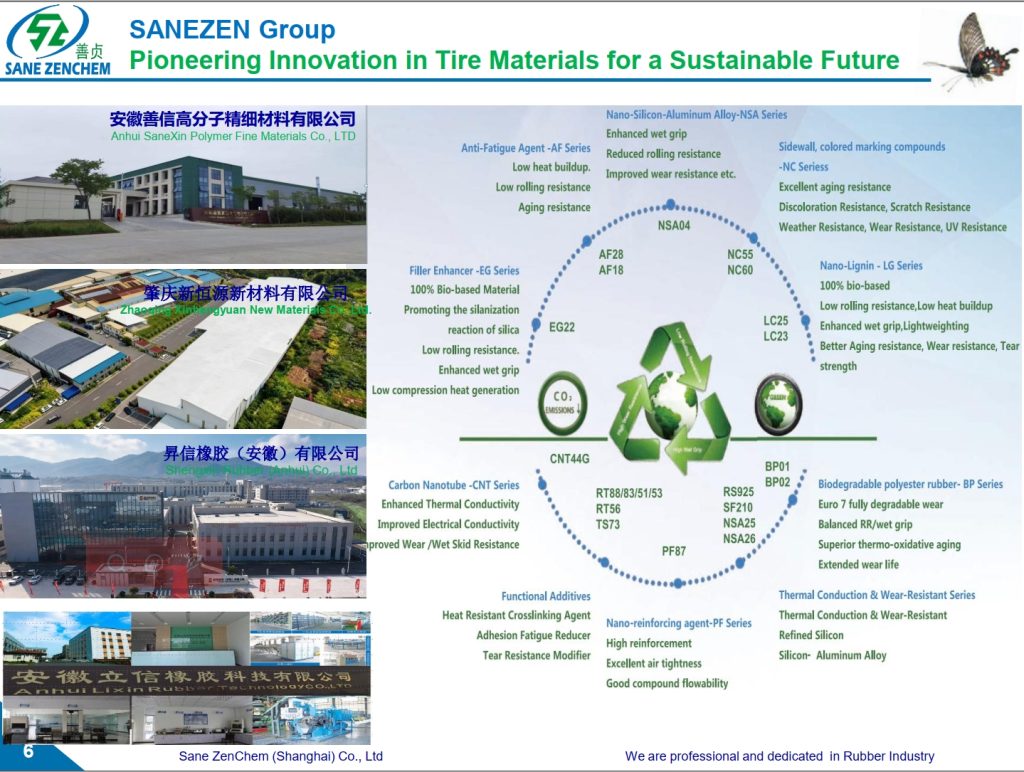
GreenThinking® RT56 is a high-performance rubber adhesion and anti-fatigue agent. It participates directly in the vulcanization and crosslinking reaction and reconstructs the crosslinked network. Its molecule carries multiple active benzene rings, which modulate the interaction between carbon black and rubber and improve carbon black dispersion.
In a rubber system it behaves as a multifunctional additive. A rubber co-crosslinking agent for NR compounds has to do two things at once, and this one builds network while it disperses filler. It acts as a co-crosslinking agent, raising crosslink density, heat resistance, modulus and hardness. It also improves filler dispersion and increases the adhesion strength between rubber and metal. Used as a добавка для каучука для улучшения дисперсии углеродного черного, it is acting on the filler network rather than on the polymer, which is a different lever from adding more carbon black. The intended base polymers are natural rubber and synthetic rubbers.
Five features are claimed for it, and each one maps to a measurement later on this page: co-crosslinking with anti-reversion, adjustable hardness and stiffness, improved fatigue performance, enhanced interfacial adhesion, and optimised carbon black dispersion.
The test: one NR compound, RT56 varied from 0 to 6 phr
The evaluation used a single natural rubber compound with carbon black N375 at 70 phr. RT56 was the only variable, tested at 0 (reference), 2, 4 and 6 phr. The vulcanization system was left untouched, because one of the product’s properties is that it does not require the cure system to be changed.
| Ingredient | фраза | Role |
| NR | 100 | base rubber |
| N375 | 70 | carbon black |
| ZnO | 3 | activator |
| Stearic acid | 2 | activator |
| 4020 | 1.5 | antioxidant |
| RD | 1 | antioxidant |
| Сера | 1.9 | curing agent |
| TBBI | 1.2 | accelerator |
| RT56 | variable | 0, 2, 4, 6 phr |
Two more reference compounds appear in the adhesion part of the study. The source figures label them REF.1 and REF.2 and do not describe their formulations, so they are carried through here exactly as labelled, with RT56 added on top of each.
Measured effect 1: hardness and stiffness move with dosage
| RT56 dosage | Твердость, Шор А | Change vs reference |
| 0 phr (reference) | 72 | – |
| 2 phr | 80 | +8 |
| 4 phr | 85 | +13 |
| 6 phr | 88 | +16 |
Hardness climbs steadily, roughly 4 to 8 points per 2 phr, and it does so without touching the accelerator or sulfur level. For a compounder this is the most immediately useful number on the page. It means hardness and stiffness become a dial rather than a reformulation.
The product data sheet also states that the dynamic-to-static stiffness ratio can be adjusted through dosage, which matters for engine mounts and other vibration-damping parts where you want one stiffness under static load and a different behaviour under vibration. The test shown here did not measure that ratio, so treat it as a documented product property rather than a result from this study.
Measured effect 2: the curing curve shows anti-reversion
The curing curves were run at 150 °C and plot torque against time. Read as an anti-reversion additive for rubber vulcanization, the shape of the curve matters as much as the torque level, because a network that gives torque back is a network that is being destroyed.
| RT56 dosage | Torque behaviour over 60 min at 150 °C |
| 0 phr (reference) | Rises to a maximum of about 26 dN·m within roughly 15 min, then falls back to about 24.5 dN·m by 60 min |
| 2 phr | Rises to about 40 dN·m and holds, with a slight decline late in the run |
| 4 phr | Rises to about 53 dN·m at 25 min and is still climbing slowly at 60 min |
| 6 phr | Keeps climbing through the whole 60 min run, passing 75 dN·m |
Two things stand out. The torque level itself scales strongly with dosage: at 6 phr the plateau is roughly three times the reference. And the shape of the reference curve is the classic reversion signature. It peaks early and then gives back torque, which happens when the crosslink network is being destroyed as fast as it is being formed. None of the RT56 compounds show that decline over the same 60 minutes, and the higher dosages are still building network at the end of the test.
Values above are read from the curing curve figure in the source presentation. The trends and the direction of the difference are unambiguous; the absolute plateau values carry normal reading error from a plotted curve.
Measured effect 3: steel cord pull-out force before ageing
Pull-out force (POF) is the force needed to pull a steel cord out of the cured compound, and it is the direct measure of whether the interface is doing its job. A steel cord adhesion promoter for tires therefore has to be judged on this number, and on how much of it survives ageing.
| Смесь | POF before ageing, N | Change with RT56 |
| REF.1 | 963 | – |
| REF.1 + RT56 | 1062 | +99 N, about +10% |
| REF.2 | 910 | – |
| REF.2 + RT56 | 977 | +67 N, about +7% |
RT56 raised unaged pull-out force in both reference compounds, by about 7% in one and about 10% in the other. That is worth pausing on, because adhesion promoters and anti-fatigue agents are often described as improving different things. Here one additive raised both the static interface strength and the hardness on the same compound.
The two references respond differently, which is normal and useful information: the size of the adhesion gain depends on the starting formulation. A compound that already has good interfacial chemistry has less room to improve.
Measured effect 4: pull-out force through 60 days of ageing
The second adhesion test is the more demanding one. Cords were aged at 85 °C and 85% relative humidity for up to 60 days, which is an aggressive but realistic proxy for hot, humid service, and pull-out force was tracked through the period.
Reading the aged curves:
| Смесь | POF at day 0, N | POF at 60 days, N | Loss over 60 days |
| REF.1 | about 930 | about 525 | about 405 N |
| REF.1 + RT56 | about 1035 | about 615 | about 420 N |
| REF.2 | about 880 | about 585 | about 295 N |
| REF.2 + RT56 | about 965 | about 645 | about 320 N |
Three observations, and the third is the one that matters commercially.
Pull-out force falls in every case, roughly linearly, across the 60 days. Ageing at 85 °C and 85% RH is genuinely hard on a rubber-to-brass bond and nothing here is claimed to stop that.
RT56 compounds sit above their references for the entire 60 days, not just at the start. The advantage measured before ageing, roughly 100 N for set 1 and roughly 85 N for set 2, is still present at day 60 at roughly 90 N and roughly 60 N. So the improvement is not a fresh-sample effect that ageing erases. A rubber additive to keep adhesion after 85 °C 85% RH aging is judged on exactly this: whether the gap is still there at the end of the exposure, not at the start.
The absolute gap is what a component designer can use. At day 60, the RT56 compounds are still delivering pull-out force that the references reached only at around day 20 to 30. In a bead area or a belt edge, that difference is the margin between a bond that survives a full service life and one that does not.
Two cautions on these numbers. They are read from a plotted curve rather than a data table, so treat them as approximate and check the original test record before quoting them. And the day-0 values on the ageing curve read slightly lower than the separate bar chart values given in the previous section, which is a normal consequence of reading points off a plot; the bar chart values are the labelled ones.
What this means when you use it
Dosage. The product data sheet gives a general range of 1 to 8 phr and recommends optimising against the target properties, whether that is hardness, fatigue life or adhesion strength. The data on this page covers 2, 4 and 6 phr, and all three moved hardness and torque in a predictable, monotonic way, which is what makes the dosage adjustable rather than a one-point setting.
Cure system. RT56 is compatible with sulfur and accelerator systems and can be used together with them without changing the original vulcanization system. That was true in this test: sulfur, TBBI, ZnO and stearic acid were all held constant while hardness moved by 16 Shore A. That is what makes it a rubber additive that increases hardness without changing the cure system, which is the property most compounders ask about first.
Mixing. Add the rubber and the carbon black together with RT56 first and mix for 60 seconds, then add the rest of the ingredients. A heat treatment step at 160 °C for 1 minute is recommended to realise the full effect. If the only goal is higher modulus and hardness, the data sheet allows adding RT56 during the final mixing or masterbatch stage instead. Used that way it works as a co-agent for NR compounds to raise modulus and hardness without a full reformulation.
Where the dosage goes. Because hardness and pull-out force both increase with dosage, the choice is usually driven by which specification is harder to meet. A run-flat support compound that needs high hardness and high adhesion will sit at the upper end. A conveyor belt cover or an engine mount that mainly needs fatigue life will often work at a lower dosage. The same reasoning applies to a fatigue resistant additive for conveyor belt and transmission belt rubber, where cut growth under repeated flexing decides service life, and to a rubber additive for engine mount dynamic fatigue life, where the acceptance criterion is a dynamic test rather than a static one.
Reading an adhesion or fatigue failure
| What you see | What it usually means | What to do |
| Steel cord pulls out clean, with little rubber adhering to the wire | Interfacial failure, the bond is the weak point | Before changing the bonding system, check whether a co-crosslinking additive raises POF, as it did by 7 to 10% here |
| Rubber tears away in chunks with cord still attached | The matrix is weaker than the interface | Stiffness and crosslink density in the matrix need attention, not the bonding chemistry |
| Heat build-up rises as you add hardness | Higher crosslink density concentrating strain | Look for an additive that raises modulus without the usual penalty in dynamic performance |
| Torque rises then falls during the curing curve | Reversion, network being destroyed as it forms | Anti-reversion chemistry, or a cure system review |
| Crack starts at a visible speck in the rubber | Filler agglomerate acting as a stress raiser | Dispersion, which is a mixing and additive question |
| Adhesion is fine when new and poor after ageing | The interface layer is degrading, not poorly formed | Test with an ageing step in it, at realistic temperature and humidity |
Where this applies
An adhesion and fatigue resistance agent for run flat tire support rubber has to raise rigidity and interfacial strength at the same time. The product data sheet lists the following applications:
- Tires, including run-flat tire support rubber, adhesion enhancement, increased rigidity and modulus, and heat resistance
- Vibration-damping rubber, for example automotive engine mounts
- Conveyor belts and transmission belts
- Rubber rollers and motor brackets
- Other rubber products requiring high fatigue resistance, high adhesion and heat aging resistance
The base polymers are natural rubber and synthetic rubbers. Across these parts the same three requirements keep coming back in different proportions: how stiff, how well bonded, and how long it lasts under load. A run flat tire support compound additive has to lift stiffness and adhesion together, which is the hardest combination to satisfy; a fatigue resistant rubber additive for engine mounts is judged on flex fatigue instead, because there the failure mode is crack growth rather than interfacial debonding.
Часто задаваемые вопросы
What is RT56?
GreenThinking® RT56 is a rubber adhesion and fatigue resistance agent that participates directly in the vulcanization reaction and reconstructs the crosslinked network. Its molecule contains multiple active benzene rings that also modulate the carbon black to rubber interaction. In one NR compound it raised hardness from 72 to 80 Shore A at 2 phr and steel cord pull-out force by about 7 to 10%.
How much does RT56 raise hardness?
In the compound tested here, hardness went from 72 Shore A at 0 phr to 80 at 2 phr, 85 at 4 phr and 88 at 6 phr. That is a rise of 8, 13 and 16 points respectively, with no change to the sulfur or accelerator level. Because the response is steady, hardness acts as a dial rather than as a reformulation.
Can I use RT56 without changing my cure system?
Yes, according to the product data sheet, which states that it is compatible with sulfur and accelerator systems and can be used together with them without altering the original vulcanization system. In the test on this page the sulfur level, accelerator, ZnO and stearic acid were all unchanged while hardness moved by 16 points.
How to suppress vulcanization reversion in natural rubber
The curing curve at 150 °C is the evidence. The reference compound peaked at about 26 dN·m at roughly 15 minutes and then fell back to about 24.5 dN·m at 60 minutes, which is reversion. The compounds with 2, 4 and 6 phr did not show that decline over the same period, and the 6 phr compound was still building torque at the end of the run. Read the original curve before quoting exact values.
How to improve steel cord pull out force in tire compounds
Change the crosslink network rather than the bonding chemistry. Before ageing, pull-out force went from 963 N to 1062 N in one reference compound, and from 910 N to 977 N in another. That is roughly +10% and +7%. With cords aged at 85 °C and 85% RH for 60 days, the RT56 compounds remained above their references for the whole period.
Is the adhesion improvement still there after ageing?
Yes. The gap measured before ageing, roughly 100 N and 85 N for the two reference compounds, was still present at day 60 at roughly 90 N and 60 N. That matters because fresh-sample adhesion gains often disappear once a compound has been through heat and humidity.
What ageing condition was used for the adhesion test?
Steel cords were aged at 85 °C and 85% relative humidity for up to 60 days, with pull-out force tracked through the period. In all compounds pull-out force fell roughly linearly across the 60 days; nothing in this data suggests ageing can be stopped, only that the level can be raised.
Which rubbers is RT56 for?
Natural rubber and synthetic rubbers. The applications in the product data sheet are tires including run-flat support compounds, vibration-damping rubber such as engine mounts, conveyor and transmission belts, rubber rollers and motor brackets, and other parts that need high fatigue resistance, high adhesion and heat aging resistance together.
What dosage should I start at?
The general range given in the data sheet is 1 to 8 phr, optimised against whichever property you are trying to hit. If your constraint is hardness or adhesion, you will likely end up higher in that range. If the constraint is fatigue life with hardness already satisfied, a lower dosage is often enough. Start with a small trial and check hardness and pull-out force together.
How do I mix RT56?
Add the rubber and the carbon black together with RT56 first and mix for 60 seconds before adding the other ingredients. A heat treatment step at 160 °C for 1 minute is recommended to get the full effect. If you only need higher modulus and hardness, the data sheet permits adding it at the final mixing or masterbatch stage.
How to improve carbon black dispersion with a co-crosslinking agent
The data sheet states that the benzene ring structure modulates the carbon black to rubber interaction and improves dispersion, which improves material uniformity. Filler agglomerates are a common crack initiation site, so dispersion is one of the routes by which the fatigue improvement happens.
Will it work in a run-flat tire support compound?
Run-flat tire support rubber is the first application named in the product data sheet, specifically for adhesion enhancement and increased rigidity, modulus and heat resistance. That combination is exactly what the hardness and pull-out force data on this page address. Verify in your own formulation, since the two reference compounds in the adhesion test responded differently.
How to test a rubber adhesion promoter in your own compound
Run four compounds: your current compound, and the same compound with the additive at two or three dosages. Keep sulfur and accelerator constant. Measure Shore A hardness and cure characteristics first, then steel cord pull-out force both before and after ageing. Age the adhesion specimens at a realistic temperature and humidity, not just in a dry oven. If pull-out force gains vanish after ageing, you have learned something important before it reached production.
Does RT56 replace the bonding system I already use?
The data sheet does not claim that. What the test shows is that a co-crosslinking additive raised pull-out force by 7 to 10% on top of two existing reference compounds, and raised hardness as well. Whether that lets you reduce a cobalt salt or a resorcinol-formaldehyde resin is a formulation decision that needs its own trial.
What are the packing and storage conditions?
20 kg bags. Store dry, cool and sealed at around 25 °C. Shelf life is approximately 2 years.
About the data on this page
All measurements on this page come from the application presentation “Application of Adhesion & Fatigue Resistance Agent RT56 in Tires” and the technical data sheet SZ0325-2023-24 V2 for GreenThinking® RT56. The formulation used was NR 100, N375 70, ZnO 3, stearic acid 2, 4020 1.5, RD 1, sulfur 1.9, TBBI 1.2, with RT56 varied from 0 to 6 phr.
The hardness values and the unaged pull-out force values are labelled numbers. The curing curve torque values and the aged pull-out force values were read off plotted curves, and are marked as approximate wherever they appear; confirm them against the original test records before using them in a specification. The formulations of the two reference compounds labelled REF.1 and REF.2 are not described in the source material and are not assumed here. Nothing on this page is a claim about performance in a specific application; test in your own compound before changing production.
Why Choose Us
Choosing a functional filler supplier is not only about purchasing a mineral powder. It is about selecting a technical partner that understands polymer compounding, physical failure mechanisms, and long-term product performance. As a leading specialty functional filler and performance additives manufacturer, we bring decades of compounding expertise to every customer collaboration.
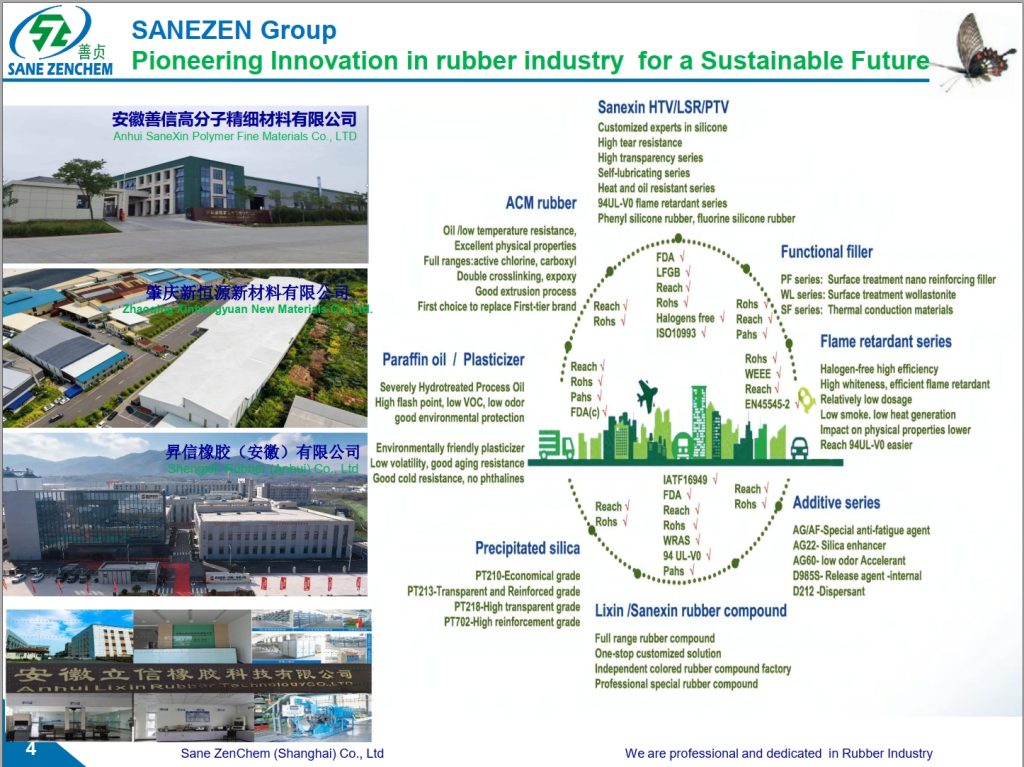
SaneZenChem operates five manufacturing facilities specialising in:
• Rubber Compounds
• Silicone Rubber Compounds
• Specialty Functional Fillers
• Flame Retardants
• Polymer Performance Additives
Because we formulate and manufacture rubber and silicone compounds ourselves, every specialty product we develop originates from solving real production challenges rather than laboratory concepts alone. This application-driven approach allows us to deliver practical solutions that create measurable improvements in customer products – from eliminating processing viscosity spikes and preventing micro cracking, to ensuring high dielectric strength in harsh electrical environments. Our unique dual position as both a direct compounder and a premier specialty functional filler manufacturer means we are uniquely equipped to support rubber, epoxy, and electrical insulation manufacturers in achieving longer service life, processing efficiency, and ultimate reliability.
Связаться с
Sane ZenChem (Shanghai) Co., Ltd
Адрес завода: Дорога Байшоу, северный район зоны экономического развития Сюань Чжоу, город Сюань Чэн, провинция Аньхой, Китай.
Commercial address: Room 1606-1608, Boda Commercial Buildings, No. 11 Puhuitang Road, Xuhui District, Shanghai, China 200030
Тел: +86 21 6487 9251
Факс: +86 21 5106 2693
Электронная почта: yorichen@sanezen.com
Веб-сайт: www.sanezenrubber.com
When you compare a rubber adhesion promoter manufacturer China with any other supplier, the useful questions are the same three: what ageing standard was used, were the unaged reference values supplied so retention can be calculated, and was the comparison made at equal loading. A supplier that can answer all three is telling you something a sample book cannot.
If you are weighing hardness against adhesion
Send us the compound you are running and the specification you are trying to hit, whether that is Shore A hardness, steel cord pull-out force, or fatigue life. We will tell you the dosage to start at, and whether the additive is likely to help in your base rubber at all. In this study, one of the two reference compounds gained 10% in pull-out force and the other gained 7%, and that difference came from the formulations, not from the additive. Knowing which side your compound sits on saves a trial.
Samples and technical support are available on request.
 Russian
  English
  Spanish