Abstract
Carbon Nanotubes (CNTs), as a material with ultra-high strength, exceptional conductivity, and a unique nanostructure, have shown immense potential in the field of rubber composites in recent years. This article focuses on the specific application of carbon nanotubes in Hydrogenated Nitrile Butadiene Rubber (HNBR), analyzing the enhancing effects of CNTs on the mechanical properties, conductivity, thermal stability, and durability of HNBR by combining the actual test performance of Shanzen’s CNT44G. By comparing experimental data with competitor performance, it elaborates in detail on the mechanism through which CNTs function within the HNBR system and prospects their application in high-end sealing, automotive, aerospace, and other fields. This article aims to provide theoretical reference for rubber engineering technicians and data support for material selection.
Keywords integrated: carbon nanotubes for HNBR, CNT for conductive hydrogenated nitrile rubber, HNBR rubber reinforcement materials, antistatic rubber sealing materials, additive for rubber thermal conductivity
Chapter 1: Introduction—The Convergence of Carbon Nanotubes and High-Performance Elastomers
1.1 Overview of Carbon Nanotubes
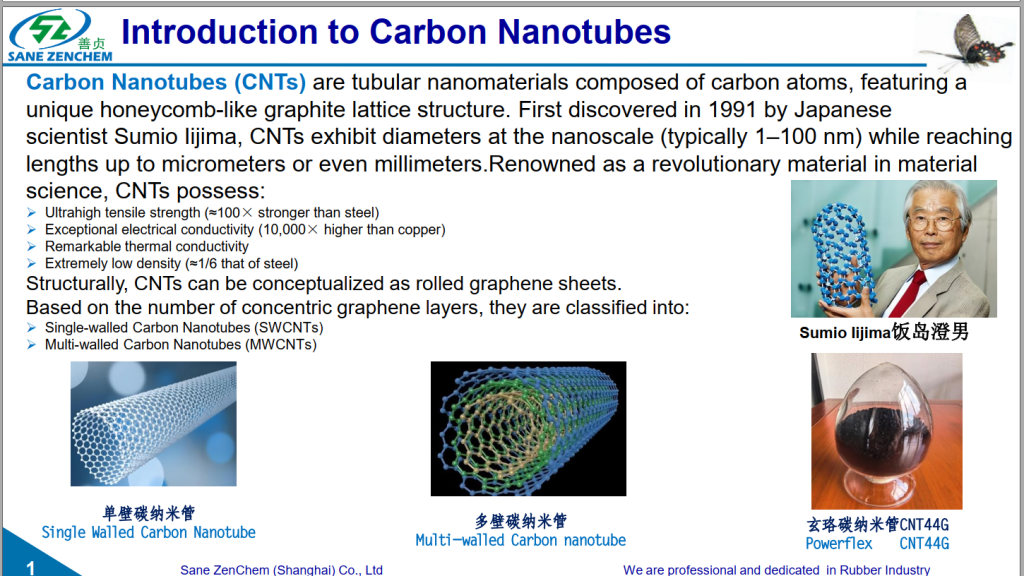
Carbon Nanotubes are tubular nanomaterials formed by carbon atoms through sp² hybridization, with diameters at the nanoscale and lengths reaching micrometers or even millimeters. Since their discovery by Sumio Iijima in 1991, CNTs have been hailed as the “ultimate reinforcing material” due to their ultra high tensile strength (approximately 100 times that of steel), exceptional electrical conductivity (superior to copper), outstanding thermal conductivity, and extremely low density. In the rubber industry, CNTs not only serve as reinforcing fillers but, due to their unique network structure, can significantly enhance the comprehensive performance of composite materials. Companies seeking a reliable carbon nanotube supplier China or a carbon nanotube manufacturer China often prioritize products that offer both quality and consistent performance.
1.2 Characteristics and Application Bottlenecks of Hydrogenated Nitrile Rubber (HNBR)
HNBR is a highly saturated special rubber obtained through the hydrogenation of Nitrile Rubber, possessing excellent oil resistance, heat resistance, ozone resistance, and resistance to chemical media. It is widely used in automotive fuel systems, aerospace seals, and industrial dynamic sealing. However, traditional HNBR composites still have room for improvement in terms of conductivity, retention of mechanical strength at high temperatures, and wear resistance. Especially in applications requiring antistatic or conductive properties, large amounts of conductive carbon black are often added, which can sacrifice mechanical performance and processing fluidity. This highlights the need for advanced solutions like carbon nanotubes for rubber and specifically carbon nanotubes for HNBR.
1.3 The Opportunity in Combining CNT with HNBR
Introducing CNTs into the HNBR system can precisely address these bottlenecks. CNTs can form an efficient three-dimensional conductive network at very low loading levels, while their nano-scale reinforcing effect can significantly improve the material’s modulus, tear strength, and wear resistance without significantly compromising its elasticity. The following sections will delve into the actual application effects of CNT44G in HNBR based on specific experimental data, a topic crucial for those involved in optimizing HNBR formulation with multi walled carbon nanotubes.
Chapter 2: In-depth Interpretation of Experimental Data—Performance of CNT44G in HNBR System
2.1 Comparison of Basic Physical Properties
Based on the provided test data (HNBR system, peroxide vulcanization, CNT44G loading of 1 part), the following conclusions can be drawn:
- Tensile Strength: The CNT44G formulation reaches 21.5 MPa, slightly lower than the competitor’s 23 MPa but significantly exceeding the requirement of ≥16 MPa, demonstrating sufficient reinforcing effect. This is a key consideration when selecting HNBR rubber reinforcement materials.
- Elongation at Break: 278%, meeting the requirement of ≥200%, indicating that the addition of CNT did not impair the flexibility of HNBR.
- Hardness: 80 A, within the specified range (75±5) and slightly higher than the competitor (78 A), indicating that CNT provides effective stiffness supplementation.
- Brittle Temperature: -55°C, on par with competitors, meaning excellent low temperature performance is preserved.
2.2 Core Advantage One: Revolutionary Conductive Performance
The most outstanding result of this test is the leap in conductive performance:
- Volume Resistivity: The CNT44G formulation achieves an astounding 26 Ω·cm.
- Comparative Analysis: This value is not only far below the requirement of ≤10⁶ Ω·cm but is also significantly ahead of the competitor’s 4.8×10² Ω·cm (i.e., 480 Ω·cm), a difference of several orders of magnitude. This directly addresses the query of how to improve electrical conductivity in HNBR seals.
- Technical Significance: This means that in the HNBR system, adding just 1 part of CNT44G can achieve excellent, stable conductivity, sufficient to meet the needs of antistatic, electrostatic dissipation, and even highly conductive applications. This enables the reduction or replacement of conductive carbon black, avoiding the processing difficulties and mechanical performance losses associated with the latter. For engineers, this translates to a viable strategy when looking to choose carbon nanotubes to replace conductive carbon black.
2.3 Core Advantage Two: Excellent Hot Air Aging Performance
After severe hot air aging at 150°C × 48h:
- Tensile Strength Change Rate: +8%, better than the competitor’s +10%, indicating that CNT44G can better maintain material strength at high temperatures.
- Elongation at Break Change Rate: -30%, just meeting the upper limit of the specification, slightly behind the competitor (-22%). The report notes this may be related to small-scale trial or testing errors. It is important to emphasize that “meeting the specification limit” is still a qualified performance, and the advantage in other key properties (especially conductivity) is enormous. CNT’s own excellent thermal stability helps delay the thermo-oxidative aging process of the rubber matrix, contributing to enhancing HNBR durability with carbon nanotube reinforcement.
2.4 Summary: The Art of Performance Balance
Overall, Shanzen CNT44G achieves a high-performance balance in HNBR: while ensuring all basic physical and mechanical properties meet standards and are on par with competitors, it achieves a disruptive breakthrough in the key property of conductivity, while also showing competitiveness in heat aging resistance. This is decisive for developing next-generation high-performance, functionalized HNBR products and is central to developing an antistatic HNBR compound formula for fuel hoses.
Chapter 3: Mechanism Investigation—How CNTs Reshape HNBR Composites
3.1 Nano-Reinforcement and Network Effect
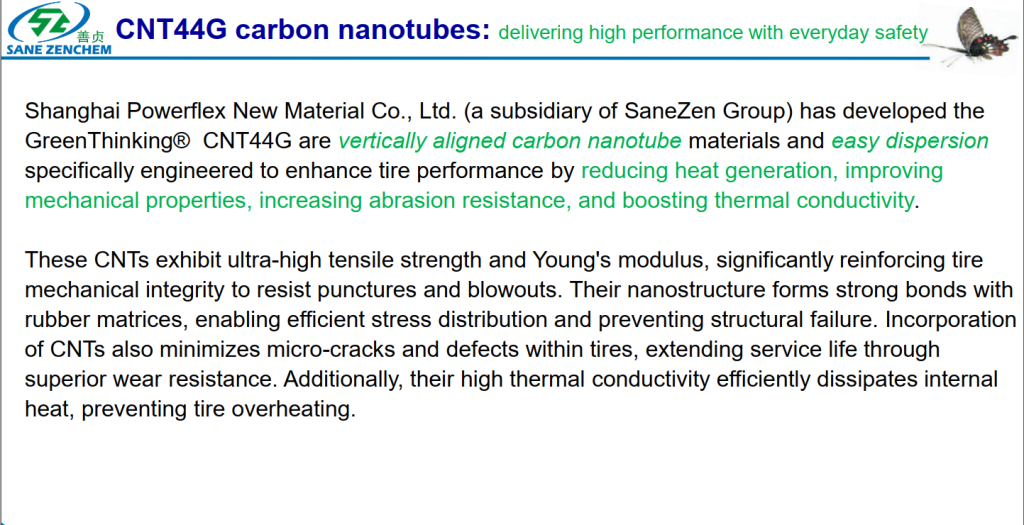
CNTs have diameters at the nanoscale and an enormous specific surface area. When well-dispersed in the HNBR matrix, they can form strong physical adsorption and mechanical interlocking with rubber molecular chains, creating an effective stress transfer network. This allows loads applied to the material to be efficiently dispersed through the CNT network, significantly improving tensile strength, tear strength (referencing PDF tire compound tests showing a 28% increase), and modulus. This network is foundational for creating high performance HNBR seals with carbon nanotube additives.
3.2 Construction of Conductive Pathways
The conductivity of CNTs stems from their perfect sp² carbon structure. In the rubber matrix, a small amount of CNT can form a three-dimensional percolation network through a “bridging” effect. When the CNT content reaches the percolation threshold, resistivity drops sharply. Experiments show that in HNBR, 1 part of CNT44G far exceeds the percolation threshold, constructing an extremely efficient electron transport channel. This is unmatched by traditional conductive carbon black, which requires high loadings to form contact conductivity, and is a key factor in developing CNT for conductive hydrogenated nitrile rubber.
3.3 Thermal Management and Durability Enhancement
- Enhanced Thermal Conductivity: CNTs have extremely high axial thermal conductivity. Adding CNTs improves the composite’s thermal conductivity (PDF data shows a 10.5% increase), which is beneficial for rapidly dissipating friction heat and hysteresis heat generated during dynamic use of the product, reducing localized high temperatures, thereby delaying thermal aging and improving durability. This positions CNTs as an effective additive for rubber thermal conductivity.
- Crack Propagation Resistance: The nanofiber structure of CNTs can blunt or bridge micro-cracks, preventing them from propagating into macro-failure. This directly contributes to improved wear resistance and fatigue life (supported by wear data in the PDF).
- Synergy with Peroxide Vulcanization Systems: The peroxide vulcanization system commonly used for HNBR forms C-C crosslinks, which have good heat resistance. Functional groups on the CNT surface (if modified) may interact with free radicals, optimizing the vulcanization network, helping to maintain performance after aging.
3.4 Impact on Processing Performance
PDF data from tire compound tests also reveals a common influence of CNTs: increasing the compound’s Mooney viscosity (ML). This is because CNTs’ high specific surface area and aspect ratio increase the resistance to movement of rubber molecular chains. In HNBR applications, this indicates the need to optimize mixing processes (e.g., using masterbatch, extending mixing time) and potentially make minor adjustments to processing aids to ensure good processability. Changes in curing speed (e.g., t90) also need to be considered in formulation design. Understanding the effect of carbon nanotube loading on rubber properties, including viscosity, is therefore essential. Successfully managing carbon nanotube dispersion in hydrogenated nitrile rubber is the first critical step to harnessing these benefits and mitigating processing challenges.
Chapter 4: Application Scenario Outlook—The Future Market for CNT/HNBR Composites
Based on their unique performance combination, CNT-enhanced HNBR composites will shine in the following high-end fields:
4.1 High-End Seals and Bearings
- Oilfield Exploration: Used for downhole seals resistant to high temperature, high pressure, and hydrogen sulfide, with conductivity preventing electrostatic buildup.
- Automotive Fuel Systems: Fuel lines, O-rings, etc., requiring fuel resistance, heat resistance, and electrostatic discharge capability.
- Aerospace Hydraulic Systems: Seals need to remain stable across a wide temperature range (-55°C to 150°C+) and under high pressure, with conductivity meeting electromagnetic compatibility requirements. These applications are prime targets for HNBR carbon nanotube composite for high temperature seals.
4.2 Antistatic and Conductive Specialized Products
- Semiconductor and Electronics Industry: Conductive rollers and wafer conveyor belts for cleanrooms, requiring cleanliness, wear resistance, and stable resistivity.
- Medical Devices: Conductive catheters, seals, to prevent static electricity from interfering with precision instruments.
- Mining and Textile Machinery: Components requiring electrostatic discharge to prevent fire or explosion. Developing these products often involves creating an antistatic HNBR compound using carbon nanotube technology.
4.3 High-Performance Dynamic Products
- Timing Belts, Multi-Rib Belts: Adding CNTs can significantly enhance the shear and tear resistance of the belt teeth, extending service life in high-temperature engine compartments. This is another example of carbon nanotubes to improve HNBR conductivity and strength for multifaceted gains.
4.4 Other Functional Applications
Leveraging the piezoresistive effect of CNTs, smart sensing rubber can be developed to monitor the stress state or wear condition of seals, enabling predictive maintenance.
Chapter 5: Conclusion and Recommendations
Carbon Nanotubes, particularly high-dispersion, high-performance products like Shanzen’s CNT44G, have opened a new chapter for the performance upgrade of Hydrogenated Nitrile Rubber. Experimental data confirms:
- Disruptive Conductivity: Achieving the transition of HNBR from insulator to conductor with extremely low loading, performance far exceeding traditional conductive fillers.
- Comprehensive Enhancement: Significantly improving mechanical strength, tear resistance, and wear resistance while preserving the inherent advantages of HNBR.
- Thermal Management Aid: Improving thermal conductivity, helping to enhance performance retention in high-temperature environments.
A thorough cost benefit analysis of CNT in HNBR vs traditional fillers often reveals that while the upfront cost of CNTs is higher, the performance gains, potential for reduced filler loading, and extended product life can lead to a superior total cost of ownership.
Recommendations for Formulation Engineers:
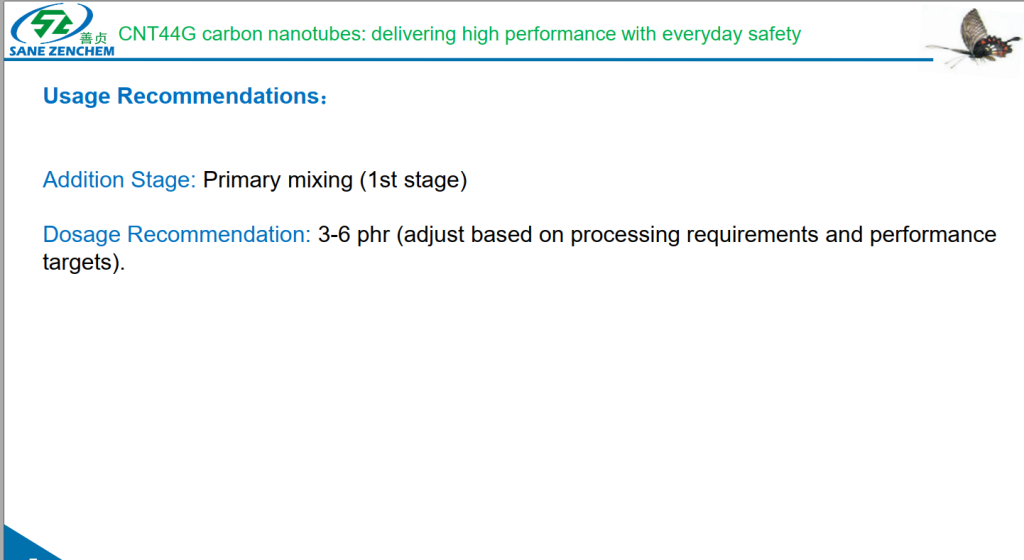
- Starting Loading: It is recommended to start from 0.5-2 phr and adjust based on conductivity and mechanical property requirements, mindful of the effect of carbon nanotube loading on rubber properties.
- Dispersion is Key: Efficient mixing processes (e.g., two-stage mixing, adding CNTs under high shear in the first stage) must be employed to ensure adequate dispersion, addressing the core challenge of carbon nanotube dispersion.
- System Synergy: Pay attention to the interaction between CNTs, the vulcanization system, and other functional fillers, optimizing the overall formulation through experimentation.
- Cost-Benefit Trade-off: Although the unit price of CNTs is higher, their extremely low usage, the performance leap they bring, and the potential extension of product life often result in higher comprehensive cost-effectiveness.
When selecting a partner for this technological journey, seeking technical support from high performance carbon nanotube suppliers is invaluable. Looking forward, as the production cost of carbon nanotubes continues to decline and surface modification technology advances, CNT/HNBR composites will inevitably move from specialized high-end applications to broader industrial fields, becoming one of the core engines driving the rubber industry towards high performance, functionality, and intelligence.
 English
  Spanish
  Russian