Abstract:
The global tire industry is undergoing a profound transformation, driven by stringent environmental regulations, the electric vehicle (EV) revolution, and consumer demand for greater safety and longevity. At the heart of this shift is the critical challenge of reducing rolling resistance without compromising traction, wear, or durability. This paper introduces GreenThinking® AF28, a advanced NR rubber anti fatigue agent engineered specifically for natural rubber (NR)-dominant tread compounds. We elucidate the unique dual-mechanism of AF28, which acts as a molecular bridge between the carbon black filler and the rubber polymer chain. This action significantly reduces hysteresis heat build-up, lowers rolling resistance, and crucially, mitigates reversion, thereby enhancing tire longevity and performance stability. Supported by comprehensive data, we demonstrate how AF28 provides a targeted solution for high rolling resistance tires and a powerful tire durability additive for manufacturers aiming to meet EU Label ‘A’ grades, improve EV range, and deliver superior, durable products in a competitive and regulated market.
1. The Tire Industry’s Trilemma: Performance, Sustainability, and Profitability
Tire formulators are tasked with a perpetual balancing act. The classic “Magic Triangle” of tire performance—rolling resistance, wet grip, and wear resistance—dictates that improving one often comes at the expense of another. Today, this challenge is intensified by external pressures:
- Regulatory Drivers: The EU Tire Labeling Regulation and its global equivalents push for higher grades, particularly in rolling resistance (impacting fuel efficiency and CO₂ emissions) and wet grip (safety). Achieving an ‘A’ grade is no longer a luxury but a market necessity, creating a strong demand for improve EU tire label grade additives.
- The EV Revolution: Electric vehicles place unique demands on tires. They are heavier, impart instant high torque, and require low rolling resistance to maximize their critically important driving range. Furthermore, EV-quiet cabins make tire noise a more prominent concern.
- Sustainability & ESG: Beyond the use-phase emissions, the entire lifecycle of a tire is under scrutiny. This includes the sourcing of materials, manufacturing energy consumption, and the ultimate durability of the product. Longer-lasting tires mean fewer resources consumed and less waste generated over time, underscoring the need for a cost effective tire durability solution.
The common thread linking these challenges is hysteresis—the energy loss of a rubber compound as it is deformed during rolling, cornering, and braking. This lost energy manifests as heat, which directly increases rolling resistance (wasting fuel or battery power), accelerates material degradation, and can lead to catastrophic failure modes like reversion. Therefore, achieving significant tire heat buildup reduction is a primary goal.
2. The Core Challenge: Hysteresis and Reversion in NR Compounds
Natural rubber, prized for its exceptional tear strength, fatigue resistance, and low heat build-up under ideal conditions, remains the polymer of choice for high-performance tire treads and carcasses. However, its interaction with reinforcing fillers like carbon black is a primary source of hysteresis. This is why an effective natural rubber additive is crucial.
- Filler-Polymer Interaction: Carbon black particles form a network within the rubber matrix. Under dynamic stress, the polymer chains adsorb to, desorb from, and slide over the surface of these filler particles. This process dissipates energy as heat—the primary source of hysteresis in a carbon-black-filled compound.
- The Scourge of Reversion: In sulfur-cured NR systems, prolonged exposure to high operating temperatures during service, or even during the curing process itself, can lead to reversion. This is the thermo-oxidative degradation of the polysulfidic crosslinks (Sx, where x>2) that form the vulcanized network. Reversion results in a loss of crosslink density, leading to a drop in modulus, hardness, and tensile strength, ultimately shortening tire life and compromising safety. The industry urgently needs a robust tire reversion inhibitor. Engineers are constantly seeking how to prevent tire reversion effectively.
Traditional approaches to mitigate these issues often involve trade-offs. For instance, using less carbon black reduces hysteresis but sacrifices reinforcement. AF28 is engineered to break this compromise.
3. GreenThinking® AF28: A Mechanistic Breakdown of Performance
AF28 is not a simple processing aid; it is a scientifically designed multifunctional coupling agent and a high-performance Tire Anti Fatigue Agent. Its molecular structure is engineered with specific functional groups (X and Y) that target the interfaces within the rubber compound.
3.1. The Dual-Action Coupling Mechanism
Our research identifies a two-pronged mechanism:
- Polymer-End Modification: The AF28 molecule features highly active groups (Y) that react with the aldehyde (C=O) groups present at the chain ends of natural rubber molecules. This chemical modification effectively “caps” the free chain ends, which are significant contributors to molecular friction and hysteresis.
- Filler-Polymer Coupling: Simultaneously, other functional groups on the AF28 molecule (X)—such as hydroxyls, amines, and others—form strong multiple interactions with the active sites on the carbon black surface. These sites include crystallite edges and slit-shaped cavities rich in oxygen-containing functional groups (e.g., carboxyl, phenol, lactone).
The result is a robust molecular bridge that covalently and physically links the rubber polymer to the carbon black filler.
3.2. Translating Mechanism to Macro-Performance
This coupling mechanism delivers a cascade of performance benefits, establishing AF28 as a premier tire performance chemical and a high performance tire tread additive:
- Reduced Hysteresis & Rolling Resistance: By creating a stable, covalent linkage, AF28 drastically reduces the slipping and sliding of polymer chains over the filler surface. This minimizes energy dissipation, as evidenced by a significant reduction in Tan δ at 60°C. Data shows an 18.4% improvement (reduction) in Tan δ at 60°C, directly translating to lower rolling resistance and higher fuel or energy efficiency. It acts as a potent rolling resistance reducer.
- Superior Dynamic Properties & Elasticity: The enhanced filler-rubber interaction promotes a more efficient stress transfer and recovery. The compound exhibits higher elasticity, which improves road contact and handling response. The storage modulus (E’) data confirms a more stable viscoelastic response across a range of temperatures.
- Anti-Reversion Effect: The AF28 molecule is designed to participate in the vulcanization chemistry. It stabilizes the polysulfidic crosslinks, reducing their tendency to break down under thermal stress. This anti-reversion effect maintains the integrity of the crosslink network over time and under high service temperatures, preserving the tire’s physical properties and extending its service life. Our data shows that compounds with AF28 retain better modulus and tensile strength after heat aging, also functioning as an anti aging agent for natural rubber tires.
- Enhanced Dispersion and Processability: The interaction with carbon black also acts as a dispersing agent, promoting a more homogeneous filler distribution. This leads to a more consistent compound. Furthermore, rheometer data (MDR/ODR) indicates that AF28 accelerates the scorch time (TS2) and reduces the optimal cure time (T90), leading to higher manufacturing throughput and reduced energy consumption during production.
4. Data-Driven Validation: AF28 in a Tire Tread Compound
The following data, derived from a standard NR-based tread formulation, quantifies the impact of adding 1.0 phr of AF28 and demonstrates its role in reduce heat generation in NR tread compound.
Table 1: Formulation and Curing Characteristics
| No. | Material | Formula 1 (Control) | Formula 2 (+1phr AF28) |
| 1 | SCR 10 (NR) | 100 | 100 |
| 2 | N234 CB | 47 | 47 |
| … | … | … | … |
| Test | Formula 1 | Formula 2 | |
| ML (dN.m) | 1.92 | 2.56 | |
| MH (dN.m) | 18.1 | 17.01 | |
| T10 (min) | 3.66 | 3.26 | |
| T90 (min) | 10.21 | 7.21 | |
| TS2 (min) | 3.92 | 3.35 |
Analysis: The increase in ML suggests better green strength. The significant reduction in T90 (29%) and TS2 demonstrates faster curing, boosting productivity.
Table 2: Physical and Dynamic Mechanical Properties (After Cure & Aging)
| Property | Test Condition | Formula 1 (Control) | Formula 2 (+AF28) | Change |
| Hardness (Shore A) | Original | 65 | 66 | +1 |
| M300 (MPa) | Original | 14.8 | 15.5 | +0.7 |
| Tensile Strength (MPa) | Original | 33.3 | 32.9 | -0.4 |
| Resilience (%) | Original | 43 | 49 | +6 |
| Tan δ @ 60°C | DMA | 0.098 | 0.080 | -18.4% |
| E” @ 60°C (MPa) | DMA | 12.45 | 10.57 | -15.1% |
*Analysis: The key improvements are crystal clear. A substantial 6-point increase in resilience confirms lower hysteresis and better elasticity. The dramatic reduction in Tan δ @ 60°C is the direct metric for lower rolling resistance. The stability of tensile strength and improvement in M300 indicate enhanced reinforcement without brittleness.*
5. Application and Synergy with Industry Trends
- Achieving EU Label ‘A’ Grade: The >18% reduction in Tan δ @ 60°C provided by AF28 is a decisive step towards achieving the highest grades for rolling resistance on the EU label.
- Extending EV Range: For EV manufacturers, every percentage point reduction in rolling resistance translates directly into extended range. AF28 offers a significant leap without sacrificing the durability needed for heavy EVs.
- Enhancing Durability and Sustainability: By combating reversion, AF28 ensures that the tire’s performance envelope remains stable over its lifespan. A tire that maintains its integrity for longer is a more sustainable product, reducing the frequency of replacement and the total environmental footprint.
- Leaner, Greener Manufacturing: The accelerated cure rate reduces cycle time and energy consumption in the curing press, contributing to a lower carbon footprint in the manufacturing process itself.
6. Our Commitment: SANEZEN Group as Your Innovation Partner
The development of breakthrough solutions like GreenThinking® AF28 is rooted in a deep commitment to material science and a clear vision for the future. SANEZEN Group operates as a technology-innovation-driven manufacturer, not just a supplier. As a leading rubber chemicals manufacturer China, we understand the global needs of the tire industry.
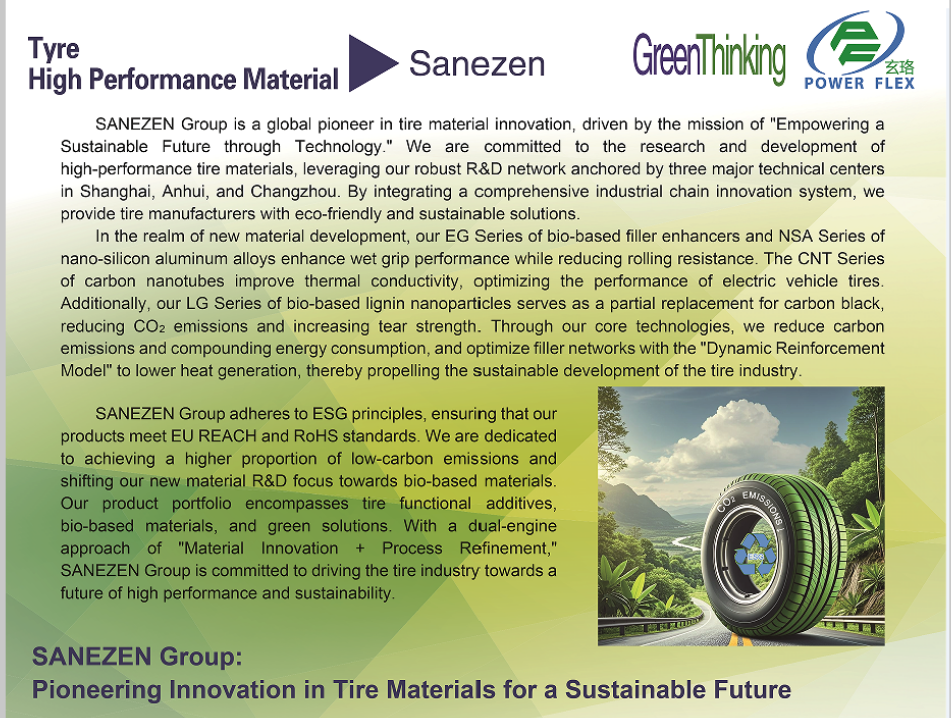
SANEZEN Group is a global pioneer in tire material innovation, driven by the mission of “Empowering a Sustainable Future through Technology.” Our R&D efforts are anchored by a robust network of technical centers in Shanghai, Anhui, and Changzhou. We are dedicated to developing solutions that align with global ESG principles, ensuring our products meet stringent international standards like EU REACH and RoHS.
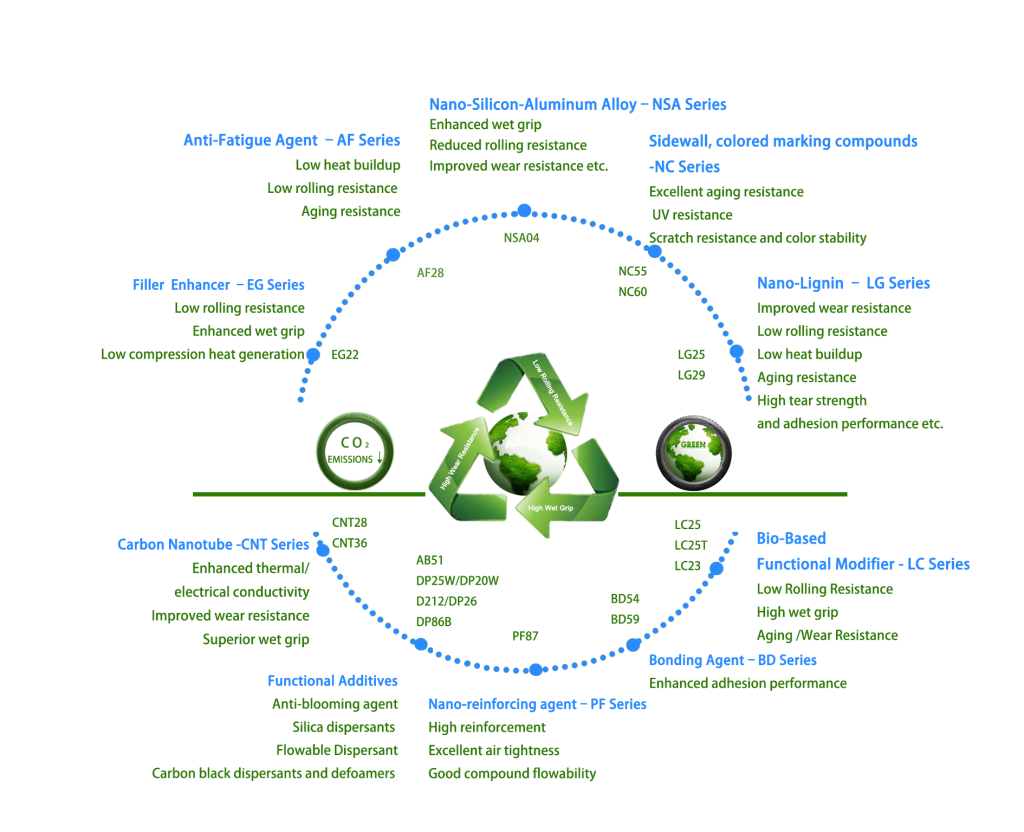
Our focus is strategically shifting towards bio-based materials and technologies that reduce CO₂ emissions and compounding energy consumption. Our core technologies, including the “Dynamic Reinforcement Model” leveraged by AF28, are designed to optimize filler networks and lower heat generation. This commitment is evident across our portfolio, from bio-based filler enhancers and nano-silicon aluminum alloys for wet grip to carbon nanotubes for EV tire performance and bio-based lignin as a sustainable alternative to carbon black.
We understand that our success is measured by the value we create for our customers. As a reliable rubber raw material supplier for tire industry, we strive to be more than just a vendor. Through our dual-engine approach of “Material Innovation + Process Refinement,” SANEZEN Group is committed to being your strategic partner for sustainable tire manufacturing. We provide more than just products; we provide comprehensive, eco-friendly, and sustainable solutions that help you build better, safer, and more efficient tires for a demanding world. We are dedicated to continuous innovation, working tirelessly to ensure that our partnership delivers a competitive edge and drives the entire tire industry toward a high-performance, sustainable future.
 English
  Español
  Русский