
What this page answers
There are two ways to reduce hysteresis in a natural rubber compound, and most suppliers describe only one of them. You can change the filler, which is the silane route and works on the filler surface. Or you can change the polymer, which is what a rubber chain end modification additive does, and it works on the free ends of the rubber molecules.
The second route is the subject of this page. It covers a family of anti fatigue agent for natural rubber products built on a diacylhydrazide chemistry, and it reports what two of them measured in their intended applications: one at 1 phr in an NR and carbon black tread, where the loss factor at 60 C fell 18.4 percent, and one at 1.2 phr in a damping compound, where the dynamic to static stiffness ratio fell from 1.46 to 1.34.
It also sets out why the two grades exist separately, because a formulator who uses the tread grade in a mount, or the mount grade in a tread, will get a result that looks like the additive does not work.
The problem: free chain ends, not filler network
Natural rubber is a polymer with two ends. One end carries the alpha terminal group, a protein and phospholipid structure that is part of how the tree builds the molecule. The other end is the omega terminal, and it is chemically simpler.
Those ends do not participate in the sulphur network. In a vulcanised compound they remain free, and a free chain end cannot carry load. When the part is deformed, the free end slides, relaxes and dissipates energy instead of storing it. That is hysteresis, and at 60 C it is what a tire engineer measures as rolling resistance.
The standard answer in a silica compound is a silane, which couples the filler surface to the polymer and reduces the filler network contribution. In a carbon black compound there is no equivalent, because carbon black has no silanol to react with. The carbon black coupling agent for rubber has to work from the other side: it attaches to the functional groups that already exist on the black surface, and to the functional groups at the end of the NR chain.
That is the difference between the two routes, and it explains why a rubber additive to reduce rolling resistance based on chain end chemistry is not interchangeable with a silane, and why the two can be used together.
What the chemistry does
The active ingredient is a highly dispersible, superfine diacylhydrazide compound with hydrazide and hydroxyl functional groups. It works through a nucleophilic addition followed by dehydration.
On the rubber side, the hydrazide reacts with the aldehyde and carbonyl groups at the chain ends. That is a chemical modification of the polymer rather than a physical interaction, and it converts a free end into an anchored one.
On the filler side, the same molecule combines with the carboxyl, carbonyl and lactone groups that exist at the edges of the carbon black crystallites. Those groups are a minority of the surface, which is why the dosage is low: this is not a coating, it is a bridge.
| Where the molecule acts | What it reacts with | What changes |
| NR chain end, alpha terminal | Aldehyde and carbonyl groups on the protein and lipid structure | Free chain ends are anchored, so they stop sliding |
| NR chain end, omega terminal | Carbonyl groups on the 98 percent cis-1,4 end | The same anchoring at the other end |
| Carbon black surface | Carboxyl, carbonyl and lactone groups at crystallite edges | Filler and polymer are linked, and the black disperses more evenly |
| Cure system | Sulphur and accelerator chemistry | Cure accelerates, which is a side effect rather than a goal |
A diacylhydrazide coupling agent rubber additive therefore changes three things at once: the number of free ends, the rubber to filler bond, and the cure kinetics. Only the first two are the reason to buy it.
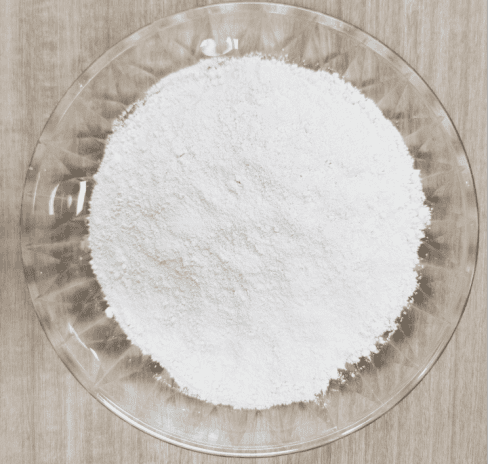
Figure 1. The anti-fatigue agent as supplied, a white powder dosed at 1 to 1.6 phr in the tread application.
The tread case: 1 phr in an NR and carbon black compound
This is the compound a truck tire tread is built on: 100 phr of natural rubber and 47 phr of N234, with no silica at all. It is the case a tire tread additive for truck tire has to win, because a truck tread is all carbon black and there is no silane route available.
| Material, phr | Blank | With AF28 |
| Natural rubber | 100 | 100 |
| Carbon black N234 | 47 | 47 |
| Zinc oxide | 3 | 3 |
| Stearic acid | 3 | 3 |
| Wax | 1 | 1 |
| Antioxidant 4020 | 1.2 | 1.2 |
| Antioxidant RD | 1 | 1 |
| Sulphur | 1.5 | 1.5 |
| Accelerator NS | 1.1 | 1.1 |
| Anti-fatigue agent AF28 | – | 1 |
| Total | 158.8 | 159.8 |
| Property | Blank | With 1 phr | Change |
| ML, dN.m | 1.92 | 2.56 | +33 percent |
| MH, dN.m | 18.10 | 17.01 | -6.0 percent |
| TS2, min | 3.92 | 3.35 | -14.5 percent |
| T10, min | 3.66 | 3.26 | -10.9 percent |
| T50, min | 4.91 | 3.88 | -21.0 percent |
| T90, min | 10.21 | 7.21 | -29.4 percent |
The cure result is the first thing a factory notices: T90 falls from 10.21 to 7.21 minutes, a 29 percent shorter cycle, with TS2 also shorter. Why does cure time shorten when adding a hydrazide has a simple answer, which is that the hydrazide participates in the sulphur chemistry as well as in the coupling reaction. It is a real effect and it is worth having, but it also means the compound has to be re-verified rather than assumed, because a shorter TS2 changes the safety window on a hot line.
The Mooney viscosity rises, from 62 to 75, which is the one result on this page that runs against expectation. Why does Mooney viscosity rise when adding an anti fatigue agent is a fair question, and the answer is that the reaction between chain ends and filler groups builds a bound network before cure. The compound is stiffer in the mixer and faster to cure, which is a combination that has to be managed in the mixing cycle rather than in the recipe.
What it does to the properties that matter
| Property | Blank | With 1 phr | Change |
| Hardness, Shore A | 65 | 66 | +1 point |
| Modulus at 100 percent, MPa | 2.9 | 3.0 | +3.4 percent |
| Modulus at 300 percent, MPa | 14.8 | 15.5 | +4.7 percent |
| Tensile strength, MPa | 33.3 | 32.9 | -1.2 percent |
| Elongation at break, percent | 551 | 529 | -4.0 percent |
| Tear strength, kN/m | 95 | 94 | -1.1 percent |
| Rebound resilience, percent | 43 | 49 | +6 points |
| Lambourn abrasion volume, cm3 | 0.141 | 0.143 | +1.4 percent |
The vulcanisate is one point harder, 5 percent stiffer in modulus and 1 percent lower in tensile strength, which is close to no change in the properties a specification normally fixes. The changes that are large enough to matter are the two at the bottom.
Rebound resilience rises 6 points, from 43 to 49 percent. A rubber additive to improve rebound resilience normally has to work against the modulus, and the useful question is whether it can do both. How to improve rebound resilience of a damping compound is normally answered by reducing filler or changing the cure, and here it happened at a higher modulus, which is only possible if the network is dissipating less energy per cycle. That is the same physics as the hysteresis result that follows.
Abrasion volume rises 1.4 percent, from 0.141 to 0.143 cm3. That is a small loss of wear resistance and it is reported as a loss rather than as no change. It is consistent with a slightly stiffer, less dissipative compound, and on a truck tread it is a trade against the rolling resistance gain rather than a separate result.
The dynamic result, and the trade nobody mentions
| DMA property, 10 Hz, 0.25 percent strain | Blank | With 1 phr | Change |
| E’ at 0 C, MPa | 22.01 | 17.67 | -19.7 percent |
| E’ at 60 C, MPa | 12.45 | 10.57 | -15.1 percent |
| tan delta at 0 C | 0.129 | 0.126 | -2.3 percent |
| tan delta at 60 C | 0.098 | 0.080 | -18.4 percent |
| tan delta at 60 C, indexed | 100 | 81.6 | -18.4 percent |
The 18.4 percent reduction in the loss factor at 60 C is the headline, and it is a large effect for 1 phr. In tread terms, rolling resistance tracks this number directly.
The line above it is the one that rarely appears in a supplier’s presentation. The loss factor at 0 C fell 2.3 percent, which means the wet grip indicator moved in the wrong direction. Why does wet grip fall when rolling resistance improves is not a mystery and not a defect: both ends of the loss factor curve are driven by the same dissipation mechanisms, and a change that reduces the movement of free chain ends reduces the friction available on a wet road as well.
The magnitude matters. A 2.3 percent loss at 0 C against an 18.4 percent gain at 60 C is a good trade for a truck tire, where fuel and casing life dominate. It is a poor trade for a passenger tire where wet braking is a regulated label value, and for that application the additive should be combined with a grip measure rather than used alone.
The storage modulus also falls, by 15 to 20 percent across the temperature range. A softer compound at equal hardness is unusual, and it is consistent with the load being carried by fewer, better anchored chains rather than by a dense network.
Heat build-up, on both loading modes
| Test | Blank | With 1 phr | Change |
| Constant load, centre temperature, C | 82.2 | 76.1 | -6.1 C |
| Constant load, temperature rise, C | 27.1 | 21.3 | -5.8 C |
| Constant load, creep, percent | 12.8 | 12.6 | -0.2 points |
| Constant strain, centre temperature, C | 80.4 | 77.2 | -3.2 C |
| Constant strain, temperature rise, C | 25.7 | 22.2 | -3.5 C |
| Constant strain, creep, percent | 11.9 | 11.5 | -0.4 points |
As an NR carbon black heat build up additive, the honest test is to measure both loading modes, and that is what this trial did. One of the values of this data set is that heat build-up was measured both ways, at constant load and at constant strain. In a great many additive trials the two modes disagree, because a change in hardness moves the deflection under a fixed load and not under a fixed stroke. Here both improve, by 21 percent and 14 percent respectively, which is what a genuine reduction in hysteresis should look like rather than a hardness artefact.
Creep falls slightly in both tests. A part that creeps less holds its position, which in a truck tire matters for the casing and in a mount matters for the alignment.
How to reduce compression heat build up in a truck tire therefore has two answers that work together: reduce the dissipation per cycle, which this additive does, and avoid the geometry that concentrates strain, which no additive can fix.
The damping case: 1.2 phr in a mount compound
The second grade is tuned for dynamic rubber goods rather than for treads, and the trial below is a shock absorbing compound with 35 phr of carbon black split between N330 and N774. This is the profile of a rubber additive for engine mount compound: a natural rubber base, a mid-range black loading, and a specification written on stiffness and isolation rather than on strength.
| Property | Blank | With 1.2 phr AF27 |
| Static stiffness Ks | 156 | 153 |
| Dynamic stiffness Kd | 107 | 114 |
| Ratio as stated in the source | 1.46 | 1.34 |
| Ratio change | – | -8.2 percent |
A dynamic to static stiffness ratio additive is judged on the ratio rather than on the two stiffness values separately, and the ratio falls 8.2 percent, which is the number a chassis engineer wants to see, because it describes how much stiffer the part behaves when it is being excited than when it is loaded slowly.
There is a definition problem in the source that should be resolved before this figure is quoted. The stated ratio of 1.46 equals 156 divided by 107, which is static over dynamic. The convention in most mount specifications is the inverse, dynamic over static, and on these numbers that would be 0.69 and 0.75. Either the labels are transposed or the test conditions differ from the convention, and a customer comparing this result with their own specification will notice. The direction of the improvement is unambiguous; the definition needs one line of confirmation.
What the numbers also show is the mechanism. Static stiffness fell 1.9 percent while dynamic stiffness rose 6.5 percent. A part that is slightly softer under slow load and slightly stiffer under vibration is exactly what a rubber additive for damping compound is bought to do, and it is the opposite of what adding filler would achieve.
How to lower the dynamic to static stiffness ratio with a filler is essentially impossible, because filler raises both. With a chain end chemistry it is achievable, because the chemistry acts on the relaxation spectrum rather than on the modulus.
Why the two grades are not interchangeable
Both grades are built on the same chemistry and both are dosed at about 1 to 1.5 phr, so the temptation to treat them as one product is understandable. The difference is in the balance of the two ends of the molecule.
Both grades are also sold as an anti reversion agent for NR compound, because the same coupling reaction protects the polysulphide bridges from thermal degradation, and that second use is what the heat ageing numbers later in this page come from. The tread grade is tuned so that the 60 C loss factor moves as far as possible while elasticity rises, and it accepts a small loss at 0 C and a small loss in abrasion. The damping grade is tuned for the stiffness ratio and for rebound, and its dosage range runs slightly higher, 1 to 1.8 phr against 1 to 1.6 phr.
| AF28, tread | AF27, damping | |
| Intended compound | NR with carbon black, tread | NR based damping and dynamic goods |
| Dosage range, phr | 1.0 to 1.6 | 1.0 to 1.8 |
| Primary claim | Rolling resistance, heat build-up | Stiffness ratio, rebound |
| Secondary claim | Heat ageing, anti-reversion | Heat ageing, anti-reversion |
| Measured here | tan delta at 60 C, -18.4 percent | Stiffness ratio, -8.2 percent |
| Addition point | First stage, with the NR | First stage, with the NR |
Difference between AF27 and AF28 anti fatigue agent is therefore a question of which property the compound is judged on, not which chemistry is stronger. A formulator who puts the tread grade in a mount will see rebound improve and the stiffness ratio move less than expected, and will conclude the product is weak. The reverse swap produces the mirror image.
Both are anti fatigue agent supplier China products in the same family, and both are supplied as a fine powder that has to be added in the first mixing stage with the natural rubber. That last point is not a preference. The reaction needs the chain ends and the filler surface to be available while the compound is being built, and an additive added with the sulphur in the final stage has missed the window.
Dosage, addition and the mixing consequence
| Item | Recommendation |
| Dosage, tread grade | 1.0 to 1.6 phr on 100 phr of rubber |
| Dosage, damping grade | 1.0 to 1.8 phr |
| Base polymer | Natural rubber, or compounds where NR is the primary rubber |
| Addition point | First mixing stage, with the rubber |
| Effect on Mooney | Rises, 62 to 75 in the tread trial |
| Effect on cure | T90 falls 29 percent; re-verify the cycle |
| Effect on hardness | Plus 1 point at 1 phr |
Anti fatigue agent dosage in NR compound should start at 1 phr rather than at the top of the range, because two of the side effects grow with dosage: the Mooney rise and the cure acceleration. At 1 phr the cure is already 29 percent faster, and at the top of the range it will be faster still, which on a thick part means a scorch risk and on a thin part means a cycle that no longer matches the press.
The NR-only restriction is real and worth stating plainly. The chemistry targets the terminal groups of natural rubber, and a compound based on SBR or BR does not have them in the same form. An anti fatigue agent for natural rubber used in an all-synthetic compound will still accelerate the cure, because the hydrazide reacts with sulphur, and it will not deliver the hysteresis benefit. That combination is the worst outcome: a change in the cure with no gain in the property.
How to add an anti fatigue agent in a first stage mix is a sequence question. Add it with the rubber at the start, before the filler, so that it is dispersed in the polymer phase and can meet the filler surface as the black is incorporated. Added after the filler, it still reacts, but with less chance of reaching the chain ends that are already bound to the black.
What this route can and cannot do
It can reduce the loss factor at 60 C by a fifth at 1 phr, raise rebound by 6 points, and cut heat build-up in both loading modes. In a carbon black compound it does something a silane cannot, because there is no silanol to work with.
It cannot replace a silane in a silica compound, and the two work better together than as alternatives. How to compare an anti fatigue agent with a silane coupling agent comes down to which interface is limiting: the silane fixes the filler side, this chemistry fixes the polymer side.
It cannot improve wet grip at the same time, and the data here says the opposite. A customer who needs both should expect to recover the loss at 0 C with another measure, such as a resin or a different oil.
And it cannot be used outside natural rubber. That single restriction removes a large part of the market, and stating it on the first page of a quotation saves a trial that cannot work.
FAQ
How to reduce rolling resistance in a carbon black tread
Reduce the number of free chain ends that can slide, because in a black-filled compound the filler network is not the sole source of hysteresis. A diacylhydrazide at 1 phr cut the loss factor at 60 C from 0.098 to 0.080, an 18.4 percent reduction, while rebound rose from 43 to 49 percent. There is no silane route in this compound, which is why the polymer route is the one available.
Why do free chain ends increase hysteresis in natural rubber
Because a chain end cannot carry load. Under deformation it slides and relaxes instead of storing energy, and the energy it releases becomes heat. Natural rubber has two terminal groups per molecule and neither participates in the sulphur network, so the fraction of free ends is fixed by the polymer unless something anchors them.
Difference between AF27 and AF28 anti fatigue agent
They share a chemistry and differ in balance. The tread grade moves the 60 C loss factor and elasticity, and measured an 18.4 percent reduction in tan delta at 60 C at 1 phr. The damping grade moves the stiffness ratio and rebound, and measured a fall from 1.46 to 1.34 at 1.2 phr. Use the tread grade where fuel matters and the damping grade where isolation matters.
How much anti fatigue agent to add to a natural rubber compound
Start at 1 phr. The recommended ranges are 1.0 to 1.6 phr for the tread grade and 1.0 to 1.8 phr for the damping grade, and at 1 phr the side effects are already visible: Mooney viscosity rose from 62 to 75 and T90 fell 29 percent. Higher dosage increases both, and neither is usually wanted.
How to lower the dynamic to static stiffness ratio
Change the relaxation behaviour rather than the modulus. Adding filler raises both stiffness values and moves the ratio little. In the damping trial here, 1.2 phr of the additive lowered static stiffness 1.9 percent and raised dynamic stiffness 6.5 percent, and the ratio moved 8.2 percent. Confirm which ratio your specification uses before quoting the result.
Why does Mooney viscosity rise when adding an anti fatigue agent
Because the coupling reaction starts during mixing, not in the press. Chain ends and carbon black surface groups become linked while the compound is still hot, which builds a bound network and shows up as higher viscosity. The advantage is a faster cure; the cost is a stiffer batch, so the mixing cycle rather than the recipe is where this is managed.
How to improve heat aging of a natural rubber compound
Anchor the network so that fewer chains are free to oxidise at their ends, and keep the polysulphide bridges from degrading. In this trial, tensile strength after 48 hours at 100 C rose from 25.4 to 26.9 MPa while the blank’s fell, and elongation retention improved from 79.5 to 86.2 percent. Both changes point at a network that held together rather than one that was merely stiffer.
What is a carbon black coupling agent
A molecule with one end that reacts with the functional groups on the carbon black surface, carboxyl, carbonyl and lactone at the crystallite edges, and another end that reacts with the polymer. It is the black-filled equivalent of a silane, which does the same job on a silica surface and has no effect on carbon black.
How to reduce compression heat build up in a truck tire
Reduce dissipation per cycle and keep the geometry from concentrating strain. Heat build-up measured at constant load fell from 27.1 to 21.3 C and at constant strain from 25.7 to 22.2 C, with 1 phr of the additive. Both modes improving is the sign of a real hysteresis reduction rather than a hardness effect.
Why does cure time shorten when adding a hydrazide
Because the hydrazide is not inert towards sulphur chemistry. It participates in the crosslinking reactions as well as in the coupling, so T90 fell from 10.21 to 7.21 minutes and TS2 from 3.92 to 3.35. Treat the cure as changed and re-verify it; a 29 percent shorter cycle on an existing press setting will over-cure something else in the plant.
How to improve rebound resilience of a damping compound
Reduce the energy dissipated per cycle without reducing modulus. Rebound rose from 43 to 49 percent here at a modulus that also rose slightly, which is only possible if the network is losing less energy. Reducing filler would raise rebound but lower modulus, which is a different trade.
How to test rolling resistance with DMA
Run a temperature sweep at a defined frequency and strain and read tan delta at 60 C. Ours used 10 Hz, 5 percent preload and 0.25 percent dynamic amplitude from -80 to 100 C at 3 C per minute. The value is only comparable at the same conditions, because the loss factor of a filled compound is strain dependent.
Why does wet grip fall when rolling resistance improves
Because both ends of the loss factor curve respond to the same dissipation mechanisms. Reducing the movement of free chain ends cut tan delta at 60 C by 18.4 percent and at 0 C by 2.3 percent in the same compound. The trade is favourable for a truck tire and needs to be watched for a passenger tire with a labelled wet grip value.
How to add an anti fatigue agent in a first stage mix
Add it with the natural rubber at the start of the first stage, before the filler. The reaction needs the chain ends and the black surface to be available while the compound is being built. Added in the final stage with the sulphur it will still react with the cure system, which gives you the side effect without the benefit.
How to compare an anti fatigue agent with a silane coupling agent
Ask which interface is limiting. A silane works on the silica surface and needs silanol groups; this chemistry works on the polymer chain ends and the carbon black surface. In a compound with both fillers they are complementary, and the useful trial is both together against each alone rather than one against the other.
Why Choose Us
Choosing a functional filler supplier is not only about purchasing a mineral powder. It is about selecting a technical partner that understands polymer compounding, physical failure mechanisms, and long-term product performance. As a leading specialty functional filler and performance additives manufacturer, we bring decades of compounding expertise to every customer collaboration.
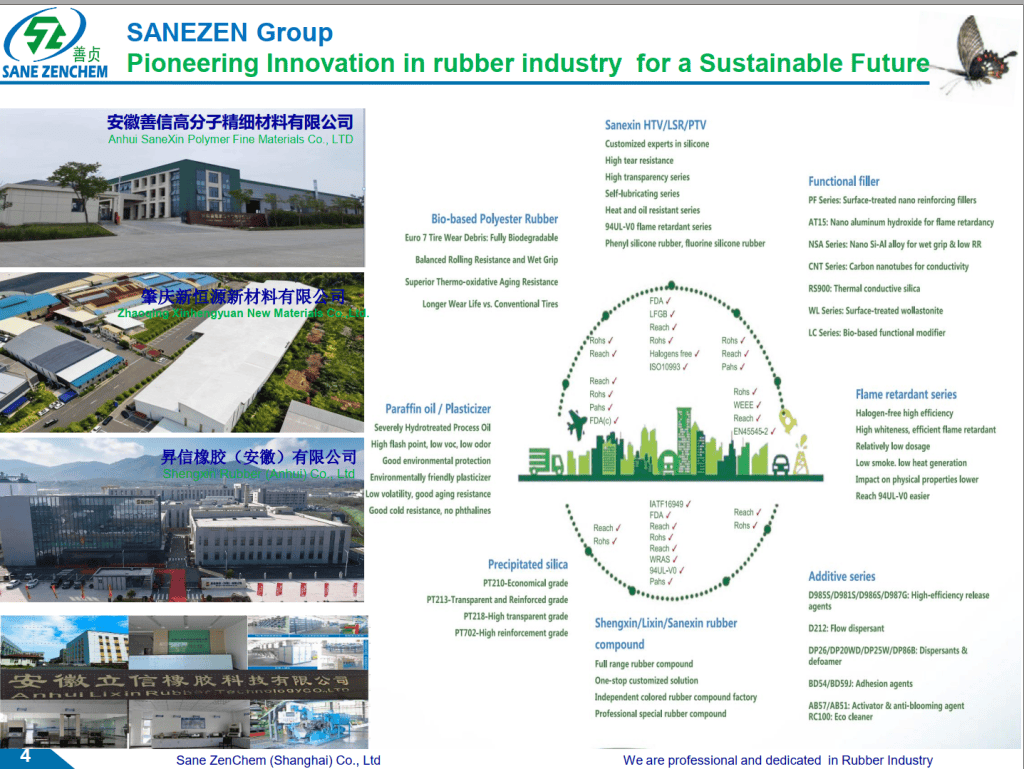
SaneZenChem operates five manufacturing facilities specialising in:
• Rubber Compounds
• Silicone Rubber Compounds
• Specialty Functional Fillers
• Flame Retardants
• Polymer Performance Additives
Because we formulate and manufacture rubber and silicone compounds ourselves, every specialty product we develop originates from solving real production challenges rather than laboratory concepts alone. This application-driven approach allows us to deliver practical solutions that create measurable improvements in customer products – from eliminating processing viscosity spikes and preventing micro cracking, to ensuring high dielectric strength in harsh electrical environments. Our unique dual position as both a direct compounder and a premier specialty functional filler manufacturer means we are uniquely equipped to support rubber, epoxy, and electrical insulation manufacturers in achieving longer service life, processing efficiency, and ultimate reliability.

Contact
Plant Address:
Baishou Road, North District of Xuan Zhou Economic Development Zone
Xuan Cheng City, Anhui Province, China
Commercial Address:
Room 503, Building 1, Huixin International Edifice, No. 150 Puhuitang Road, Xuhui District, Shanghai, China 200030
Tel: +86 136 7164 1995
Email: yorichen@sanezen.com Website: www.sanezenrubber.com
 English
 Spanish
 Russian