
What this page answers
A silica tread compound has two problems that pull in opposite directions. Silica needs a coupling reaction to become reinforcing, and that reaction is slow, moisture sensitive and never quite complete. The filler that does not react stays as a network, and that network is hysteresis. You pay for it at the fuel pump.
This page reports a full trial of a bio based filler reinforcement agent added at 4 phr to an SSBR and BR tread compound with 80 phr of silica. It covers Mooney viscosity, the complete cure curve, physical properties before and after ageing, Lamborn abrasion, heat build-up at constant stress and at constant strain, and the DMA loss factors at 0 and 60 C. It also reports the two places where the additive made a measured value worse, and one inconsistency in the source data that should be resolved before any of it is quoted to a customer.
Why silica is the difficult filler
Carbon black reinforces by physical contact. Silica reinforces only after its surface silanol groups have reacted with a silane, and the silane has then bonded to the polymer. That two step reaction is what the industry calls silanization, and it is the reason a silanization promoter for silica compound is a category of product rather than a mixing instruction.
When the reaction is incomplete, three things follow. The unreacted silanol groups hydrogen bond to each other and build a filler network, which shows up as a high Payne effect, meaning the storage modulus falls steeply as strain amplitude rises. That network breaks and reforms under every deformation cycle, and each cycle dissipates energy as heat. The second consequence is viscosity: a filler network raises Mooney viscosity and makes the compound harder to mix, extrude and calender. The third is that the silanol surface absorbs cure accelerators, so a compound with poorly coated silica cures slowly and unpredictably.
The usual answers are more silane, more mixing time, or a higher mixing temperature. All three cost money, and all three have limits. More silane beyond the stoichiometric ratio produces free sulphur and changes cure. More mixing time consumes capacity. Higher temperature drives the reaction but also drives premature scorch and, in some compounds, re-agglomeration when the batch cools.
What this material is, and what it is not
The product discussed here is a purely bio-based granule, positioned as a filler dispersion additive for rubber that promotes the silanization reaction in high surface area filler systems. It is added at 4 to 8 phr in the first mixing stage. Because the carbon it carries is biogenic rather than fossil, it also counts toward the bio-based content of the compound, which is the part of the story that matters to a sustainable rubber additive manufacturer conversation and to any customer reporting scope 3 emissions.
It is not a silane. In the trial below, the silane dosage was held constant at 6.4 phr against 80 phr of silica, and the additive was added on top. That means the results show what an extra 4 phr of this material does when the coupling system is untouched. It does not show what happens if you reduce the silane, and the claim that it can work as a silica coupling agent alternative is therefore not tested here. That distinction matters, because a customer who reduces silane and adds this material is running a different experiment from the one reported.
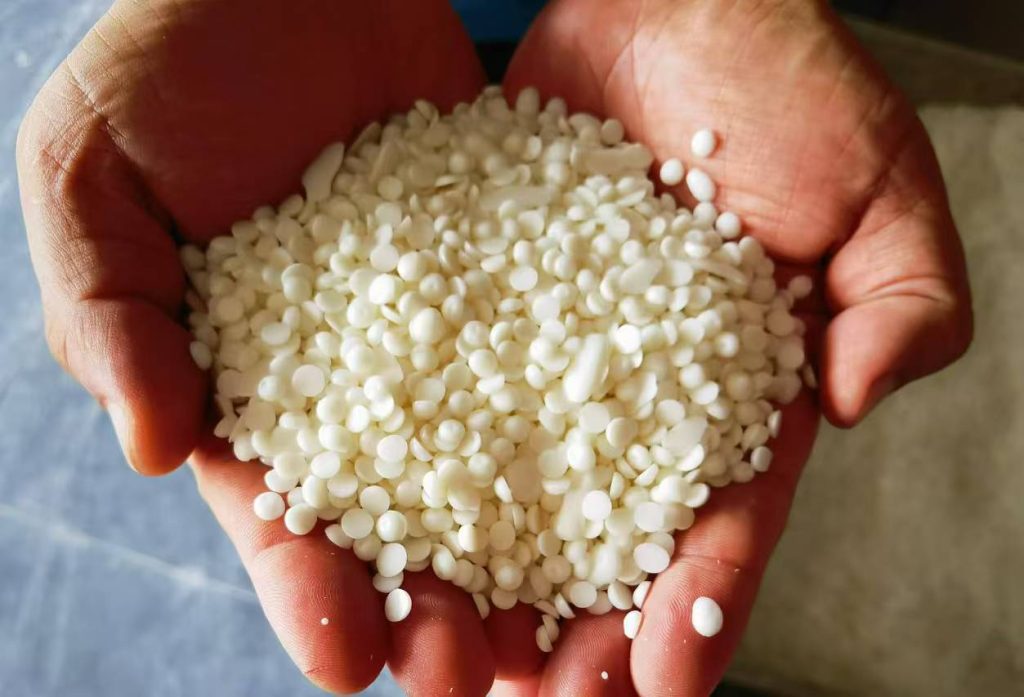
Figure 1. The bio-based filler reinforcement agent as supplied, a white granule added at 4 to 8 phr in the first mixing stage.
The compound, and the conditions
The reference is a passenger car tread compound built on solution polymerised SSBR with butadiene rubber, 80 phr of silica and a conventional silane, with an RAE process oil.
| Material, phr | Blank | With EG22 |
| SSBR SOL-6270M | 96 | 96 |
| Butadiene rubber BR9000 | 30 | 30 |
| Silica PT702 | 80 | 80 |
| Carbon black N330 | 6.4 | 6.4 |
| Silane SI-69 | 6.4 | 6.4 |
| Bio-based filler reinforcement agent EG22 | – | 4 |
| Zinc oxide | 3 | 3 |
| Stearic acid | 2 | 2 |
| RAE process oil P50S | 10 | 10 |
| Microcrystalline wax | 1 | 1 |
| Antioxidant 4020 | 1.5 | 1.5 |
| Sulphur | 1.5 | 1.5 |
| Accelerator CZ | 1.5 | 1.5 |
| Accelerator DPG | 2 | 2 |
| Total | 241.3 | 245.3 |
Cure characteristics were measured at 160 C. Physical properties were taken on slabs cured at 160 C for 30 minutes. Ageing was 48 hours at 100 C in hot air. The heat build-up test used a separate cure at 150 C for 30 minutes, which is a different condition and is noted again when those results are discussed.
Viscosity and cure: the two productivity numbers
| Property | Blank | With 4 phr EG22 | Change |
| Mooney viscosity ML(1+4), MU | 62 | 46 | -25.8% |
| Minimum torque ML, dN.m | 2.46 | 1.92 | -22.0% |
| Maximum torque MH, dN.m | 20.01 | 17.63 | -11.9% |
| Scorch TS1, min | 0.62 | 1.85 | +198% |
| Scorch TS2, min | 1.81 | 3.11 | +71.8% |
| T10, min | 1.45 | 2.55 | +75.9% |
| T50, min | 5.67 | 5.03 | -11.3% |
| T90, min | 22.39 | 12.41 | -44.6% |
The Mooney viscosity result is the one that changes a factory. A drop from 62 to 46 MU at the same filler loading means the compound extrudes faster, calenders more evenly and holds a tread profile with less die swell. It also means the mixer can be pushed, because the batch is thinner earlier. For a rubber additive to lower Mooney viscosity, that is the whole argument in one number. It is also why a compound that has been fighting its extruder often gains more from a silica dispersant for tyre tread than from a change in process oil.
The scorch numbers are the second surprise. TS2 moved from 1.81 to 3.11 minutes, which is a 72 percent longer safety window, while T10 moved from 1.45 to 2.55. A compound that is safer before cure and still cures faster afterwards is an unusual combination and it is worth checking on your own rheometer before planning a line rate change.
The T90 figure needs a flag. A halving of cure time from 22.39 to 12.41 minutes is a large claim, and the same table reports a TS5 of 16.89 minutes for the same compound. On a single rheometer curve, a torque rise of 5 dN.m is reached long before 90 percent of the total rise, so TS5 of 16.89 and T90 of 12.41 cannot both come from the same run. Either the TS5 was measured on a different instrument or at a different temperature, or one of the two records needs rechecking. We print both and flag the conflict rather than choosing the more attractive number.
One thing in this table is unambiguous and slightly unwelcome. MH fell from 20.01 to 17.63 dN.m, which is consistent with the lower hardness and lower moduli further down, and it tells you the compound is softer at the same cure. That is a formulation consequence, not a defect, but it has to be compensated if the tread specification has a hardness window.
Physical properties before ageing
| Property | Blank | With 4 phr EG22 | Change |
| Hardness, Shore A | 69 | 67 | -2 points |
| Tensile strength, MPa | 16.6 | 16.4 | -1.2% |
| Elongation at break, percent | 422 | 455 | +7.8% |
| Tear strength, kN/m | 32 | 37 | +15.6% |
| Modulus at 10 percent, MPa | 1.0 | 0.9 | -10.0% |
| Modulus at 30 percent, MPa | 1.3 | 1.3 | unchanged |
| Modulus at 50 percent, MPa | 1.7 | 1.5 | -11.8% |
| Modulus at 100 percent, MPa | 2.9 | 2.8 | -3.4% |
| Modulus at 300 percent, MPa | 11.4 | 10.6 | -7.0% |
Read this as a package rather than as a list. Tensile strength is unchanged within measurement, elongation is up 7.8 percent, tear is up 15.6 percent, and every modulus is slightly lower. That is the signature of a compound that deforms more freely at low strain, which is what a better dispersed filler network produces, and it is also why the hardness fell.
The tear result is worth separating from the rest. As a tear strength improver for silica compound, a 15.6 percent gain at unchanged tensile strength is a real effect, and it is the one that shows up in service as resistance to cutting and chipping rather than in a data sheet comparison. Tear in a silica tread is limited by the filler clusters that act as initiation sites, so a material that reduces clustering should raise tear, and here it did.
After ageing, and the retention that matters
| Property after 48 h at 100 C | Blank | With 4 phr EG22 |
| Hardness, Shore A | 75 | 71 |
| Tensile strength, MPa | 15.6 | 15.5 |
| Elongation at break, percent | 307 | 339 |
| Tear strength, kN/m | 29 | 33 |
| Modulus at 100 percent, MPa | 4.4 | 3.9 |
| Modulus at 300 percent, MPa | 13.2 | 14.1 |
| Retention, aged divided by unaged | Blank | With 4 phr EG22 | Difference |
| Tensile strength, percent | 94.0 | 94.5 | +0.5 points |
| Elongation at break, percent | 72.7 | 74.5 | +1.8 points |
| Tear strength, percent | 90.6 | 89.2 | -1.4 points |
| Hardness change, points | +6 | +4 | 2 points less hardening |
| Modulus at 300 percent, percent | 115.8 | 133.0 | +17.2 points |
Three observations belong here, and the second one is not flattering.
Tensile retention is unchanged at about 94 percent in both compounds, so the additive did not protect tensile strength against oxidative ageing. Anyone selling this material on ageing resistance is overselling it.
Tear retention is 1.4 points lower with the additive, even though the absolute aged tear value is 13.8 percent higher. This is the difference between an absolute and a relative comparison, and it matters when a specification is written as a percentage. If your specification says 90 percent tear retention, the blank compound passes and the modified one does not, while the modified one is still the tougher material in absolute terms. Write the specification against the absolute value, or you will reject the better compound.
The modulus at 300 percent elongation retained 133 percent of its original value against 116 percent for the blank, and hardness hardened 4 points instead of 6. Both say the same thing: the network in the modified compound continued to develop during ageing rather than degrading. That is consistent with a silanization reaction that was still completing, which is a point to raise with the material supplier rather than to assume.
The two dynamic numbers that decide a tread
Rolling resistance and wet grip are read from the loss factor at two temperatures. Around 60 C the loss factor tracks rolling resistance, and lower is better. Around 0 C it tracks wet grip, and higher is better. A tread compound is normally a compromise between them.
| Dynamic property | Blank | With 4 phr EG22 | Change |
| tan delta at 0 C | 0.282 | 0.312 | +10.6% |
| tan delta at 60 C | 0.138 | 0.121 | -12.3% |
Both moved in the direction the tyre industry wants. Wet grip improved by 10.6 percent and rolling resistance fell by 12.3 percent, on the same compound, at the same cure, with no other change. The mechanism that explains it is the dispersion state rather than the chemistry: a filler network that is less connected dissipates less energy at 60 C, while a larger fraction of polymer immobilised at the filler surface raises the loss factor at 0 C. Better dispersion improves both ends of the curve at once, which is why a rubber additive to reduce rolling resistance can also work as a wet grip additive for tyre tread. That combination is what a low rolling resistance tread compound additive is normally asked to deliver, and on this data it was delivered without changing the polymer or the silane.
Two figures from our own presentation do not match these values. The presentation states an 11 percent wet grip improvement and a 14 percent rolling resistance reduction. The wet grip figure matches the measured loss factors. The rolling resistance figure does not: 0.138 falling to 0.121 is 12.3 percent, not 14. Both numbers describe an improvement, and the difference should be resolved against the original DMA file before either is published.
The DMA conditions were 10 Hz, 5 percent preload, 0.25 percent dynamic strain, from -80 C to 100 C at 3 C per minute. Those conditions should be quoted with the result, because the loss factor at 60 C moves with strain amplitude and a comparison made at a different strain is not comparable.
Heat build-up: two tests, two directions
This is the part of the data set that a supplier would rather leave out, and it is the part that decides whether the compound works in a real tyre.
| Test | Condition | Blank | With 4 phr EG22 | Change |
| Compression heat build-up, constant stress | 700 N, 10 Hz, from 55 C | 23.8 C rise | 29.3 C rise | +5.5 C, worse |
| Compression heat build-up, constant strain | 3.0 mm, 10 Hz, from 55 C | 28.8 C rise | 26.4 C rise | -2.4 C, better |
The two tests disagree, and the reason is hardness. Under a fixed load, a softer compound deflects further, does more work per cycle and gets hotter. Under a fixed deflection, the same softer compound stores and returns the deformation more efficiently and gets cooler. Both results are real. Which one predicts your part depends on whether the part is load controlled or deflection controlled, which for a tyre tread means it depends on the load case.
So the honest reading is this. A green tyre tread compound additive that lowers hardness by 2 points will look worse in a constant stress test unless something else compensates. The note attached to this data in the source says the process oil can be reduced to bring the heat build-up back, which is the right correction: the additive softened the compound, so take some plasticiser out and restore the modulus. That adjustment was not made in this trial and is the next experiment worth running.
Abrasion, and the cost side of the ledger
| Property | Blank | With 4 phr EG22 | Change |
| Lamborn abrasion, volume loss, cm3 | 0.138 | 0.142 | +2.9% |
A 2.9 percent higher volume loss is a small loss of abrasion resistance, and it should be reported as a loss rather than as no effect. It is consistent with the 2 point drop in hardness and the lower moduli: a softer compound abrades slightly faster in a laboratory test. If the process oil is reduced to restore hardness, this number should improve at the same time, and that is the second reason to run the trial again with the oil adjusted.
Set against it, the tread compound gained 15.6 percent in tear strength, 7.8 percent in elongation, 10.6 percent in wet grip and 12.3 percent in rolling resistance, and the factory gained 25.8 percent in Mooney viscosity. That is a favourable trade for a passenger car tread, provided the hardness and the heat build-up are brought back into specification.
Where this works, and where it needs care
| Situation | What the data supports | What to watch |
| PCR tread with 70 to 90 phr silica and a fixed silane level | Rolling resistance and wet grip both improve | Hardness and heat build-up under constant load |
| Compound that is viscosity limited at the extruder | Mooney viscosity falls sharply | Die swell changes, so re-set the profile |
| Mixing capacity limited plant | Cure and mixing both faster in the data | Confirm the T90 record before changing line rate |
| Compound with a hardness floor in the specification | Not directly supported | Reduce process oil to compensate |
| Compound where silane is being reduced for cost | Not tested here | Reducing silane and adding this material is a new experiment |
| Highly filled compound above 90 phr silica | Not tested here | Dispersion gains may be smaller once the surface is already covered |
The fourth and fifth rows are the ones that cause disputes. A customer who buys this material to cut silane cost is buying a different benefit from the one measured, and a customer who fits it into a compound with a hardness window will see the specification move. Both are solvable. Neither is solved by increasing the dosage.
How much to add
| Item | Recommendation |
| Dosage, general | 4 to 8 phr on 100 parts of rubber |
| Dosage used in this trial | 4 phr |
| Addition point | First mixing stage |
| Packaging | 25 kg per bag |
| Storage | Sealed, dry, around 25 C |
| Shelf life | About 2 years in the sealed bag |
Our own documents give the range as 4 to 8 phr in the data sheet and 2 to 8 phr in the presentation. The trial used 4 phr, which sits near the bottom of both. Because the mechanism is surface coverage, the response should flatten once the accessible silica surface is covered, and the useful trial is 2, 4 and 6 phr on the same compound rather than a single point at the top of the range.
What this trial did not test
Four things, stated plainly, because each one changes the commercial case.
The silane level was not reduced, so the material was tested as an addition and not as a substitution. A bio based additive to replace part of a silane coupling agent may well work, and this data does not show it.
The Payne effect was measured on an RPA strain sweep at 60 C, and the curves are in the presentation as a figure rather than as a table of numbers. The direction is clear, with the storage modulus gap between low and high strain narrowing, but the delta G values have not been tabulated here. Ask for them if a numerical Payne effect reduction in silica compound claim is needed.
The process oil was not adjusted, so the hardness and constant stress heat build-up results reflect an unoptimised compound. The next trial should reduce oil by an amount that restores hardness to 69 and re-measure everything.
No road test, no rolling resistance drum test and no wet braking test were run. The loss factors are laboratory proxies and they are the right proxies, but they are not a tyre result.
The carbon question
The material is described as purely bio-based, and that is the part of the offer that a bio based rubber additive supplier is usually asked to prove. Two documents settle it: a biobased carbon content figure measured by radiocarbon analysis to ASTM D6866, and a cradle to gate carbon footprint in kg CO2 equivalent per kg of material. The current data sheet states neither, so the claim rests on the raw material description until those figures are supplied.
For a compound, 4 phr of a bio-based material in a 245 phr recipe is 1.6 percent of the mass. That is a small number, and it will not transform a scope 3 inventory. Its value is as one of several substitutions that add up, and the honest framing is that the performance case comes first and the carbon case is a secondary benefit rather than the reason to buy.
FAQ
How to reduce the Payne effect in a silica filled tread compound
Increase the fraction of silica surface that is chemically coated, so that the filler network has fewer silanol to silanol contacts to rebuild. Three routes exist: more silane, longer or hotter mixing, and an additive that promotes the silanization reaction. In the trial here, 4 phr of a bio-based promoter at a fixed silane level narrowed the storage modulus gap in the RPA strain sweep and cut the loss factor at 60 C by 12.3 percent, which is the hysteresis part of the Payne effect expressed as a tyre property.
How to lower rolling resistance without losing wet grip
Reduce the filler network without reducing the polymer to filler interaction, and both ends of the loss factor curve can improve together. In this trial the loss factor fell 12.3 percent at 60 C and rose 10.6 percent at 0 C on the same compound. That combination comes from dispersion, not from a change in the polymer or the silane, which is why it is available at 4 phr rather than through a new SSBR grade.
How to improve silica dispersion when silane dosage is fixed
Add a promoter that works alongside the silane instead of increasing the silane. At a fixed 6.4 phr of silane on 80 phr of silica, the additive here cut Mooney viscosity from 62 to 46 MU and raised tear strength by 15.6 percent, both of which indicate better dispersion. Check the mixer’s dump temperature as well, because a silanization reaction that is starved of temperature will not be rescued by an additive alone.
Bio based additive to replace part of a silane coupling agent
That is a reasonable next trial and it is not what this data shows. Here the silane was held at 6.4 phr and the additive went on top. If you reduce silane, the sulphur donated by the silane falls as well, so the cure system has to be rebalanced at the same time. Run the substitution at 10, 20 and 30 percent silane reduction and measure the loss factors as well as the physical properties.
How to reduce Mooney viscosity in a silica compound
Break the filler network and lubricate the filler-polymer interface rather than adding oil. The measured result here was a fall from 62 to 46 MU, a 25.8 percent reduction, at unchanged filler loading and unchanged oil content. That is a different mechanism from oil extension, which dilutes the compound and costs hardness. The trade is a lower MH and a softer vulcanisate, so hardness has to be checked.
How to improve tear strength of a silica tread compound
Reduce the number of filler clusters that can act as crack initiation sites. Tear rose from 32 to 37 kN/m here, up 15.6 percent, at unchanged tensile strength, which points at the dispersion state rather than at a stronger polymer network. Note that tear retention after ageing was 1.4 points lower even though the absolute value was higher, so write the specification against the absolute number.
How to shorten the mixing cycle of a silica compound
Improve wetting so the filler incorporates faster, and keep the dump temperature high enough for the silanization to finish. The Mooney viscosity drop in this trial indicates the compound thins earlier, which allows a shorter cycle at the same rotor work. Do not shorten the cycle until the dispersion rating has been checked on the shorter cycle, because a compound can look thin and still be badly dispersed.
Why does silica re agglomerate during storage
Because unreacted silanol groups continue to hydrogen bond as the compound cools and rests, and because the silane reaction is not fully complete when the batch leaves the mixer. The practical signs are a Mooney viscosity that rises over the first two weeks and a cure that drifts. A compound with a higher degree of silanization has less unreacted surface, so it re-agglomerates less, which is one reason to measure viscosity at day one and day fourteen rather than only on the day of mixing.
How to reduce the carbon footprint of a tyre compound
Substitute fossil-derived ingredients with biogenic ones and reduce the energy in mixing. A rubber compound additive for PCR tyre that is fully bio-based addresses the first, and the viscosity reduction addresses the second by lowering specific mixing energy. Ask for a biobased carbon content to ASTM D6866 and a cradle to gate footprint in kg CO2 equivalent, because without those two numbers the claim cannot go into a customer’s scope 3 report.
How to improve wet grip and rolling resistance at the same time
Attack dispersion rather than the polymer. The usual trade-off exists because most formulation changes move the whole loss factor curve up or down. A change that reduces filler-filler contact lowers the curve at 60 C and raises the contribution from immobilised polymer at 0 C, so the two move apart in the wanted direction. The measured result here was 0.282 to 0.312 at 0 C and 0.138 to 0.121 at 60 C.
Difference between a silane coupling agent and a bio based promoter
A silane forms a covalent bridge from the silica surface to the polymer and contributes sulphur to the cure. A promoter changes the kinetics and the wetting so that the silane can do its job more completely. They are not interchangeable, which is why the additive in this trial was evaluated at a constant silane level. The practical question is not which one to use but how much of each, and the answer depends on the silica grade and the mixing temperature.
How to check the degree of silanization in a rubber compound
Three practical checks: the Payne effect from an RPA strain sweep, the bound rubber content, and the Mooney viscosity trend over the first two weeks after mixing. A compound that is well silanized shows a smaller storage modulus drop with strain, a higher bound rubber fraction and a flatter viscosity trend. None of the three is a direct measurement of chemical conversion, so use at least two of them together.
How to reduce heat build up in a tyre tread compound
Decide whether the part is load controlled or deflection controlled before choosing a formulation direction. In this trial the heat build-up fell 2.4 C at constant strain and rose 5.5 C at constant stress, on the same compound, because hardness dropped by 2 points. Reducing the process oil to restore hardness is the correction, and it should be verified in both tests rather than in the one that flatters the additive.
How much bio based filler enhancer to add to a tread compound
Start at 4 phr, which is what this trial used, and map 2, 4 and 6 phr on the same compound. Our documents give the working range as 4 to 8 phr, and the response should flatten once the accessible silica surface is covered. Above the plateau you are adding cost and softening the compound without gaining dispersion, which shows up as a further drop in hardness and a further loss in abrasion resistance.
How to keep cure time under control when adding a silica dispersant
Measure it rather than assume it, because the two directions are both possible. Here TS2 lengthened from 1.81 to 3.11 minutes while T90 shortened from 22.39 to 12.41 minutes, and the two cannot be reconciled with the TS5 of 16.89 minutes in the same table. Run a full rheometer curve to plateau with and without the additive at your own cure temperature, and check the TS5 and T90 records against the instrument log before any cycle change.
Why Choose Us
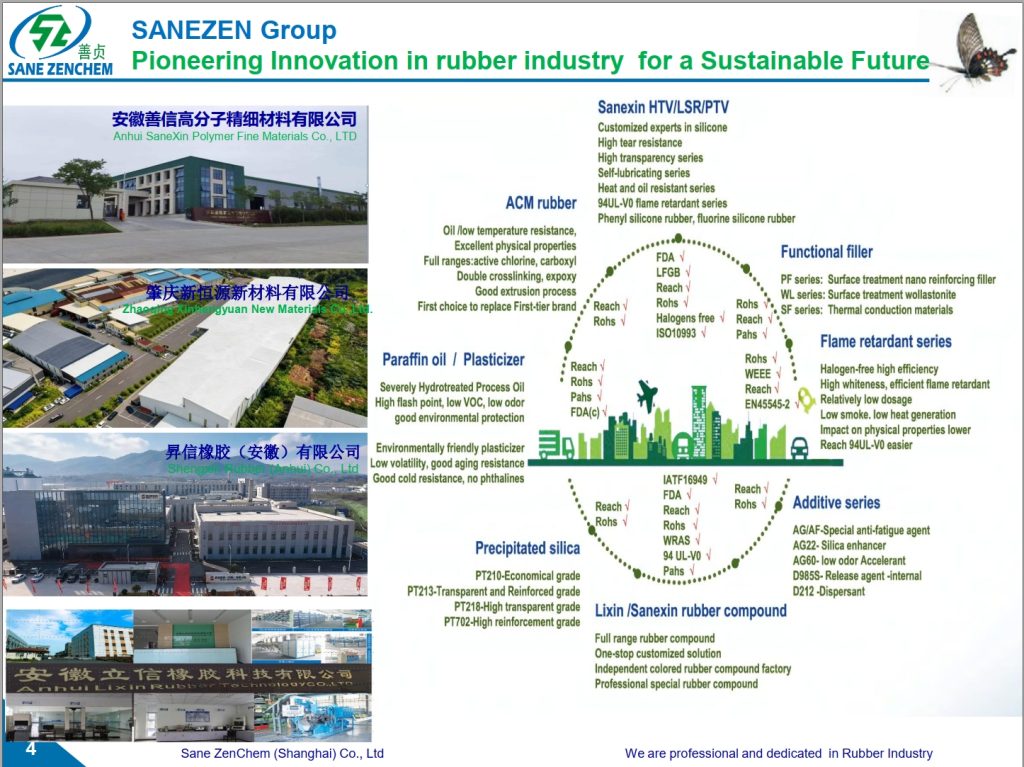
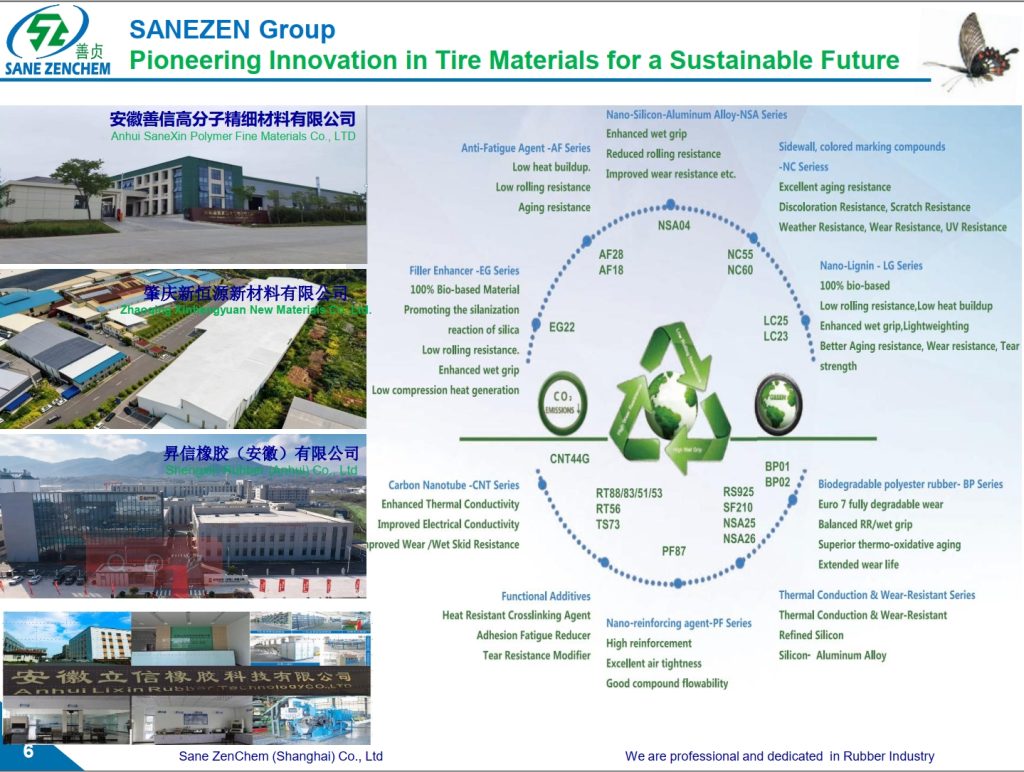
Choosing a functional filler supplier is not only about purchasing a mineral powder. It is about selecting a technical partner that understands polymer compounding, physical failure mechanisms, and long-term product performance. As a leading specialty functional filler and performance additives manufacturer, we bring decades of compounding expertise to every customer collaboration.
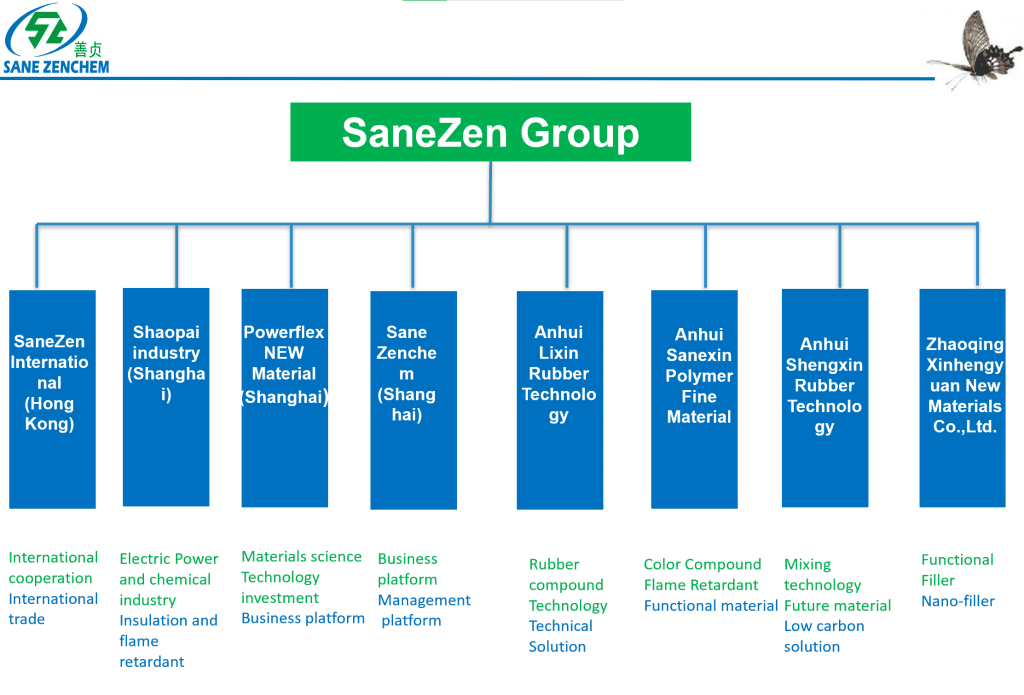
SaneZenChem operates five manufacturing facilities specialising in:
• Rubber Compounds
• Silicone Rubber Compounds
• Specialty Functional Fillers
• Flame Retardants
• Polymer Performance Additives
Because we formulate and manufacture rubber and silicone compounds ourselves, every specialty product we develop originates from solving real production challenges rather than laboratory concepts alone. This application-driven approach allows us to deliver practical solutions that create measurable improvements in customer products – from eliminating processing viscosity spikes and preventing micro cracking, to ensuring high dielectric strength in harsh electrical environments. Our unique dual position as both a direct compounder and a premier specialty functional filler manufacturer means we are uniquely equipped to support rubber, epoxy, and electrical insulation manufacturers in achieving longer service life, processing efficiency, and ultimate reliability.
Contact
Plant address: No. 6, Xinqing Road, North Economic Development Zone, Xuanzhou District, Xuancheng City, Anhui Province, China
Commercial address: Room 1606-1608, Boda Commercial Building, No. 11 Puhuitang Road, Xuhui District, Shanghai, China 200030
Tel: +86 136 7164 1995
Email: yorichen@sanezen.com
Website: www.sanezenrubber.com
The filler reinforcement agent discussed on this page is supplied as GreenThinking EG22 by SaneZenChem, a bio based rubber additive supplier working with tyre and technical rubber producers on silica systems.
 English
 Spanish
 Russian