High-Efficiency Rubber & Plastics Reinforcement and Gas Permeation Barrier Technology
Micro-interface Mechanism, Long-term Service Degradation Behavior, and TCO Evaluation of Nano-scale Dehydroxylated Modified Flake Fillers in Demanding Compound Systems
Target Applications: Tire Inner Liners, Special Extruded Profiles, High-Pressure Hoses, Anti-Vibration Seals, Halogen-Free Flame Retardant Compounds
1. Industry Status & Service Life Discrepancy Analysis
In modern polymer materials and rubber engineering applications, accurately predicting the real service life of rubber and plastic products under complex working conditions remains a major technical challenge. Traditional engineering design generally relies on static physical metrics under standard laboratory environments (such as initial tensile strength, elongation at break, and tensile stress) for quality acceptance, and extrapolates via high-temperature hot air accelerated aging tests according to standards [ISO 11346 / ASTM D2000]. However, extensive failure analysis data from tire inner liners, high-pressure oil seals, industrial extruded sealing strips, and bridge isolation bearings demonstrate that even when “Time 0” static physical parameters fully meet standards, products frequently experience unexpected loss of air tightness, abnormal hardness increases, surface cracking, and dynamic fatigue failures after 3 to 5 years of actual service.
This phenomenon is defined as Service Life Discrepancy. Its root cause lies in the cognitive limitations of traditional formulation systems regarding filler mechanisms:
- Pain Points of Traditional Carbon Black Reliance: Carbon black (such as N330, N550, N660) provides good mechanical reinforcement, but high loadings lead to a sharp increase in Mooney viscosity, high heat build-up, and high mixing energy consumption. Furthermore, it easily forms micro-agglomerates inside the compound, creating dynamic stress concentration points; meanwhile, near-spherical carbon black particles cannot establish high-density physical gas barriers. This is precisely where a Carbon Black Replacement Filler becomes essential for modern compounders seeking both performance and cost efficiency.
- Interfacial Defects of Conventional Mineral Fillers: Conventional silica, calcined kaolin, or calcium carbonate possess high densities of surface free silanol groups (-OH) and polar sites. They exhibit poor lipophilicity, aggregate easily, and strongly adsorb accelerators and peroxide initiators from the vulcanization system. This leads to uncontrollable scorch times, uneven crosslink density, and accelerated thermal-oxidative degradation of the rubber backbone during long-term service. As a leading Rubber Reinforcing Filler Supplier, SaneZen has developed solutions that overcome these interfacial deficiencies through advanced surface chemistry.
Core Cognitive Paradigm:
Modern rubber chemistry and engineering research shows that fillers must no longer be viewed merely as cost-reducing “inert extenders”, but rather as “multi-functional nano-structural units” that regulate polymer crosslinking networks, interface stress transfer, and medium diffusion barriers. Through deep dehydroxylation modification and nano-scale flake exfoliation of mineral crystals, the “iron triangle” tradeoff between mechanical reinforcement, processing rheology, and gas barrier performance can be resolved at the molecular scale. The GreenThinking® PF Series exemplifies next-generation Nano Reinforcing Fillers for Rubber, engineered to deliver balanced property profiles unattainable with conventional fillers.
2. Coupled Stress Matrix & Failure Degradation Mechanism
Rubber and plastic products in actual service do not operate in a single static environment; instead, they endure a Coupled Stress Matrix composed of “Thermal-Oxidative-Dynamic High-Frequency Flexing-Medium Permeation”.
2.1 Dynamic High-Frequency Flexing & Hysteresis Heat Build-up
Under alternating stress (tested per GB/T 13934-2006 / ISO 132), debonding at the filler-rubber interface induces internal friction, causing severe hysteresis loss. Hysteresis heat build-up increases internal temperature, accelerating the breakdown of rubber backbone thermal-oxidative-sulfur crosslinks, while causing micro-cracks to initiate and propagate rapidly at the edges of coarse filler aggregates.
2.2 Gas Permeation & Internal Oxidation Aging
In tire inner liners and high-pressure gas seals, gas molecules migrate through the rubber matrix under pressure differentials. Spherical or disordered particles cannot block small gas molecules. Continuous oxygen permeation inside the rubber triggers internal autoxidation reactions, causing excessive crosslinking or chain scission, which directly leads to steep hardness increases, deterioration of compression set, and air-tightness failure. This is why Gas Barrier Fillers for Rubber Compounds have become critical for demanding applications such as tire inner liners and high-pressure hoses.
Degradation Slope Evaluation under Coupled Stress:
Evaluating the true engineering value of a material must not rely solely on “Time 0” certificates. One must introduce the Full Service Life Degradation Slope: the evolution trajectory of modulus retention, permeation coefficient, and cracking level after enduring 500,000 dynamic flexing cycles and high-pressure gas permeation.
3. Micro-structure & Interfacial Chemical Mechanism
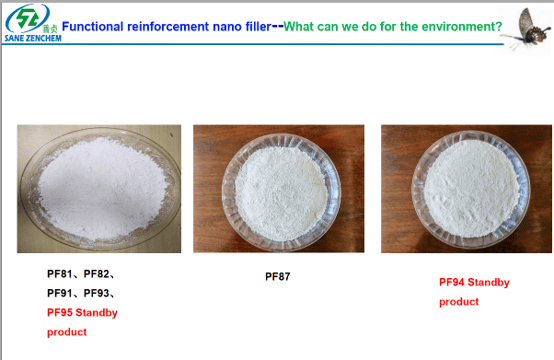
Developed by SaneZen Group (Shanghai Xuanluo New Material Co., Ltd. & Anhui Shanxin Polymer Fine Material Co., Ltd.), the GreenThinking® PF Series Nano-Reinforcing Fillers (including PF81, PF82, PF87, PF88, PF90, PF91, PF93) utilize high-whiteness natural composite mineral exfoliation and deep dehydroxylation surface activation technology. As a premier Nano Rubber Reinforcing Filler Manufacturer in China, SaneZen combines advanced processing with rigorous quality control to deliver consistent performance.
3.1 Maze Effect & Physical Barrier
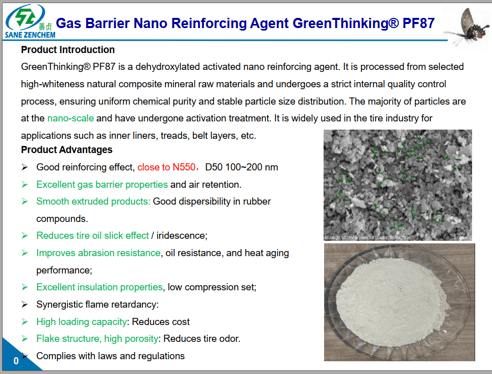
After specialized exfoliation processing, the particle size distribution of the PF series reaches the nano scale (e.g., PF87 median particle size D50 reaches 100–200 nm, typical D50 = 0.153 µm). During mixing and shearing, high-aspect-ratio inorganic flake crystals align parallel to the flow direction, constructing a high-density “Maze Effect” in the continuous rubber phase. The gas molecule diffusion path is extended by several fold to dozens of fold, significantly reducing permeability and permeation coefficients. These are truly Nano Reinforcing Fillers for Improving Gas Barrier and Mechanical Properties, addressing both permeability and strength in a single additive.
3.2 Complete Dehydroxylation & Interfacial Coupling
Through high-temperature deep calcination dehydroxylation, the PF series completely eliminates free silanol (-OH) groups on crystal surfaces and interiors, achieving high chemical inertness and stability. Organosilane coupling agents and surface activators are then applied. The modified nano-particles exhibit strong lipophilicity, forming durable chemical bonds with polymer chains in NR, BIIR, EPDM, NBR, and VMQ, eliminating vulcanization retardation and interfacial side reactions. These are REACH & RoHS Compliant Rubber Reinforcing Fillers, ensuring full regulatory compliance for global markets.
3.3 Performance Benchmark Matrix
| Evaluation Dimension / Metric | Conventional Kaolin / CaCO₃ | Carbon Black Alone (N660 / N550) | GreenThinking® PF81/PF87 Nano-Composite Solution |
| Micro-morphology & Dispersion | Micro-scale disordered particles, prone to agglomeration | Spherical aggregates, high surface area | Nano-scale high-aspect-ratio flakes, uniformly dispersed (D50: 0.15–0.8 µm) |
| Surface Chemistry & -OH Status | High density free -OH, adsorbs accelerators | Hydrophobic surface, no flake barrier | Fully dehydroxylated, zero accelerator adsorption, high coupling activity |
| Mooney Viscosity & Rheology | High viscosity, large die swell | Viscosity spikes at high loading, high heat build-up | Significant viscosity reduction (Mooney drops by 3–5 units), excellent flowability |
| Gas Permeation Coeff. [10⁻¹⁴ cm³·cm/(cm²·s·Pa)] | > 25.0 (Weak barrier) | 18.0 – 22.0 | ≤ 15.43 (Permeability rate as low as 11.32 m³/(m²·d·Pa)) |
| Flex Fatigue (500k cycles, ISO 132) | Cracks appear at 100k–150k cycles | Grade 1–2 cracks at 200k–300k cycles | Zero visible cracks after 500k cycles (Maintains Grade 0) |
| Vulcanization Behavior (TC90 / Scorch) | Unstable scorch, delayed TC90 | Normal vulcanization | Extended scorch for processing safety, shortened TC90 for higher efficiency |
| Compliance & Surface Finish | Low whiteness, impurities | Black limitations, prone to oil spots/sheen | High whiteness (GEM ≥ 94), no oil spots, REACH/RoHS compliant |
4. Key Application Scenarios & Technical Parameters
4.1 Tire Inner Liner – GreenThinking® PF87
In BIIR/NR tire inner liner formulations, replacing a portion of carbon black N660 with PF87 delivers the following empirical gains:
- Enhanced Flowability: Compound Mooney viscosity drops from 56.3 to 53.6, improving calendering/extrusion flow and reducing calendering bubbles and thickness variation. This directly addresses the question of How to Reduce Mooney Viscosity in Rubber Compounds without sacrificing reinforcement.
- Superior Gas Barrier: Gas permeability drops to 11.32 m³/(m²·d·Pa), and permeation coefficient reaches 15.43 × 10⁻¹⁴ cm³·cm/(cm²·s·Pa), significantly outperforming control formulas of identical thickness. These are proven High-Performance Gas Barrier Fillers for Tire Inner Liners, delivering measurable improvements in air retention and tire durability.
- Doubled Flex Fatigue Life: Tested per GB/T 13934-2006, after 500,000 continuous high-frequency flexing cycles, the sample exhibits zero visible micro-cracks, maintaining Grade 0.
- Surface Finish & Odor Reduction: Eliminates rainbow sheen and oil spots on tire sidewalls/inner liners while absorbing volatile impurities to minimize vulcanization odors.
4.2 Industrial Profiles & High-Pressure Hoses – GreenThinking® PF81
PF81 is a broad-spectrum dehydroxylated active nano-filler (Whiteness GEM 94, D50 ~800 nm, oil absorption 60–70 g/100g, specific gravity 2.53), consisting mainly of SiO₂ (~55.0%) and Al₂O₃ (~42.0%).
- High Loading & Modulus Reinforcement: Reinforcement approaches N660/N550. Recommended dosage in EPDM, NBR, and CR is 30–150 phr. Adding 8–10 phr generally increases hardness by 1 Shore A. As specialized EPDM Rubber Reinforcing Fillers, PF81 and PF87 enable high-performance EPDM compounds with excellent balance of properties.
- Low Compression Set & High Resilience: Zero accelerator adsorption ensures a dense, uniform crosslink network, yielding excellent resilience and exceptionally low compression set.
4.3 Selection Matrix by Polymer Matrix & Vulcanization System
| Polymer Matrix | Vulcanization System | Reinforcement Ranking | Compression Set Ranking | Cost-Performance Ranking |
| Non-polar Rubber (EPDM, VMQ, IIR) | Peroxide System | PF87 > PF93 > PF91 > PF81 | PF93 > PF91 > PF81 > PF87 | PF81 > PF87 > PF91 > PF93 |
| Non-polar Rubber (EPDM, VMQ, IIR) | Sulfur System | PF87 > PF91 > PF93 > PF81 | PF93 > PF91 > PF81 > PF87 | PF81 > PF87 > PF91 > PF93 |
| Polar Rubber (NBR, HNBR, CR) | Peroxide System | PF93 > PF87 > PF81 | PF93 > PF81 > PF87 | PF81 > PF87 > PF91 > PF93 |
| Polar Rubber (NBR, HNBR, CR) | Sulfur System | PF87 > PF91 > PF93 > PF81 | PF91 > PF93 > PF81 > PF87 | PF81 > PF87 > PF91 > PF93 |
These rankings confirm that the PF Series offers versatile High Performance Mineral Fillers for Rubber, adaptable to both polar and non-polar matrices with tailored performance characteristics. They represent the Best Nano Reinforcing Fillers for Rubber Compounds across a wide range of vulcanization systems and service conditions.
5. Manufacturing Uniformity & Quality Control
A technical specification sheet only determines theoretical performance limits; factory-side manufacturing uniformity defines the quality floor. If nano-fillers fail to achieve dispersion (Grade 1–2 per ASTM D2663) during mixing, coarse aggregates become initiation sites for fatigue failure.
SaneZen Quality Assurance: Our production site (Anhui Shanxin Polymer Fine Material Co., Ltd.) is fully certified under IATF 16949:2016 (Certificate No.: 35295/A/0001/SM/E). All products comply with EU REACH, RoHS, and PAHs standards, ensuring batch-to-batch consistency in D50 particle distribution, oil absorption, pH, and moisture content (< 0.3%). As a trusted Rubber Compound Reinforcing Filler Manufacturer, SaneZen guarantees reliable performance from every shipment.
6. Total Cost of Ownership (TCO) & Economic Value Quantification
In premium rubber component sourcing, purchase price is only a fraction of TCO. Adopting GreenThinking® PF series delivers quantifiable economic dividends:
- Direct Formula Cost Reduction: Replacing 20%–40% of expensive carbon black, silica, or special polymer blends reduces overall compound volumetric cost by 8%–15%. This is the economic promise of a true Carbon Black Replacement Fillers for Rubber Compounds that does not compromise performance.
- Reduced Mixing Energy & Extrusion Scrap: Mooney viscosity drops by 3–5 units, lowering internal mixer power consumption (kWh/t) while eliminating die swell and surface defects, reducing scrap rates by > 2%.
- Reliability Premium: Grade 0 cracking at 500,000 flexing cycles and low permeation prevent warranty claims and unscheduled downtime.
7. Technical FAQ
Q1: Which traditional fillers can GreenThinking® PF series replace in rubber formulations?
Answer: PF series primarily replaces silica, calcined kaolin, precipitated kaolin, and calcium carbonate, while partially substituting semi-reinforcing and fast-extruding carbon blacks (e.g., N660, N550, N774). It offers exceptional cost-performance in light-colored compounds and demanding gas-barrier / flex-fatigue applications. In many cases, it acts as an effective Carbon Black Replacement Filler, reducing dependency on petroleum-based reinforcing agents.
Q2: Why does PF87 significantly boost tire inner liner gas barrier properties and eliminate rainbow sheen?
Answer: PF87 features a median particle size D50 of 100–200 nm and a high-aspect-ratio flake structure. During processing, flakes align parallel to flow, constructing a “Maze Barrier” that reduces gas permeation coefficient to 15.43 × 10⁻¹⁴ cm³·cm/(cm²·s·Pa). Its high-purity mineral structure absorbs volatile migrates, eliminating oil spots and rainbow sheen on tire surfaces. This makes PF87 one of the most effective Gas Barrier Fillers for Rubber Compounds available today.
Q3: Do I need to modify existing mixing procedures or accelerator packages when switching to PF series?
Answer: No major equipment or process modifications are required. Because PF series is deeply dehydroxylated, it does not absorb accelerators, ensuring consistent MDR curves. You can maintain your existing cure package or slightly adjust accelerator levels by ~5%. TC90 cure times are generally shorter than conventional kaolin systems, boosting productivity.
Q4: What is the recommended loading level of PF series, and how does it affect hardness?
Answer: Depending on matrix type (NR, EPDM, NBR, CR, PVC) and physical requirements, recommended dosage is 30 to 150 phr. As a general rule of thumb in NR and EPDM, adding 8 to 10 phr of PF filler increases hardness by approximately 1 Shore A degree. For EPDM Rubber Reinforcing Fillers, this predictable hardness response allows precise formulation tuning.
Q5: What international certifications and compliance approvals do PF series products hold?
Answer: Production facilities are certified under IATF 16949:2016. Products pass SGS and third-party testing, complying with EU REACH, RoHS, PAHs, and CE directives for export to Europe, North America, India, and global markets. They are fully REACH & RoHS Compliant Rubber Reinforcing Fillers, meeting the strictest environmental and safety standards.
8. Corporate Background & Manufacturing Excellence
Why Work With SaneZenChem?
Choosing a specialty functional filler supplier is not simply about purchasing a raw material—it is about partnering with a manufacturer that truly understands rubber processing from the inside out.
Unlike conventional mineral filler producers, SaneZenChem did not begin as a filler manufacturer. Our journey started nearly 28 years ago in the rubber compounding industry, where we built our reputation by developing high-performance rubber and silicone compounds for customers in the automotive, electrical power, construction, cable, and industrial manufacturing sectors.
Over almost three decades of continuous innovation, SaneZen Group has grown into one of China’s leading rubber compound manufacturers and the country’s first manufacturer of dust-free silicone compounds. This extensive experience has enabled us to master every critical stage of rubber processing—from formulation design and raw material selection to mixing, extrusion, molding, curing, and long-term performance evaluation.
Unlike traditional raw material suppliers, we face the same processing challenges as our customers every day. Our engineers continuously optimize compound viscosity, filler dispersion, reinforcement efficiency, compression set, flame retardancy, weather resistance, and production stability on commercial manufacturing lines rather than only under laboratory conditions.
Through years of compound development, we identified a recurring industry challenge: conventional mineral fillers often became the limiting factor in rubber performance. Poor dispersion, high compound viscosity, limited reinforcement efficiency, and inconsistent processing prevented manufacturers from achieving higher productivity and better product reliability.
Rather than accepting these limitations, we decided to solve them ourselves.
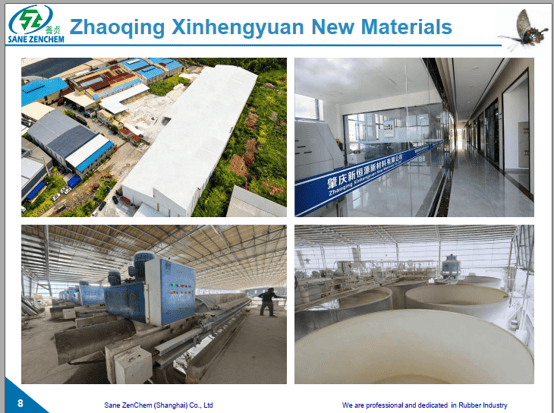
Leveraging nearly three decades of compounding expertise, SaneZen Group established its dedicated functional filler manufacturing base in Guangdong, focusing on the research, development, and production of next-generation nano-scale rubber reinforcing fillers. This strategic investment marked the transition from being only a compound manufacturer to becoming a complete materials technology company capable of developing innovative reinforcing systems specifically for modern rubber formulations.
Today, the GreenThinking® PF Series represents the result of this long-term technological evolution. Manufactured using proprietary processing technology, the PF Series delivers one of the world’s finest particle-size rubber reinforcing fillers, combining ultra-fine particle distribution, excellent dispersion, superior reinforcement, lower Mooney viscosity, improved gas barrier performance, and enhanced long-term durability. Every material is developed not only through laboratory research but also validated continuously in our own commercial rubber and silicone compound production facilities before reaching customers.
From Compound Manufacturing to Advanced Material Innovation
Today, SaneZen Group has established an integrated manufacturing platform covering the complete value chain of advanced polymer materials:
- Custom Rubber Compound Manufacturing
- Dust-Free Silicone Compound Manufacturing
- GreenThinking® Functional Nano Rubber Reinforcing Fillers
- Halogen-Free Flame Retardants & Micro-encapsulation Additives
- Polymer Additives and Processing Solutions
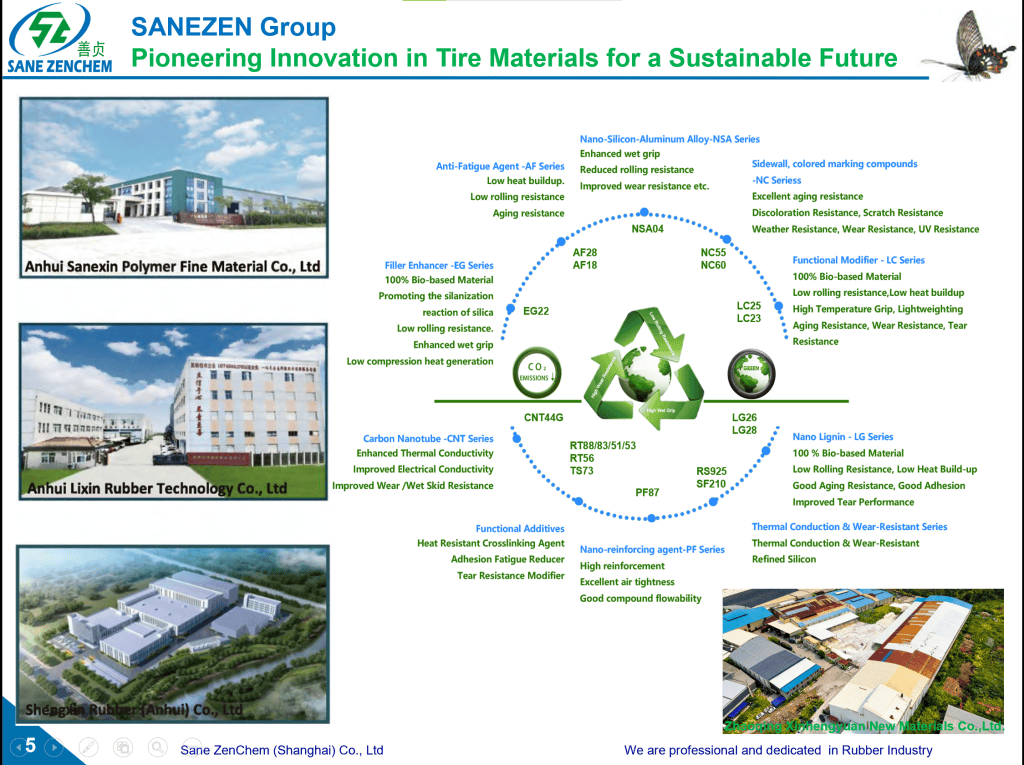
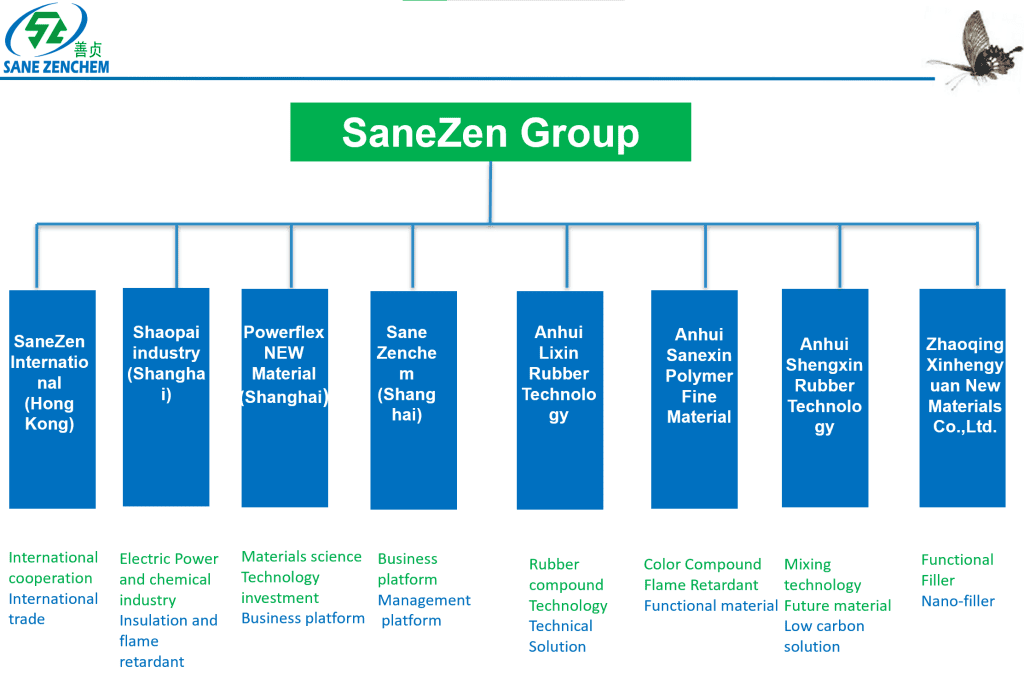
Our advanced functional filler production is supported by Anhui Sanexin Polymer Fine Material Co., Ltd. (Operating under an IATF 16949:2016 certified quality management system, Certificate No.: 35295/A/0001/SM/E), ensuring consistent particle size distribution, surface treatment quality, moisture control (< 0.3%), and batch-to-batch manufacturing stability for customers worldwide. This makes us a preferred Nano Rubber Reinforcing Filler Manufacturer in China for global OEMs and compounders.
Unlike suppliers that simply sell raw materials, SaneZenChem develops every product from the perspective of a compound manufacturer. Because we formulate, manufacture, process, and test high-performance rubber compounds every day, we understand how fillers perform under real production conditions—not just how they perform in laboratory testing.
This manufacturing-first philosophy enables us to provide customers with materials that improve processing efficiency, enhance product performance, and reduce total manufacturing costs across automotive, electrical, sealing, cable, infrastructure, and specialty industrial applications.
Why Global Manufacturers Choose SaneZenChem
- Nearly 28 years of expertise in rubber and silicone compounding
- One of China’s leading rubber compound manufacturers
- China’s first dust-free silicone compound manufacturing technology
- Dedicated functional filler manufacturing base in Guangdong & primary production complex in Xuancheng, Anhui
- Producer of one of the world’s finest particle-size rubber reinforcing fillers
- IATF 16949:2016 certified manufacturing and quality control system
- Integrated capabilities spanning R&D, compounding, filler manufacturing, application testing, and technical support
- Validated through real industrial production rather than laboratory evaluation alone
We didn’t become experts in rubber because we manufacture fillers. We developed our fillers because we have spent nearly three decades manufacturing high-performance rubber compounds. That experience is what makes SaneZenChem different.
9. Technical Inquiry, Sample Request & Custom Formulations
SaneZen Group’s R&D Engineering Center is equipped with internal mixers, two-roll mills, calenders, MDR rheometers, tensile testers, and gas permeation analyzers to provide global customers with end-to-end technical support: “Condition Assessment – Recipe Recommendation – Free Sample Dispatch – Rig Testing Verification”.
Request Your Custom Technical Solution & Trial Samples (Lead Inquiry Matrix)
If you are facing insufficient gas tightness, high Mooney viscosity, vulcanization fluctuations, flex fatigue cracking, or high carbon black costs, please submit the following details to our technical service team:
- Your Rubber Base Matrix: [e.g., BIIR / NR / EPDM / NBR / FKM / Others]
- Current Vulcanization System: [Sulfur / Peroxide DCP / Phenolic Resin]
- Current Fillers & Ratios: [e.g., N660 50 phr + Kaolin 40 phr]
- Primary Improvement Goals: [Viscosity Reduction / Gas Tightness / 500k Flex Grade 0 / VOC Reduction / Light-Color Substitution]
Service Commitment: Upon receiving your inquiry, SaneZen technical experts will match the ideal grade (PF81 / PF87 / PF91 / PF93) within 24 hours and dispatch 1–5 kg free trial samples along with complete TDS / MSDS documentation.
Contact Details:
SaneZen Group
Manufacturing Base: Anhui Shanxin Polymer Fine Material Co., Ltd. (IATF 16949 Certified) | Guangdong Functional Filler Base
Website: www.sanezenrubber.com
Technical Support: yori@sanezen.com
Flagship Lines: GreenThinking® PF Series Nano-Reinforcing Fillers, Powerflex® Special Rubber Additives, Halogen-Free Flame Retardants
 English
  Spanish
  Russian