
In the rubber industry, the selection of reinforcing fillers directly determines the mechanical properties, processability, and service life of finished products. While carbon black and precipitated silica serve as the core components of traditional reinforcement systems with excellent performance, they exhibit inherent limitations in light-colored product compatibility, high-loading processability, and overall cost control. The GreenThinking® PF series of nano-reinforcing agents—including PF81, PF87, PF91, and others—achieve a performance combination of high whiteness, low Mooney viscosity, excellent gas barrier properties, and superior processing fluidity through surface activation treatment and nanoscale particle size control, while maintaining reinforcement levels approaching N550 carbon black. As a high performance substitute for silica filler and cost effective alternative to carbon black, the PF series delivers exceptional value. Based on ASTM and GB/T standard test data, this paper systematically evaluates the application potential of this technology in tires, sealing products, and industrial rubber components from four dimensions: microscopic mechanisms, empirical performance, process compatibility, and life-cycle value.
1. Industry Status: The Structural Contradiction in Reinforcing Filler Selection
Reinforcing fillers constitute the second largest component in rubber formulations after the base polymer, directly influencing hardness, strength, wear resistance, dynamic performance, and cost structure. A structural contradiction has long persisted in the industry’s conventional selection logic: carbon black systems offer excellent reinforcement but impose severe color limitations, failing to meet the requirements of light-colored or colored products; precipitated silica can be used in light-colored applications but presents difficulties in dispersion and high processing energy consumption; traditional mineral fillers (kaolin, calcium carbonate) are cost-effective but offer limited reinforcement, falling short in high-performance scenarios.
This contradiction is particularly acute in the following scenarios: tire sidewall markings require light-colored substrates combined with excellent weatherability; inner liners demand high loading for cost reduction while maintaining gas barrier properties; light colored industrial rubber components need to balance reinforcement and pigmentation. Conventional approaches often force trade-offs between performance and cost, creating an industry dilemma where “strong reinforcement means poor color, and good color means weak reinforcement.” As a white reinforcing filler alternative, the PF series offers a compelling solution to this persistent challenge.
The PF series seeks to establish a new equilibrium in this contradiction through the technical pathway of hydroxyl-removing surface activation treatment for nano-reinforcement.
2. Composite Reinforcement Mechanisms: The Logic of Performance Enhancement at the Molecular Level
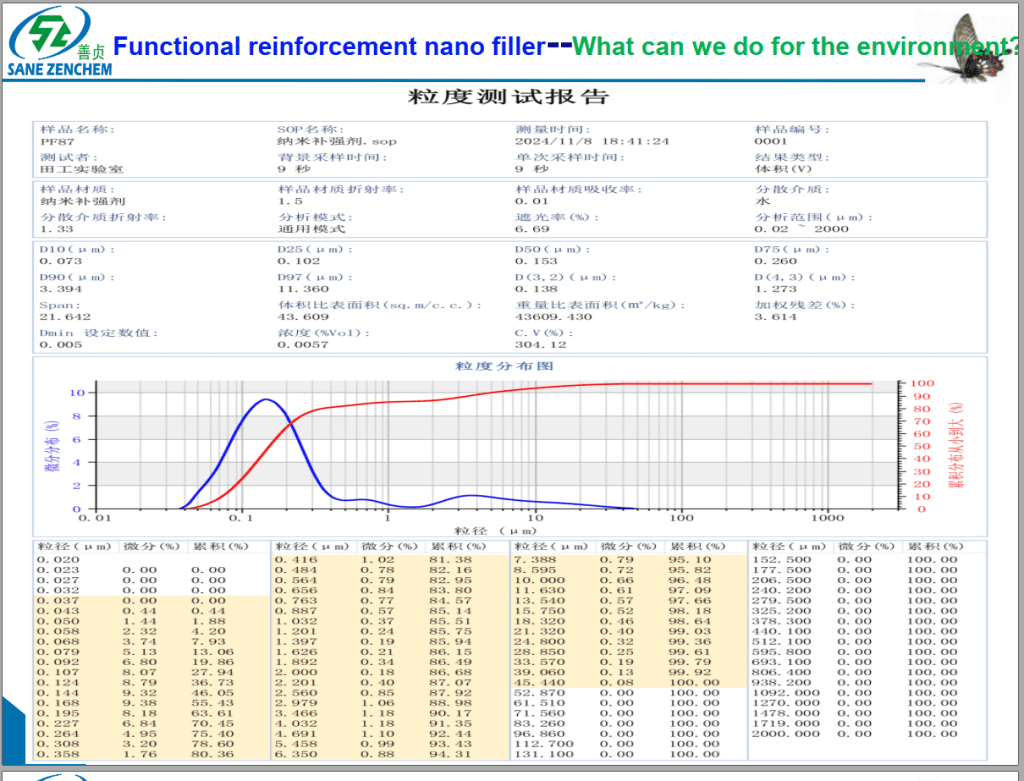
The technical foundation of the PF series rests on a clear structure-property relationship: select high-whiteness natural composite minerals as raw materials, process them through nanonization to achieve particle size distribution predominantly in the nanoscale range (PF87 median particle size D50 ≈ 153 nm, D10 ≈ 73 nm), and then apply surface activation treatment to remove hydroxyl groups, thereby improving interfacial bonding with the rubber matrix. As a leading nano reinforcing agent for rubber, the PF series demonstrates how precise engineering at the nanoscale translates to macroscopic performance advantages.
| Technical Dimension | Conventional Filler Pain Points | PF Series Technical Strategy | Macro Performance Mapping |
| Particle Size Control | Kaolin D50 ≈ 200 nm, limited reinforcement | Nanoscale particle size (D50 100-200 nm) | Reinforcement approaching N550 |
| Surface Activity | Hydroxyl-rich surfaces, weak rubber bonding | Hydroxyl-removing activation treatment, enhanced interfacial bonding | Improved strength, higher retention after aging |
| Flake Structure | Spherical or amorphous | Flake structure, high porosity | Enhanced gas barrier, smooth extruded surfaces |
| Whiteness Control | Dark or off-white | Conventional whiteness ≥91% (PF91) | Suitable for light-colored product manufacturing |
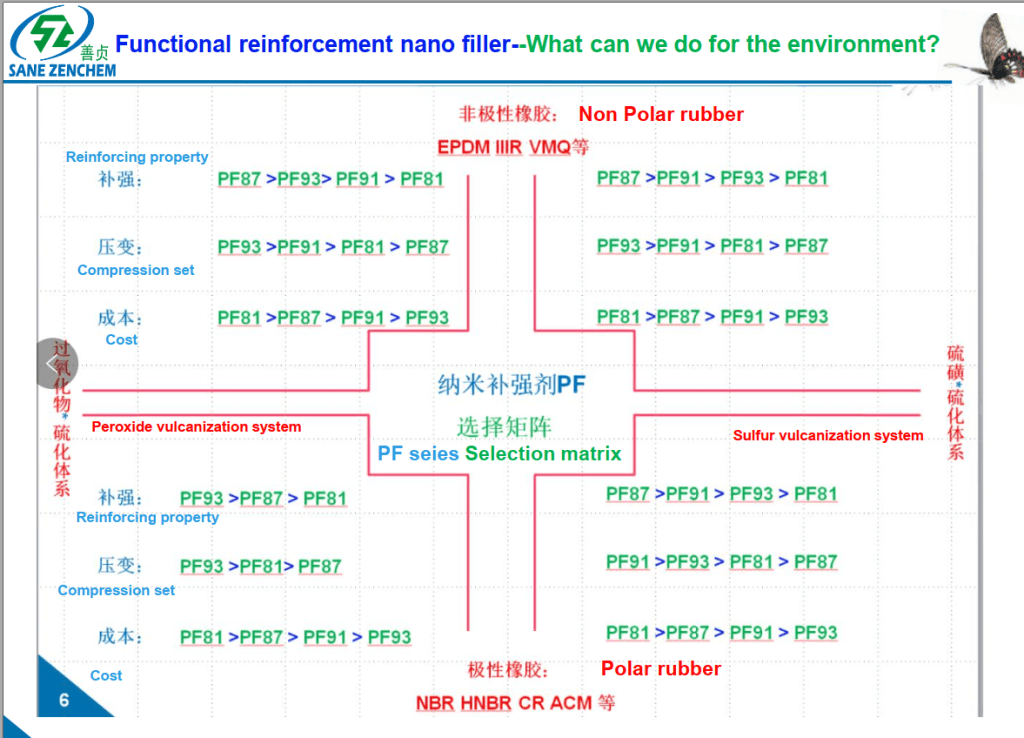
It should be noted that the degree of surface activation treatment directly determines the upper limit of reinforcement efficiency. PF91, with thorough surface treatment, achieves a tensile strength of 17.12 MPa in NBR formulations, significantly outperforming comparable competitive products. Even with similar particle sizes, insufficiently treated fillers exhibit systematic gaps in reinforcement and dispersion uniformity.
3. Empirical Performance Boundaries: Standardized Test Data and Critical Interpretation
3.1 Reinforcement Performance: N550-Approaching Enhancement
The core value proposition of the PF series—reinforcement approaching N550 carbon black—is supported by substantial experimental data. In NBR vulcanization systems:
- PF87: Tensile strength 18.44 MPa, elongation 698%, hardness 67 Shore A
- PF91: Tensile strength 17.12 MPa, elongation 468%, hardness 73 Shore A
- PF81: Tensile strength 13.34 MPa, elongation 710%, hardness 67 Shore A
Comparative data shows that PF91 outperforms Domestic Competitor 2 (13.97 MPa) by 22.5% and Domestic Competitor 1 (16.68 MPa) by 2.6% in tensile strength. PF81 achieves a post-aging tensile strength retention of 12.85 MPa with elongation retention superior to multiple international competitors. These results firmly establish the PF series as a high performance substitute for silica filler that does not compromise on mechanical properties.
3.2 Gas Barrier Properties: Differentiated Advantage in Tire Inner Liners
In tire inner liner applications, using a bromobutyl rubber (BIIR/NR = 80/20) matrix with 20 phr PF87 replacing an equivalent amount of N660 carbon black:
| Test Parameter | Control Formulation | PF87 Formulation | Trend |
| Mooney Viscosity ML(1+4)@100°C | 56.3 | 53.6 | ↓ Improved processability |
| Air Permeability (m³/(m²·d·Pa)) | 12.73 | 11.32 | ↓ 11% improvement in gas barrier |
| Permeability Coefficient (×10⁻¹⁴ cm³·cm/(cm²·s·Pa)) | 16.53 | 15.43 | ↓ Enhanced gas barrier |
| Flex Crack Resistance (500k cycles) | Grade 0 | Grade 0 | Equivalent |
| Post-Aging Tensile Strength Retention | 92.1% | 90.8% | Equivalent |
These data demonstrate that replacing a portion of carbon black with PF87 can significantly enhance gas barrier properties and improve processing fluidity without sacrificing mechanical performance or flex fatigue resistance. For tire inner liners, this performance combination has direct engineering significance—improved gas barrier translates to better tire pressure retention and reduced rolling resistance. As a dedicated gas barrier rubber filler for tire inner liner, PF87 offers a differentiated value proposition in this demanding application.
3.3 Processing Behavior: Optimization of Mooney Viscosity and Curing Characteristics
The PF series exhibits notable processing advantages. In NBR formulations:
- PF87: ML = 0.78 dN·m (lowest), TC90 = 111s (fastest)
- PF91: MH = 14.02 dN·m (highest), TC90 = 134s
Lower Mooney viscosity means better fluidity, facilitating processing under high-loading formulations in extrusion and mold filling. As a low Mooney viscosity rubber filler, the PF series directly addresses one of the most persistent challenges in rubber compounding—achieving high reinforcement without sacrificing processability. Shortened TC90 directly translates to improved production efficiency—in continuous vulcanization lines, this difference could mean a 10-20% increase in unit time output.
3.4 Critical Examination of Standardized Testing
The above data are all obtained through ASTM and GB/T standard methods, constituting a necessary but insufficient basis for material selection. The limitations of standardized testing include:
- Single-stress mode: Laboratory vulcanized test plaques only reflect “time-zero” static performance and cannot fully predict degradation trajectories under coupled thermal-oxidative-dynamic loading
- Accelerated aging extrapolation bias: High-temperature short-term extrapolation based on the Arrhenius equation may deviate significantly under moderate-temperature long-term service conditions
- Processing history sensitivity: Standard test plaque preparation conditions are highly controlled, while actual shop-floor variables such as mixing shear force and dump temperature significantly affect actual filler dispersion
Therefore, material datasheets should be regarded as the starting point of technical dialogue, not the final verdict. The performance advantages demonstrated by the PF series in standard tests require confirmation and calibration through process validation under actual production conditions.
4. Process Consistency: Transition Control from Formulation to Production
The formulation defines the theoretical ceiling of performance, while manufacturing uniformity determines the actual floor achieved in the final product.
The PF series’ advantages in dispersion—good dispersion in compounds, excellent fluidity, easy extrusion, and stable dimensional accuracy—have been validated across multiple application scenarios. Surface activation treatment ensures more uniform interfacial bonding between the filler and rubber matrix, reducing the formation of microscopic agglomerates. As a functional filler for rubber compounding, the PF series demonstrates how thoughtful material design can simultaneously address multiple processing and performance objectives.
However, the following process variables warrant particular attention during production scale-up:
- Mixing shear force control: The dispersion effectiveness of nano-fillers is highly dependent on the shear force input during the initial mixing stage. Insufficient shear may result in agglomerate residues that serve as initiation sites for fatigue cracks
- Dump temperature management: The thermal stability of the surface activation layer has defined boundaries; excessive dump temperatures may damage the activation layer, compromising interfacial bonding effectiveness
- Curing temperature profile: The PF series can shorten the optimum cure time (TC90), which means that minor fluctuations in curing temperature may have a greater impact on crosslink density, necessitating recalibration of the curing process window
Field audits at multiple rubber product manufacturers reveal that even with identical formulations, the performance scatter of final products often depends on precise control of initial mixing shear force and dump temperature stability. This observation underscores that in-depth engagement during the process validation phase holds greater quality control value than raw material inspection alone.
5. Life-Cycle Value Analysis: Quantifying the Technological Dividend
From a Total Cost of Ownership (TCO) perspective, the value creation logic of the PF series nano-reinforcing agents can be quantified across the following dimensions:
| Value Dimension | Hidden Costs of Conventional Schemes | PF Series Value Anchors |
| Material Cost | Volatile carbon black pricing; additional colorants needed for light-colored products | High-whiteness natural minerals with stable costs; no additional colorants needed for light-colored products |
| Processing Cost | High energy consumption and high Mooney viscosity with silica | Low Mooney viscosity, reduced mixing energy consumption, improved fluidity |
| Production Efficiency | Long cure cycles | Shortened TC90, increased unit time output |
| Quality Cost | Batch-to-batch variation due to poor filler dispersion | Surface activation ensures dispersion uniformity, high batch consistency |
| Service Life | Rapid performance degradation after aging | Excellent retention of strength and elongation after aging |
For manufacturers seeking a cost effective alternative to carbon black, the PF series delivers compelling economic justification. Taking the tire inner liner formulation as an example: replacing an equivalent amount of N660 with 20 phr PF87 results in minimal material cost change, yet the 11% improvement in gas barrier translates to enhanced tire pressure retention, which further translates to reduced rolling resistance and improved fuel economy—over the full lifecycle of commercial vehicle tires, the cumulative effect of this technological dividend far exceeds the initial material cost differential. Additionally, as a high loading rubber functional filler for cost reduction, the PF series enables formulators to achieve significant cost savings through increased filler loading without compromising performance.
6. Industry Application Map
The PF series has established mature application solutions across the following domains:
| Application Area | Recommended Grade | Core Value |
| Tire Inner Liners | PF87 | Enhanced gas barrier, improved processability; serves as gas barrier rubber filler for tire inner liner |
| Tire Sidewall Markings | PF81/PF91 | High whiteness, weatherability, N550-approaching reinforcement; functions as high whiteness rubber reinforcing filler for light colored products |
| Sealing Products | PF91/PF93 | Low compression set, heat aging resistance; delivers nano mineral filler with excellent aging resistance for seals |
| Light-Colored Industrial Rubber Parts | PF81/PF91 | High whiteness, excellent insulation; provides high whiteness insulating nano filler for rubber |
| Hose/Extruded Products | PF87/PF93 | Smooth extruded surfaces, dimensional stability; acts as flake shaped nano reinforcing agent for hose and extruded products |
7. Technical Inquiry (FAQ)
Q1: What are the core differences between the PF series and traditional mineral fillers (kaolin, calcium carbonate)?
Traditional mineral fillers (kaolin D50 ≈ 200 nm) offer only 50-100% of the reinforcement effectiveness of carbon black. Through nanonization processing (D50 as low as 153 nm) and surface activation treatment (hydroxyl removal), the PF series elevates reinforcement to levels approaching N550 carbon black—effectively serving as a N550 carbon black replacement filler for rubber compounding—while retaining the advantages of high whiteness and low cost. This means that in light-colored products, high whiteness can be achieved without compromising mechanical performance. As a cost effective white mineral filler with N550 level reinforcement, the PF series offers formulators an unprecedented combination of performance and economy.
Q2: How does the PF series affect vulcanization efficiency?
Experimental data indicate that the PF series can extend scorch time (TS2) while shortening optimum cure time (TC90). In NBR formulations, PF87 achieves a TC90 of 111s, significantly faster than competitive products. This characteristic provides manufacturers with a larger processing safety window while enhancing unit time output. As a low Mooney viscosity nano filler for improved rubber processing, the PF series delivers tangible productivity gains. It is recommended to recalibrate vulcanization process parameters when transitioning formulations to fully realize this efficiency dividend.
Q3: What is the regulatory compliance status of the PF series?
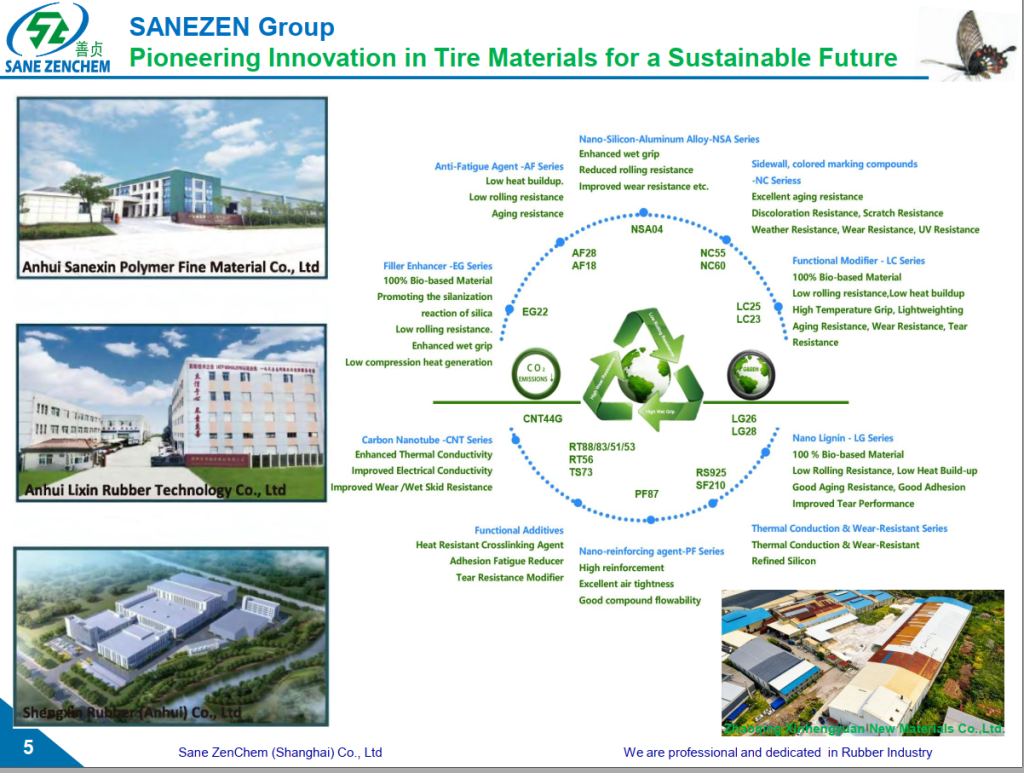
The PF series features low impurity content, is non-toxic and odorless, and exhibits excellent chemical stability. The manufacturing facility (Anhui Sanexin Polymer Fine Material Co., Ltd.) has obtained IATF16949:2016 quality management system certification, with the certified scope covering “Design and Manufacture of Rubber Compound and Flame Retardant”. For specific market regulatory compliance (e.g., RoHS, REACH, TSCA), it is recommended to conduct item-by-item verification with the supplier based on the final product’s sales regions.
Q4: Who are the Rubber reinforcing filler Manufacturers and Suppliers for the PF series?
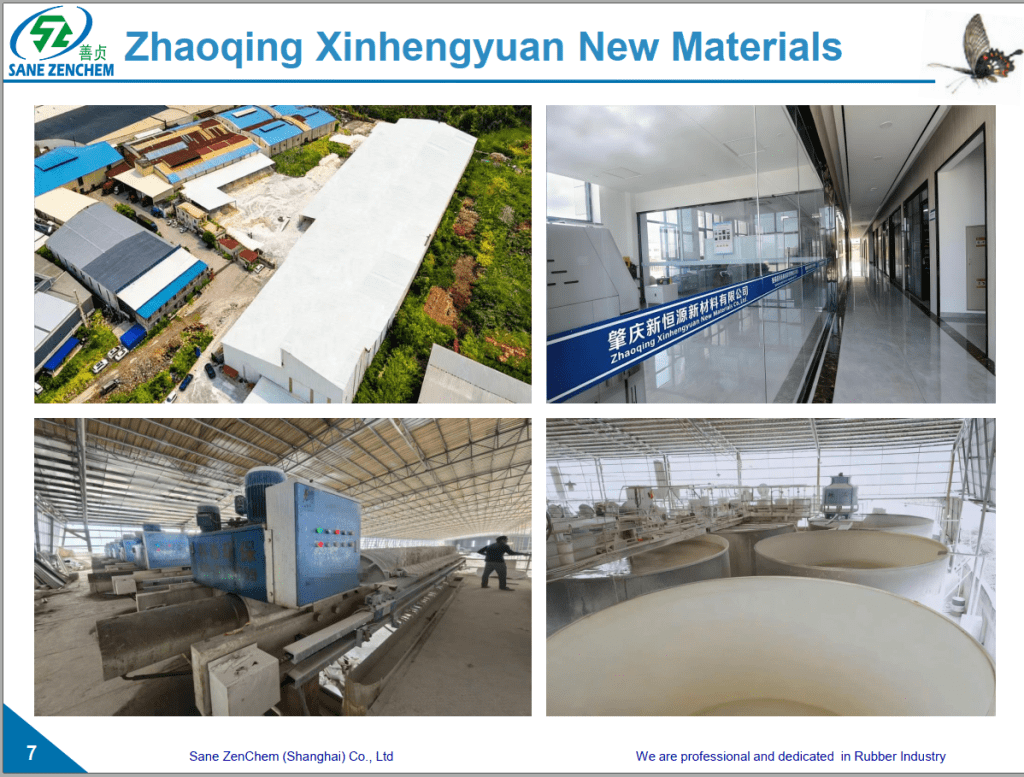
Anhui Sanexin Polymer Fine Material Co., Ltd. stands as a premier Rubber reinforcing filler Manufacturer with over a decade of specialized experience in functional mineral filler development. As one of the leading Rubber reinforcing filler Suppliers globally, the company combines advanced nanonization technology with rigorous quality management systems to deliver consistent, high-performance products. The PF series represents the culmination of extensive R&D efforts in surface activation treatment and particle size control engineering, positioning Sanexin as a trusted partner for rubber compounders worldwide.
Resources & Contact
For tailored validation protocols and technical support addressing specific rubber products, formulation systems, or particular service conditions, please contact the SaneZen technical team.
Email: yorichen@sanezen.com
Website: www.sanezenrubber.com
 English
  Spanish
  Russian