Meeting both UL94 and IEC 60332 flame retardancy standards with halogen-free silicone cables remains one of the more demanding formulation problems in cable material science. The two standards test different fire behaviors under different conditions, and achieving both without halogenated compounds requires careful balancing of additive chemistry, filler dispersion, and processing parameters. This article walks through the technical requirements, formulation challenges, and practical strategies for dual compliance, drawing on direct experience with silicone compound development for fire-rated cable applications.
What UL94 and IEC 60332 Actually Test and Why Both Matter
UL94 and IEC 60332 approach flame retardancy from different angles, and understanding the distinction matters for formulation decisions.
UL94 is a material-level test, primarily used in North America. It evaluates how a small plastic specimen behaves when exposed to a controlled flame in a vertical orientation. The test measures afterflame time (how long the material continues burning after the flame source is removed), afterglow time, whether the material drips flaming particles, and the burn rate. A V-0 rating, the most stringent classification, requires the specimen to self-extinguish within 10 seconds with no flaming drips that ignite cotton placed below.
IEC 60332 is a cable-level test with broader international recognition, particularly in Europe and Asia. Rather than testing raw material, it evaluates finished cables or cable bundles under fire conditions. The test measures how far flames propagate along the cable length and whether the cable self-extinguishes. IEC 60332-1 covers single cables; IEC 60332-3 covers bundled cables, which is significantly more demanding because grouped cables create a larger fuel load and different airflow dynamics.
| Characteristic | UL94 | IEC 60332 |
|---|---|---|
| Test subject | Material specimen | Finished cable or cable bundle |
| Primary measurement | Self-extinguishing time, dripping behavior | Flame propagation distance, char length |
| Dominant markets | North America | Europe, Asia, international projects |
| Design implication | Guides compound formulation | Validates complete cable construction |
For manufacturers targeting global markets, dual certification is not optional. A cable that passes UL94 at the material level may still fail IEC 60332-3 if the cable construction allows flame spread between bundled conductors. Conversely, a cable designed for IEC 60332 may use materials that do not meet UL94 V-0 requirements. The formulation must address both simultaneously.
How Halogen-Free Flame Retardants Work in Silicone Systems
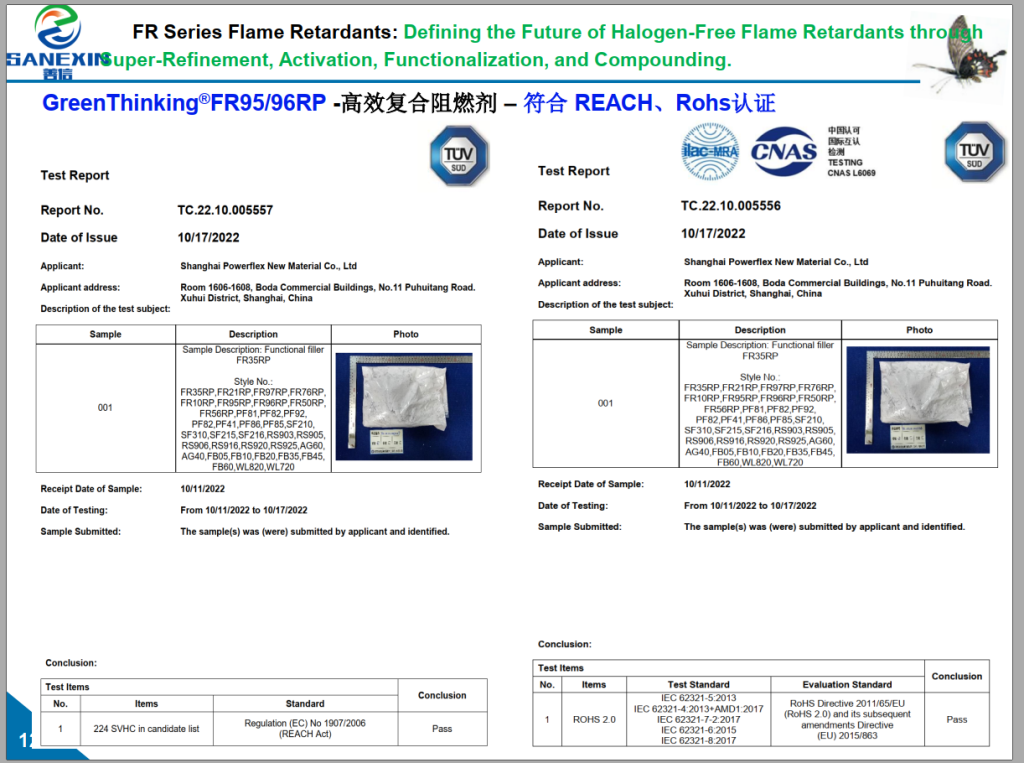
Halogenated flame retardants, particularly brominated and chlorinated compounds, have historically been effective at suppressing combustion. However, they release hydrogen halides during burning, which are toxic, corrosive, and create dense smoke that impairs visibility during evacuations. Regulatory pressure and end-user specifications have driven the shift toward halogen-free alternatives, particularly in rail, aerospace, and building applications where smoke toxicity is a primary concern.
Halogen-free flame retardant (HFFR) systems in silicone rely on different suppression mechanisms. The most common additives fall into two categories.
Mineral hydroxides, specifically aluminum hydroxide (ATH) and magnesium hydroxide (MDH), work through endothermic decomposition. When heated, ATH releases water vapor at around 200°C, absorbing heat from the combustion zone and diluting flammable gases. MDH decomposes at a higher temperature, approximately 300°C, making it suitable for silicone systems that operate at elevated temperatures. The water release cools the flame front, and the resulting metal oxide residue forms a protective layer on the material surface.
Phosphorus-based compounds promote char formation. During combustion, phosphorus additives react with the silicone matrix to create a carbonaceous char layer that insulates the underlying material from heat and oxygen. This char barrier slows pyrolysis and reduces the rate of volatile fuel release.
The interaction between these additives and the silicone polymer backbone determines overall performance. Silicone itself has inherent fire resistance due to its silicon-oxygen backbone, which forms a protective silica ash layer when burned. The challenge is enhancing this natural behavior without compromising the mechanical and electrical properties that make silicone valuable for cable applications.
Achieving UL94 V-0 in a 1.5 mm thick silicone insulation layer while maintaining flexibility and dielectric strength requires precise control of additive loading. Too little ATH or MDH, and the material burns too long to meet V-0 criteria. Too much, and the compound becomes brittle, difficult to extrude, and may fail elongation requirements after thermal aging.
The Real Formulation Challenges Beyond Flame Retardancy
Meeting flame retardancy targets is only part of the problem. The harder challenge is maintaining all other required properties simultaneously.
Filler dispersion is the first obstacle. Mineral hydroxide loadings for effective flame retardancy typically range from 40% to 65% by weight. At these concentrations, achieving uniform dispersion throughout the silicone matrix requires careful attention to mixing sequences, shear rates, and surface treatment of the filler particles. Agglomerated filler creates weak points that reduce tensile strength and can cause localized failures during cable bending. It also creates inconsistent flame retardancy, since regions with lower filler concentration will burn differently.
Processing stability during extrusion presents the second challenge. High filler loadings increase compound viscosity and can cause die buildup, surface roughness, and dimensional inconsistencies in the finished cable. The rheological profile must be optimized so the compound flows smoothly through the extrusion die while maintaining enough green strength to hold its shape before vulcanization. Silicone compounds with high ATH loading often require processing aids or surface-treated fillers to achieve acceptable extrusion behavior.
Long-term durability is the third consideration. Silicone cables are often specified for high-temperature applications where they must maintain properties over thousands of hours. A formulation that passes initial flame tests but degrades after thermal aging at 200°C is not commercially viable. The flame retardant additives must not accelerate thermal degradation or react with other compound components over time. We have seen formulations that meet all initial specifications fail thermal aging tests because the surface treatment on the mineral filler was not stable at elevated temperatures.
Electrical properties add another constraint. Silicone insulation must maintain dielectric strength and volume resistivity within specification. Some flame retardant additives can introduce ionic contamination or moisture sensitivity that degrades electrical performance, particularly in humid environments. The formulation must be validated for electrical properties both initially and after accelerated aging.
Practical Strategies for Achieving Dual Compliance
Successful dual compliance requires a systematic approach rather than trial-and-error formulation adjustments.
Material selection starts with understanding the specific requirements of both standards and the end-use application. For applications requiring UL94 V-0 at thicknesses below 2 mm, the flame retardant system must be aggressive enough to achieve rapid self-extinguishment. For IEC 60332-3 bundle tests, the cable construction, including jacket material and overall cable design, becomes as important as the insulation compound. The formulation strategy must account for both.
Synergistic additive combinations often outperform single-additive approaches. Combining ATH with smaller amounts of phosphorus-based additives can achieve equivalent flame retardancy at lower total filler loading, preserving mechanical properties. The phosphorus component promotes char formation while the ATH provides endothermic cooling. The specific ratio depends on the silicone base polymer and the target property balance.
Surface treatment of mineral fillers significantly affects both processing and final properties. Silane-treated ATH or MDH improves compatibility with the silicone matrix, reducing viscosity at equivalent loadings and improving tensile strength. The treatment must be stable at the processing and service temperatures of the application.
Iterative testing throughout development catches problems early. Running abbreviated flame tests on laboratory samples before committing to full-scale cable production saves significant time and material. However, the correlation between small-scale tests and full cable tests is not always linear, so validation on actual cable constructions remains essential.
If your application involves unusual cable geometries or particularly demanding thermal aging requirements, it is worth discussing the specific formulation constraints before committing to a development path.
Where HFFR Silicone Cables Are Specified and Why
The shift toward halogen-free flame retardant silicone cables is driven by specific application requirements where smoke toxicity and corrosivity are primary concerns.
Rail and mass transit systems have some of the most stringent requirements. European rail standards, particularly EN 45545, specify smoke density, toxicity, and flame spread limits that effectively mandate halogen-free materials. In enclosed train carriages and tunnels, the reduced smoke opacity from HFFR cables improves evacuation visibility, and the absence of corrosive hydrogen halides protects both passengers and electronic control systems.
Aerospace applications face similar constraints in confined spaces where evacuation time is limited and smoke toxicity directly affects survival rates. Weight is also a factor, and silicone’s favorable strength-to-weight ratio compared to some alternative insulation materials provides an advantage.
Data centers and critical infrastructure increasingly specify HFFR cables because corrosive combustion gases can damage servers and networking equipment even in areas not directly affected by fire. The cost of equipment replacement and data loss often exceeds the cost of the fire damage itself.
Building codes in many jurisdictions now require low-smoke, halogen-free cables in public buildings, hospitals, and high-rise construction. The trend is toward more restrictive requirements as building codes are updated.
Renewable energy installations, particularly solar and wind, often specify silicone cables for their temperature resistance and UV stability. Adding HFFR capability addresses fire safety requirements in installations where cable runs may be difficult to access for firefighting.
What Comes Next in Flame Retardant Technology
Current HFFR technology works, but the formulation constraints remain tight. Several development directions are being pursued to expand the design space.
Nano-scale additives, particularly nano-clays and nano-metal oxides, can improve flame retardancy at lower loadings than conventional micron-scale fillers. The high surface area of nano-particles creates more effective barrier layers during combustion. However, dispersion challenges are more severe at the nano scale, and the long-term stability of nano-composite formulations requires more validation data than is currently available.
Synergistic systems that combine multiple flame retardant mechanisms are becoming more sophisticated. Rather than simply blending additives, some approaches involve reactive combinations where the additives interact during combustion to create more effective protective layers.
Intumescent coatings, which expand when heated to form insulating foam layers, are being adapted for cable applications. These systems can provide fire protection with lower additive loadings in the base compound, but they add complexity to the cable construction.
The regulatory environment continues to evolve. Standards bodies are developing more comprehensive test methods that better predict real-world fire behavior, and some jurisdictions are moving toward performance-based codes that may require additional testing beyond current UL94 and IEC 60332 requirements.
Frequently Asked Questions About Halogen-Free Flame Retardant Silicone Cables
Why do cable manufacturers need both UL94 and IEC 60332 certification rather than just one?
UL94 and IEC 60332 test different aspects of fire behavior. UL94 evaluates the base material’s self-extinguishing properties in a controlled laboratory setting, while IEC 60332 tests how flames propagate along actual cables under more realistic fire conditions. A material that self-extinguishes quickly in a UL94 test may still allow flame spread in a bundled cable configuration. Manufacturers targeting global markets need both certifications because North American customers typically require UL94 compliance while European and Asian specifications reference IEC 60332. Meeting only one standard limits market access and may not provide adequate fire protection for all installation scenarios.
What makes formulating halogen-free silicone compounds more difficult than using halogenated flame retardants?
Halogenated flame retardants are effective at relatively low concentrations, typically 10-20% by weight, which minimally affects mechanical and processing properties. Halogen-free alternatives, particularly mineral hydroxides, require loadings of 40-65% to achieve equivalent flame retardancy. These high filler concentrations increase compound viscosity, making extrusion more difficult, and can reduce tensile strength and elongation. The formulator must balance flame retardancy against processability, mechanical properties, electrical performance, and long-term durability. Surface treatment of fillers, processing aid selection, and careful optimization of the mixing process become critical to achieving acceptable overall performance.
How do halogen-free cables perform differently during an actual fire compared to halogenated alternatives?
The most significant difference is in combustion byproducts. Halogenated cables release hydrogen chloride and hydrogen bromide gases when burning, which are toxic, corrosive, and create dense black smoke. These gases can incapacitate building occupants before they can evacuate and cause extensive damage to electronic equipment throughout a building. Halogen-free cables produce primarily water vapor and metal oxides, resulting in lower smoke density, reduced toxicity, and no corrosive gases. In practical terms, this means better visibility for evacuation, lower risk of inhalation injury, and less secondary damage to equipment and building systems. For questions about specific application requirements or formulation options, contact our technical team at yorichen@sanezen.com.
If you’re interested, you may want to read the following articles:
- Understanding EN 45545 Requirements for Rail Cable Materials
- Thermal Aging Performance of High-Temperature Silicone Compounds
- Mineral Hydroxide Dispersion Techniques for Filled Silicone Systems
redefining nano scale innovation tire inner liner rubber reinforcement
custom silicone rubber manufacturers china high performance compounding solutions
 English
  Spanish
  Russian