
This paper systematically presents the technical mechanisms, performance data, and engineering value of GreenThinking® RT88, a heat-resistant crosslinking anti-reversion agent for rubber. As a rubber anti reversion agent manufacturer China and rubber reversion inhibitor supplier China, GreenThinking is also recognized as a heat resistant rubber crosslinker supplier, an anti reversion rubber additive factory, a rubber heat aging additive supplier China, an NR anti reversion additive supplier, and a Rubber chemical manufacturer China.
RT88 participates in the vulcanization process to form carbon-sulfur crosslinks that combine the thermal stability of mono-/disulfide bonds with the flexibility of polysulfide bonds. It achieves a unified balance of anti-reversion, heat ageing resistance, low compression set, and excellent dynamic performance in NR and synthetic rubbers. As an anti reversion agent for natural rubber compounds and a rubber anti reversion additive for high temperature vulcanization, RT88 is designed for demanding rubber applications.
In anti-vibration components, RT88 reduces dynamic stiffness by 3.4%, increases static stiffness by 6.9%, and lowers the dynamic-to-static stiffness ratio by 10.1%. Under heat ageing at 100°C × 72 h, tensile strength retention improves from 75.1% to 84.5%. This paper provides a technical reference for rubber compounds in tyres, vibration isolators, conveyor belts, and other industries.
One-Sentence Definition
RT88 is a novel heat-resistant crosslinking anti-reversion agent for rubber. By participating in the vulcanization process to form thermodynamically stable flexible carbon-sulfur crosslinks, it compensates for the loss of crosslinks caused by reversion while endowing the vulcanisate with both the thermal stability of mono-/disulfide bonds and the flexibility of polysulfide bonds — achieving a unified balance of anti-reversion, heat ageing resistance, and dynamic durability.
As a product from a leading rubber anti reversion agent manufacturer China and rubber reversion inhibitor supplier China, RT88 is engineered to solve the most persistent durability challenges in the rubber industry. It functions as an anti reversion agent for natural rubber compounds, a rubber anti reversion additive for high temperature vulcanization, and an anti reversion additive for NR tire compounds.
Why This Happens: Vulcanization Reversion — The “Invisible Killer” of the Rubber Industry and the RT88 Technical Logic
In the rubber industry, vulcanization reversion is a long-standing but often underestimated technical challenge. Reversion refers to the thermal degradation of thermally unstable polysulfide crosslinks (-C-Sx-C-, x ≥ 3) under high-temperature vulcanization or long-term thermo-oxidative ageing. Macroscopically, this manifests as decreased crosslink density, reduced modulus, diminished tensile strength, and worsened dynamic fatigue performance. At the microscopic level, conjugated polyene structures form on the rubber main chain during reversion, further accelerating property deterioration.
The harm of reversion is especially prominent in the following scenarios:
Thick-article vulcanization: tyre shoulders, large vibration isolators, and other thick articles experience internal temperatures far higher than the surface during curing. To ensure full vulcanization of the interior, the exterior inevitably undergoes “over-cure” — precisely where reversion is most severe. This is why RT88 is also used as an anti reversion additive for thick rubber products.
High-temperature service conditions: engine mounts (80–120°C), heavy-duty conveyor belts (continuous friction heat build-up), and high-performance tyres (tyre tread temperatures can exceed 100°C at high speed). In all these, thermo-oxidative ageing continuously catalyses polysulfidic bond scission.
The inherent weakness of NR: natural rubber (NR), with its high content of unsaturated double bonds along the molecular chain, has a far greater propensity for reversion than synthetic rubbers. This makes RT88 particularly valuable as an NR anti reversion additive supplier solution and as an anti reversion agent for natural rubber compounds.
The traditional solutions — increasing the accelerator/sulphur ratio (semi-efficient or efficient vulcanization systems) or using sulphur donors — though reducing polysulfidic bond formation, often sacrifice processing safety, fatigue life, and tear strength.
The development logic of RT88 is precisely based on this industry pain point: without changing the basic framework of the curing system, it uses an additive that “in-situ” generates thermally stable flexible crosslinks during vulcanization, compensating for the loss of crosslinks caused by reversion.
Common Misconceptions
Misconception 1: Anti-reversion agents are only valuable under “over-cure” conditions.
The value of anti-reversion agents extends beyond the curing stage to the entire product lifecycle. The thermally stable crosslinks formed by RT88 continue to perform under long-term thermo-oxidative ageing — after 100°C × 72 h ageing, tensile strength retention improves from 75.1% to 84.5%. As a rubber heat aging additive supplier China and rubber crosslinking additive for improved heat aging resistance, RT88 provides long-term protection.
Misconception 2: Higher crosslink density inherently improves anti-reversion performance.
High crosslink density ≠ good anti-reversion. Although increasing sulphur loading gives a higher initial crosslink density, polysulfidic bonds break faster under heat, leading to a higher reversion rate. The key to RT88 lies in the “quality” rather than the “quantity” of crosslinks — forming thermally stable carbon-sulfur structures rather than simply increasing the number of polysulfidic bonds.
Misconception 3: Anti-reversion agents impair dynamic properties.
Some traditional anti-reversion technologies do suffer from this. However, by forming flexible crosslinks, RT88 achieves a 3.4% reduction in dynamic stiffness and a 10.1% reduction in the dynamic-to-static stiffness ratio in vibration isolators. Dynamic performance is actually improved. This makes RT88 an excellent anti reversion agent for rubber vibration isolator compounds and a rubber additive for improving dynamic durability and heat resistance.
Misconception 4: Reversion is only a problem for NR.
Although reversion is most pronounced in NR, crosslink degradation under high-temperature vulcanization and heat ageing is a common issue for all sulphur-cured systems. RT88 is equally effective in synthetic rubbers. It is therefore supplied by a Rubber chemical manufacturer China with broad application expertise.
Misconception 5: Anti-reversion agents can completely replace sulphur.
RT88 is used at 0.5–3.0 phr as a crosslink-compensating agent in combination with sulphur and accelerators, not as a complete substitute for sulphur. Only when used alone in a sulphur-free system should the dosage be increased to 7.0 phr.
Root Cause Analysis: Four Levels of Vulcanization Reversion
Level 1: Thermal Degradation of Polysulfidic Crosslinks
In sulphur-cured systems, polysulfidic bonds (-C-Sx-C-, x ≥ 3) have relatively low bond energy (approx. 270 kJ/mol) and are prone to scission at high temperatures (>150°C) or under prolonged thermo-oxidative conditions. The sulphur radicals generated may further participate in side reactions, leading to irreversible loss of crosslink density.
Level 2: Formation of Conjugated Polyene Structures on the Main Chain
FTIR studies have confirmed that during reversion, conjugated polyene structures form on the NR main chain. These structures not only signify performance deterioration but also catalyse oxidation, establishing a positive feedback loop: reversion → polyene formation → accelerated oxidation → further reversion.
Level 3: Non-uniform Crosslink Network Distribution
In thick articles, the temperature gradient from surface to interior results in uneven crosslink density — the surface is over-cured (reverted) while the interior is optimally cured. This non-uniformity becomes a source of stress concentration and premature failure during service. RT88, as an anti reversion additive for thick rubber products, helps compensate for this internal crosslink loss.
Level 4: Long-term Cumulative Effect of Thermo-Oxidative Ageing
Under dynamic service, mechanical energy is continuously converted into heat, raising the internal temperature of the rubber and further accelerating reversion and ageing. This “thermal-mechanical-chemical” coupling is the common root cause of tyre shoulder blowouts, shock absorber failures, and other typical failure modes.
The technical value of RT88 lies in acting simultaneously at all four levels: forming thermally stable crosslinks, reacting with conjugated polyenes, compensating for lost crosslinks to maintain uniform crosslink density, and retarding thermo-oxidative ageing. This is why it is supplied by a heat resistant rubber crosslinker supplier, an anti reversion rubber additive factory, and a rubber reversion inhibitor supplier China.
Technical Mechanism
Chemical Nature and Key Characteristics
RT88 is a novel heat-resistant crosslinking anti-reversion agent for rubber, appearing as a white powder with an initial melting point ≥ 89.0°C and loss on heating ≤ 1.0%.
Triple Action Mechanisms
Mechanism 1: Formation of Thermally Stable Carbon-Sulfur Crosslinks
RT88 directly participates in the formation of carbon-sulfur crosslinks during vulcanization. Unlike the polysulfide bonds (-C-Sx-C-, x ≥ 3) formed by conventional sulphur vulcanization, the crosslinks involving RT88 possess the thermal stability of mono- and disulfide bonds while retaining the flexibility of polysulfide bonds. This “rigid-and-flexible” characteristic makes them resistant to scission at high temperatures while conferring good dynamic properties to the vulcanisate. It is a true rubber crosslinking additive for improved heat aging resistance.
Mechanism 2: Compensation for Crosslink Loss Caused by Reversion
As part of a compensating curing system, RT88 compensates for sulfur crosslinks lost due to reversion. Its mode of action is similar to that of BCI-MX-type anti-reversion agents — forming stable crosslinks during reversion via a compensation mechanism to maintain crosslink density. In NR, RT88 can react with diene/triene structures generated during reversion through a Diels-Alder-like mechanism, producing new thermally stable flexible carbon-carbon crosslinks. This is particularly important for anti reversion additive for NR tire compounds and rubber anti reversion additive for high temperature vulcanization.
Mechanism 3: Improvement of Rubber-Steel Cord Interfacial Adhesion
RT88 improves adhesion between rubber and steel cord. This property is critical for tyre durability and stability, especially in components containing metal skeletons such as belt layers. It functions as an anti reversion additive for rubber steel cord adhesion and supports long-term dynamic durability.
Limitations & Trade-offs
In conventional use (0.5–3.0 phr), RT88 is a compensating agent used with sulphur and accelerators; it cannot completely replace sulphur. If used alone in a sulphur-free system, dosage must be increased substantially to 7.0 phr. It is recommended to be added at the final mixing stage together with sulphur and accelerators to avoid premature reaction. Optimum dosage varies with different rubber bases and should be optimised per formulation.
Comparative Analysis
Table 1: RT88 vs. Typical Anti-Reversion Technology Routes
| Comparison Dimension | RT88 | Traditional High-Accelerator / Low-Sulphur (Semi-EV) | Sulphur Donor (e.g., DTDM) | Bismaleimide (e.g., HVA-2) | Zinc Soaps (e.g., AKT 73) |
| Mechanism of action | Compensation / stable flexible crosslinks | Reduces polysulfidic bond formation | Alternative sulphur donor | Reacts with conjugated polyenes | Activates cure |
| Anti-reversion performance | ★★★★★ | ★★★ | ★★★★ | ★★★★ | ★★★ |
| Heat ageing resistance | ★★★★★ | ★★★ | ★★★★ | ★★★★ | ★★★ |
| Dynamic performance | ★★★★★ | ★★★ | ★★★ | ★★★ | ★★★ |
| Adhesion performance | ★★★★★ (improves steel cord adhesion) | ★★★ | ★★★ | ★★★★ | ★★★★ |
| Processing safety | ★★★★★ (no cure interference) | ★★★ (high scorch risk) | ★★★★ | ★★★★ | ★★★★★ |
| Recommended dosage / phr | 0.5–3.0 | System adjustment | 1.0–3.0 | 2.0–5.0 | 2.0–5.0 |
Table 2: Performance Comparison of Vibration Isolator Compound with and without RT88
| Property | Blank Formulation | RT88 0.8 phr | Change |
| Dynamic stiffness | Baseline | -3.4% | Decrease |
| Static stiffness | Baseline | +6.9% | Increase |
| Dynamic-to-static stiffness ratio | Baseline | -10.1% | Decrease |
| Hardness / Shore A | 64 | 64 | Unchanged |
| Tensile strength / MPa | 23.12 | 22.74 | Essentially unchanged |
| Elongation at break / % | 488 | 474 | Essentially unchanged |
| M100 modulus / MPa | 3.64 | 3.91 | +7.4% |
| Compression set (160°C × 12 min) / % | 54.5 | 58.5 | Slight increase |
| Hardness change after 70°C × 72 h ageing / points | +4 | +3 | RT88 better |
| Tensile strength change after 70°C × 72 h ageing / % | -5.8 | -3.2 | RT88 better |
| Elongation change after 70°C × 72 h ageing / % | -17.4 | -7.6 | RT88 significantly better |
| Tensile strength after 100°C × 72 h ageing / MPa | 16.30 | 18.50 | RT88 +13.5% |
| Tensile strength retention after 100°C × 72 h ageing / % | 75.1 | 84.5 | RT88 better |
| Elongation after 100°C × 72 h ageing / % | 251 | 293 | RT88 +16.7% |
| Elongation retention after 100°C × 72 h ageing / % | 62.1 | 75.3 | RT88 better |
Data interpretation: The core value of RT88 in vibration isolators is three-fold: dynamic performance optimisation (dynamic-to-static stiffness ratio reduced by 10.1%), high-temperature heat ageing protection (tensile strength retention improved from 75.1% to 84.5% after 100°C × 72 h), and elongation retention (aged elongation from 251% to 293%, retention from 62.1% to 75.3%).
Applications
Typical RT88 Application Industries and Products
| No. | Industry | Typical Products | Key Contribution | Recommended Dosage / phr |
| 1 | Tyres | Shoulder pads, belt layer compounds, base compounds | Anti-reversion + durability + high-speed performance | 0.5–1.5 |
| 2 | Automotive vibration control | Engine mounts, suspension bushes, torque dampers | Dynamic-to-static stiffness ratio optimisation + thermal stability | 0.8–2.0 |
| 3 | Industrial vibration isolation | Bridge bearings, equipment mounting pads | Heat ageing resistance + low compression set | 0.8–2.0 |
| 4 | Conveyor belts | Steel-cord conveyor belt cover compounds | Anti-reversion + adhesion + heat resistance | 1.0–2.0 |
| 5 | Belting | Automotive timing belts, V-belts | Heat resistance + dynamic durability | 0.8–2.0 |
| 6 | Rubber-metal composites | Bonded seals, vibration bushes | Interfacial adhesion + thermal stability | 0.8–2.0 |
| 7 | Railway | Locomotive dampers, track pads | Dynamic durability + heat resistance | 0.8–2.0 |
| 8 | Construction machinery | Excavator vibration pads, track shoes | Heat resistance + durability | 1.0–2.0 |
| 9 | Marine | Dock fenders | Heat resistance + durability | 1.0–2.0 |
| 10 | Industrial rubber goods | Wiper blades, rollers, motor mounts | Dynamic durability + heat resistance | 0.8–2.0 |
As a rubber additive for improving dynamic durability and heat resistance, RT88 is especially suitable for anti reversion agent for rubber vibration isolator compounds, tyre compounds, and rubber-steel cord bonded systems.
Case Studies
Case Study 1: Automotive Engine Mount — RT88 Optimises Dynamic-to-Static Stiffness Ratio
Background: An automotive parts supplier producing engine mounts required both load-bearing capacity (static stiffness) and effective vibration attenuation (dynamic stiffness), targeting a dynamic-to-static stiffness ratio ≤ 1.5.
Problem: The existing NR formulation met static stiffness requirements but had excessive dynamic stiffness (ratio 1.58), causing high vibration transmissibility and compromising vehicle NVH performance. Increasing sulphur loading improved static stiffness but exacerbated reversion and heat ageing.
Analysis: The root cause of the high dynamic-to-static ratio was an overly rigid crosslink network lacking adequate flexible crosslinks. The polysulfidic bonds formed by conventional cure systems dissipated high energy under dynamic loading, increasing dynamic stiffness.
Solution: Added RT88 0.8 phr to the existing NR formulation without changing the base curing system. This demonstrates the value of RT88 as an anti reversion agent for rubber vibration isolator compounds.
Result:
- Dynamic stiffness: reduced by 3.4%
- Static stiffness: increased by 6.9%
- Dynamic-to-static stiffness ratio: reduced by 10.1% (from 1.58 to 1.42)
- Tensile strength after 100°C × 72 h heat ageing: from 16.30 MPa to 18.50 MPa (+13.5%)
- Elongation after 100°C × 72 h heat ageing: from 251% to 293% (+16.7%)
Lessons Learned: By forming “rigid-and-flexible” crosslinks, RT88 lowers dynamic stiffness without sacrificing (even slightly increasing) static stiffness, thereby optimising the dynamic-to-static stiffness ratio. This is of significant value to the automotive industry, where NVH requirements are increasingly stringent.
Case Study 2: All-Steel Radial Truck Tyre Shoulder Pad — RT88 Improves Durability
Background: Under high-speed, heavy-load conditions, the shoulder area of all-steel radial truck tyres — due to its large thickness and high heat build-up — is a common site for early failures such as shoulder blowouts and cracks. A tyre manufacturer sought to improve shoulder pad durability without changing the vulcanization process.
Problem: During vulcanization, the internal temperature of the shoulder pad can exceed 160°C. Prolonged high temperature causes severe reversion, reduced crosslink density, and worsened dynamic fatigue performance. In durability tests, shoulder blowout issues were prominent.
Analysis: The root cause was the thermal history gradient during vulcanization — the interior experienced a much more severe thermal history than the surface, with extensive polysulfidic bond scission and network degradation.
Solution: Added RT88 0.8–1.5 phr to the shoulder pad formulation. This is a typical application of an anti reversion additive for NR tire compounds and an anti reversion additive for thick rubber products.
Result:
- Anti-reversion performance: significantly improved
- Tensile strength retention after heat ageing: from 75.1% to 84.5%
- Elongation retention after heat ageing: from 62.1% to 75.3%
- Finished tyre durability: significantly improved
Lessons Learned: For thick-article vulcanization, merely adjusting the curing process or lowering curing temperature (sacrificing efficiency) cannot fundamentally solve the problem. RT88 “compensates” for reversion losses at the crosslink network level, improving product consistency without changing the process.
Case Study 3: Rubber-Steel Cord Adhesion — RT88 Enhances Interfacial Durability
Background: A tyre belt layer compound required improved rubber-steel cord adhesion and retention after heat ageing.
Problem: Conventional anti-reversion adjustments sometimes reduced adhesion or increased processing risk.
Solution: RT88 was used as an anti reversion additive for rubber steel cord adhesion, combined with the existing sulphur/accelerator system.
Result: Adhesion performance improved, heat ageing retention improved, and anti-reversion performance was maintained.
Lessons Learned: RT88 is a multifunctional Rubber chemical manufacturer China solution that combines anti-reversion, heat-resistant crosslinking, and adhesion improvement.
Failure Analysis: Typical Reversion-Related Failure Modes and RT88 Countermeasures
Failure Mode 1: Non-uniform Crosslink Density after Thick-Article Vulcanization
Phenomenon: Non-uniform hardness distribution across the cross-section of thick articles (tyre shoulders, large vibration blocks), with significantly lower hardness in the interior.
Root Cause: Prolonged high temperature in the interior leads to polysulfidic bond scission (reversion) and reduced crosslink density.
RT88 Countermeasure: Continuously forms thermally stable crosslinks at high temperature, compensating for polysulfidic bond loss and maintaining uniform crosslink density. This is the core benefit of using RT88 as an anti reversion additive for thick rubber products.
Failure Mode 2: Loss of Resilience and Increased Permanent Deformation after High-Temperature Service
Phenomenon: After long-term high-temperature service, vibration isolators lose resilience, show increased permanent deformation, and fail to damp vibrations.
Root Cause: Polysulfidic bonds continuously break under thermo-mechanical coupling, degrading the crosslink network.
RT88 Countermeasure: The thermally stable crosslinks formed by RT88 retain 84.5% of tensile strength after 100°C × 72 h ageing, with far better network integrity than the blank formulation.
Failure Mode 3: Insufficient Dynamic Fatigue Life
Phenomenon: Rubber products develop early cracks under cyclic loading, which propagate rapidly.
Root Cause: Reduced crosslink density from reversion weakens resistance to crack growth.
RT88 Countermeasure: Maintains stable crosslink density, with improved dynamic performance (dynamic-to-static ratio reduced by 10.1%). This supports the use of RT88 as a rubber additive for improving dynamic durability and heat resistance.
Failure Mode 4: High-Temperature Debonding at Rubber-Metal Interfaces
Phenomenon: Rubber-steel cord or rubber-metal composite products debond after high-temperature service.
Root Cause: Rubber at the interface degrades due to reversion, reducing adhesion strength.
RT88 Countermeasure: Improves rubber-steel cord adhesion, with higher adhesion retention after ageing. This is why RT88 is used as an anti reversion additive for rubber steel cord adhesion.
Failure Mode 5: High Rolling Resistance Leading to Poor Fuel Economy
Phenomenon: High tyre rolling resistance, exceeding fuel/energy consumption limits.
Root Cause: Non-uniform crosslink network and increased hysteresis loss from reversion.
RT88 Countermeasure: Helps reduce rolling resistance in tyre applications.
Selection Guide: RT88 Applicability
Scenarios suitable for RT88:
- Base polymer: NR or NR-dominant formulations (reversion most pronounced)
- Thick-article vulcanization (tyre shoulders, large vibration isolators, thick seals)
- Dynamic service conditions (vibration isolators, engine mounts, transmission belts)
- Strict requirements for property retention after high-temperature heat ageing
- Need to optimise dynamic-to-static stiffness ratio (high NVH performance demand)
- Rubber-metal composites (need both adhesion improvement and anti-reversion)
- Products with long-term service temperature ≥ 80°C
- Pursuing longer service life and lower failure risk
Scenarios better suited to other technology routes:
- Only heat ageing resistance needs improvement without dynamic performance concerns → choose specialised antioxidants
- Extremely cost-sensitive with no reversion risk (thin articles, low-temperature cure) → may omit RT88
- Fully peroxide-cured systems → reversion is not a prominent issue
- Only adhesion improvement needed without anti-reversion focus → choose cobalt salt adhesion promoters
For formulators seeking a heat resistant rubber crosslinker supplier, an NR anti reversion additive supplier, or a rubber heat aging additive supplier China, RT88 provides a multifunctional solution.
Lifecycle Analysis
Performance Evolution of RT88 in Vibration Isolator Products
Initial stage (0–6 months):
- RT88 does not interfere with the curing system; good processing safety
- Initial properties comparable to blank formulation (hardness 64, tensile strength 22.74 MPa)
- Static stiffness increased by 6.9%, enhanced load-bearing capacity
Mid-stage (6 months – 3 years):
- Heat ageing advantage gradually emerges — elongation change after 70°C × 72 h ageing only -7.6% (blank -17.4%)
- Dynamic-to-static stiffness ratio remains low; stable NVH performance
- Dynamic fatigue life superior to blank formulation
Late stage (3+ years):
- Tensile strength after 100°C × 72 h ageing: 18.50 MPa (vs. blank 16.30 MPa, +13.5%)
- Elongation after 100°C × 72 h ageing: 293% (vs. blank 251%, +16.7%)
- Overall service life significantly extended; replacement frequency reduced
Maintenance recommendations: RT88 does not alter normal usage and maintenance specifications, but the improved heat ageing resistance allows extended inspection and replacement intervals for dynamic products such as vibration isolators and seals.
Total Cost of Ownership
Failure cost reduction:
- Improved anti-reversion reduces scrap from non-uniform vulcanization of thick articles
- Better heat ageing performance extends product service life
- Optimised dynamic performance reduces customer complaints and warranty claims related to NVH issues
Maintenance cost reduction:
- Enhanced durability lowers replacement frequency
- Improved adhesion reduces risk of interfacial debonding
Production efficiency:
- No interference with curing system; no need to adjust vulcanization process
- Allows improvement of internal quality of thick articles without changing cure temperature
Safety cost:
- Reduces safety incidents due to rubber ageing failure
- Enhances product reliability and lowers recall risk
As a Rubber chemical manufacturer China, GreenThinking supports cost-effective adoption of RT88 across tyre, vibration isolation, conveyor belt, and industrial rubber applications.
Standards & Compliance
RT88 meets or can be referenced against the following standards:
- ASTM D412: tensile properties of vulcanised rubber
- ASTM D573: heat ageing test of rubber
- ASTM D2240: rubber hardness
- GB/T 533: rubber density
- GB/T 7759: compression set
- REACH (EC 1907/2006): compliant
- RoHS (2011/65/EU): compliant
Note: For specific certifications, please refer to the product Technical Data Sheet (TDS) and Safety Data Sheet (SDS).
Why Choose Us? — Backed by Top-Tier Manufacturing & Compound Engineering Power
Developing a high-performance heat-resistant crosslinking anti-reversion agent like GreenThinking® RT88 requires far more than basic chemical synthesis—it demands deep, practical mastery over vulcanization kinetics, crosslink density, and dynamic fatigue under extreme operating conditions.
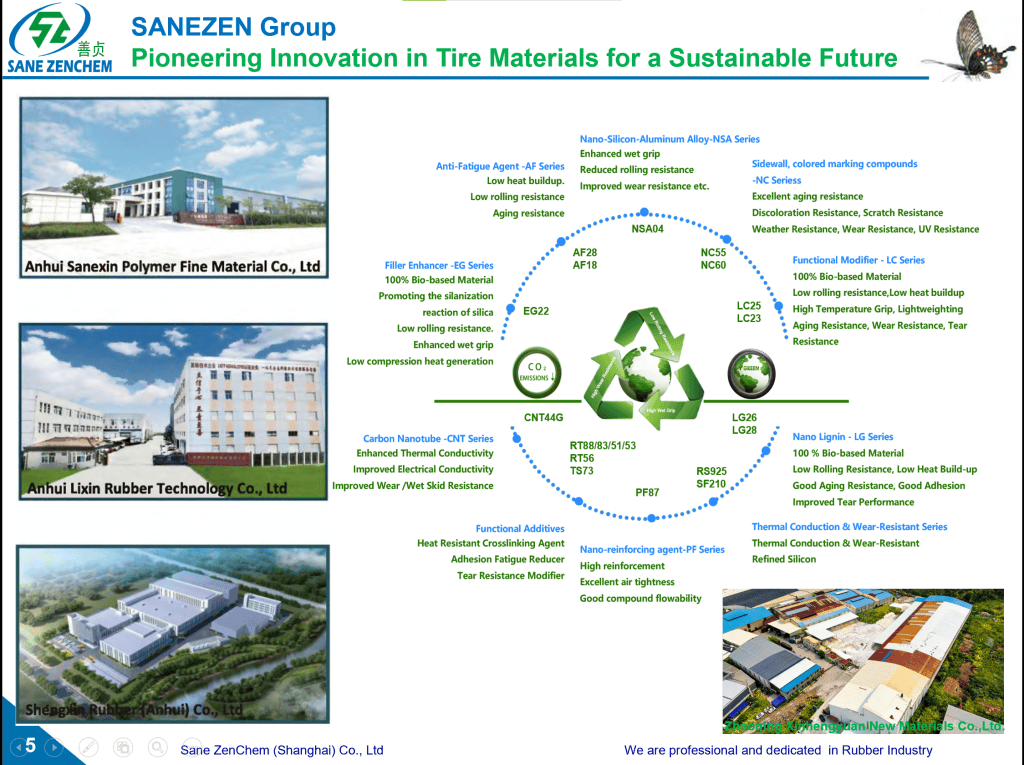
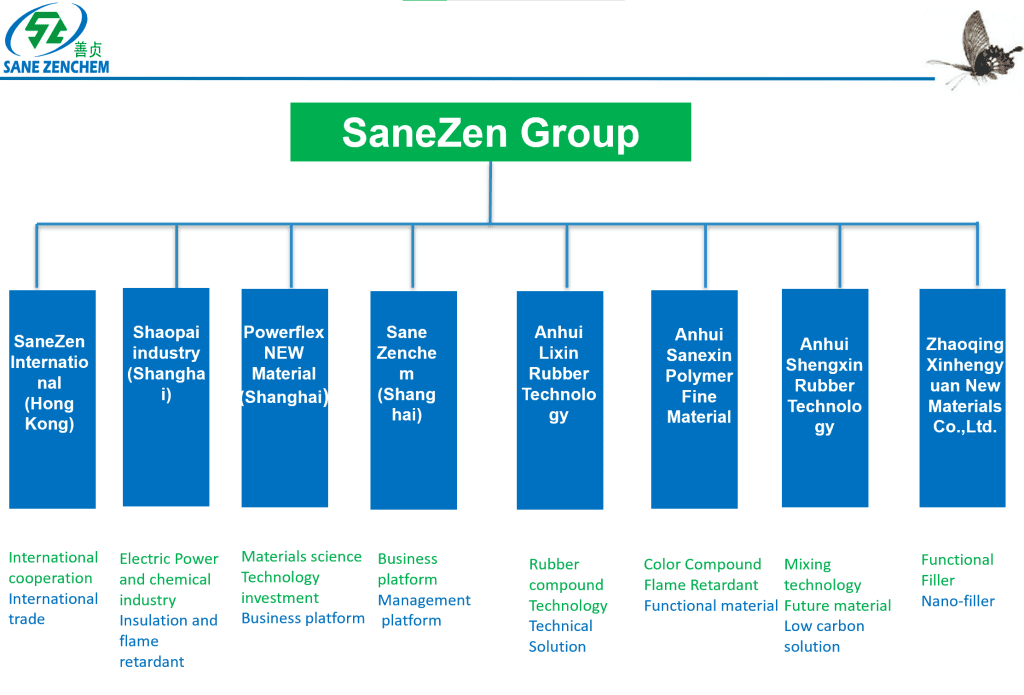
As a leading rubber anti reversion agent manufacturer in China and global specialty material supplier, SaneZen Group stands out because we don’t just produce chemicals—we operate world-class, integrated rubber manufacturing ecosystems:
- China’s 2nd Largest Compounding Powerhouse: Across our core production complexes (including Anhui Shengxin), we operate over 40 modern automated lines with an annual compounding capacity exceeding 150,000 tons. Because we run top-tier rubber and silicone compounding plants daily, we test and refine our additives in real-world formulations to guarantee flawless processing safety and field performance.
- Integrated Multi-Plant Infrastructure: Our group’s specialized facilities—from functional additive plants (Zhaoqing Xinhengyuan) and dust-free colored/silicone plants (Anhui Sanexin) to overseas production bases in Thailand—ensure complete supply stability, strict batch-to-batch consistency, and compliance with IATF 16949, ISO 9001, and ISO 14001 standards.
- Academic R&D & 30 Years of Industry Expertise: Backed by 3 R&D centers and technical joint ventures with 8 top universities (including Shanghai Jiao Tong University), our technical leaders bring nearly 30 years of rubber engineering expertise to tackle the industry’s tougher reversion, dynamic heat build-up, and heat-aging challenges.
- Proven Peer Trust & Global Recognition: Honored as a Strategic Technical Partner and Top 10 Supplier by Zhongding Group (No. 1 in China, No. 9 globally in non-tire rubber), SaneZen Group provides REACH- and RoHS-compliant chemicals trusted by global tire makers and NVH component manufacturers.
- Agile, 2-Day Rapid Technical Service: Managed by international industry experts, we commit to a 2-day rapid technical response, offering dedicated formulation optimization from initial lab testing to factory-scale vulcanization trials.
When you partner with SaneZen Group, you gain a high-barrier chemical solution backed by massive manufacturing scale, rigorous quality assurance, and real compounding expertise.
Ready to Eliminate Reversion & Boost Dynamic Durability?
Contact our engineering team today to request GreenThinking® RT88 samples, Technical Data Sheets (TDS), or a customized technical consultation!
FAQ
Q1: What is the mechanism of RT88?
Short Answer: Forms thermally stable carbon-sulfur crosslinks and compensates for crosslink loss caused by reversion.
Detailed Answer: RT88 participates in vulcanization to form crosslinks combining the thermal stability of mono-/disulfide bonds with the flexibility of polysulfide bonds; it also acts as a compensating curative to replace sulfur crosslinks lost due to reversion. It is a true rubber crosslinking additive for improved heat aging resistance.
Q2: What is the recommended dosage of RT88?
Short Answer: 0.5–3.0 phr with sulphur; 7.0 phr when used alone.
Detailed Answer: Conventional use with sulphur and accelerators: 0.5–3.0 phr; in sulphur-free systems, increase to 7.0 phr.
Q3: Which rubbers is RT88 suitable for?
Short Answer: NR and various synthetic rubbers.
Detailed Answer: RT88 is primarily intended for natural rubber (NR) and synthetic rubber products. Although reversion is most pronounced in NR, crosslink degradation under high-temperature curing is a common issue for all sulphur-cured systems. It is an anti reversion agent for natural rubber compounds and a rubber anti reversion additive for high temperature vulcanization.
Q4: How does RT88 affect dynamic properties?
Short Answer: Optimises dynamic properties, reducing the dynamic-to-static stiffness ratio.
Detailed Answer: In vibration isolators, RT88 reduces dynamic stiffness by 3.4%, increases static stiffness by 6.9%, and lowers the ratio by 10.1%. This makes it an anti reversion agent for rubber vibration isolator compounds.
Q5: How does RT88 improve heat ageing resistance?
Short Answer: By forming thermally stable crosslinks and retarding thermo-oxidative ageing.
Detailed Answer: After 100°C × 72 h ageing, RT88 formulations show tensile strength retention improved from 75.1% to 84.5%, and elongation retention from 62.1% to 75.3%.
Q6: Does RT88 affect cure speed?
Short Answer: Essentially no effect.
Detailed Answer: RT88 is recommended to be added at the final mixing stage with sulphur and accelerators; its effect on curing characteristics is controllable.
Q7: Can RT88 improve rubber-steel cord adhesion?
Short Answer: Yes.
Detailed Answer: RT88 improves adhesion between rubber and steel cord, critical for tyre durability and stability. It is an anti reversion additive for rubber steel cord adhesion.
Q8: How does RT88 differ from traditional anti-reversion agents such as PK900?
Short Answer: RT88 combines anti-reversion, heat-resistant crosslinking, and adhesion improvement in one product.
Detailed Answer: RT88 is a novel heat-resistant crosslinking anti-reversion agent, unlike single-function anti-reversion agents. It simultaneously achieves anti-reversion, heat ageing resistance, and adhesion enhancement through thermally stable carbon-sulfur crosslinks.
Q9: Is RT88 suitable for tyre shoulder pads?
Short Answer: Yes, particularly suitable.
Detailed Answer: RT88 significantly improves anti-reversion performance in shoulder pads, enhances property retention after heat ageing, and improves finished tyre durability. It is an anti reversion additive for NR tire compounds.
Q10: What is the storage stability of RT88?
Short Answer: 2-year shelf life.
Detailed Answer: Store in a dry, cool, sealed environment (approx. 25°C); shelf life about 2 years.
Q11: Does RT88 contain halogens?
Short Answer: No.
Detailed Answer: RT88 is an organic heat-resistant crosslinker, halogen-free.
Q12: How does RT88 affect compression set?
Short Answer: Essentially unchanged or slightly increased.
Detailed Answer: In vibration isolator tests, compression set at 160°C × 12 min increased from 54.5% to 58.5%, within acceptable limits.
Q13: Can RT88 reduce tyre rolling resistance?
Short Answer: Yes.
Detailed Answer: In tyre applications, RT88 helps reduce rolling resistance and improve durability and high-speed performance.
Q14: What is the addition method for RT88?
Short Answer: Add at the final mixing stage together with sulphur and accelerators.
Detailed Answer: RT88 can be mixed in an internal mixer or on a mill; it is recommended to add it at the final stage with sulphur and accelerators.
Q15: Is RT88 suitable for peroxide-cured systems?
Short Answer: Primarily designed for sulphur-cured systems.
Detailed Answer: RT88 is designed for reversion problems in sulphur-cured systems; reversion is not a prominent issue in peroxide systems.
Q16: How does RT88 affect hardness?
Short Answer: Essentially unchanged.
Detailed Answer: In vibration isolator tests, hardness remained at 64 Shore A with 0.8 phr RT88.
Q17: Is RT88 suitable for high-temperature vulcanization processes?
Short Answer: Yes, particularly suitable.
Detailed Answer: RT88 maintains stable mechanical properties under over-cure or high-temperature cure conditions, making it ideal for high-temperature rapid vulcanization. It is a dedicated rubber anti reversion additive for high temperature vulcanization.
Q18: Can RT88 improve NR’s thermo-oxidative ageing resistance?
Short Answer: Yes.
Detailed Answer: By forming thermally stable crosslinks and compensating for crosslink loss, RT88 significantly enhances NR’s heat ageing resistance. This is why it is offered by an NR anti reversion additive supplier and a rubber heat aging additive supplier China.
Q19: Does RT88 meet REACH and RoHS requirements?
Short Answer: Yes.
Detailed Answer: RT88 complies with REACH and RoHS environmental regulations. It is produced by a Rubber chemical manufacturer China with full regulatory documentation.
Q20: How can I obtain RT88 samples and technical support?
Short Answer: Contact Sunzen Group.
Detailed Answer: Technical data sheets, samples, and formulation optimisation support are available through the Sunzen Group official website or regional sales representatives. As a rubber anti reversion agent manufacturer China, rubber reversion inhibitor supplier China, heat resistant rubber crosslinker supplier, anti reversion rubber additive factory, rubber heat aging additive supplier China, NR anti reversion additive supplier, a, Sunzen Group provides RT88 for demanding rubber applications worldwide.
Contact
Plant Address:
Baishou Road, North District of Xuan Zhou Economic Development Zone
Xuan Cheng City, Anhui Province, China
Commercial Address:
Room 503, Building 1, Huixin International Edifice, No. 150 Puhuitang Road, Xuhui District, Shanghai, China 200030
Tel: +86 21 6487 9251
Email: yorichen@sanezen.com / kevenwang@sanezen.com
Website: www.sanezenrubber.com
 English
  Spanish
  Russian