
GreenThinking FR99RP is an eco-friendly, halogen-free composite flame retardant developed by SaneZen Group for mechanical rubber and engineering plastics (EPDM, NBR, HCR, NR, SBR). Engineered with a surface-treated platelet micro-structure, FR99RP easily achieves UL94 V-0 flammability ratings while preserving compound tensile strength, rebound resilience, and cure kinetics. Unlike heavy inorganic flame retardants like ATH, FR99RP exhibits low specific gravity, optimal dispersion, fast TC90 cure times, and superior thermal aging resistance. Fully compliant with EU RoHS 2.0, REACH SVHC, and WEEE regulations, FR99RP is the premium total solution for railway, automotive, cable, and industrial seal applications. As a leading halogen free flame retardant supplier China, SaneZen Group delivers consistent quality and technical excellence to global rubber compounders.
1. Introduction: The Evolving Challenge in Rubber Flame Retardancy
In the global rubber and polymer processing industry, designing compounds that meet stringent fire safety standards while retaining high mechanical performance is one of the most complex engineering challenges. Traditionally, achieving a UL94 V-0 vertical burning rating required loading rubber compounds with massive quantities of inorganic hydroxides—such as Aluminum Trihydrate (ATH) or Magnesium Hydroxide (MDH)—or relying on halogenated additive systems combined with antimony trioxide (Sb₂O₃).
However, modern regulatory frameworks, led by the European Union’s RoHS 2.0, REACH SVHC, and WEEE directives, have rapidly restricted halogenated flame retardants due to their release of toxic, corrosive hydrogen halide gases and dense toxic smoke during thermal degradation. Simultaneously, heavy loadings of conventional inorganic fillers (often exceeding 120-150 phr) severely compromise compound viscosity, slow down vulcanization, degrade tensile strength, increase compression set, and dramatically raise the specific gravity of finished rubber goods. This underscores the critical need for an innovative halogen free flame retardant for rubber compound that delivers fire safety without compromising elastomer performance.
To solve this industry dilemma, SaneZen Group (Anhui Sanexin Polymer Fine Material Co., Ltd.) engineered GreenThinking® FR99RP—a next-generation, surface-functionalized, halogen-free composite flame retardant specifically tailored for high-performance elastomer formulations.
2. What Is Halogen-Free Flame Retardant GreenThinking® FR99RP?
GreenThinking® FR99RP is an ultra-refined, surface-modified composite flame retardant designed to deliver synergistic gas-phase and condensed-phase fire suppression. Unlike single-component flame retardant powders, FR99RP integrates ultra-fine mineral platelet structures, surface activation agents, and functional synergists into a unified inorganic matrix.
FR99RP contains zero polybrominated biphenyls (PBBs), polybrominated diphenyl ethers (PBDEs), chlorine, fluorine, or antimony trioxide. It is non-toxic, odorless, and chemically stable across processing temperatures up to 220°C. Its general usage level ranges from 60 to 130 phr, depending on base polymer selection, required Shore A hardness, mechanical target values, and target flame retardancy class. As a premium halogen free flame retardant UL94 V0 EPDM compound solution, FR99RP enables compounders to meet the most demanding fire safety specifications with confidence.
As a general rule in compound design:
- Adding 6 to 8 phr of FR99RP increases compound hardness by approximately 1 Shore A degree.
- Adding 3 to 5 phr elevates the Limiting Oxygen Index (LOI) by 1 percentage unit, offering compounders precise predictability when fine-tuning formulations.
3. Why Halogen-Free Flame Retardancy Matters in Modern Rubber Compounding
The global transition toward eco-friendly flame retardancy is driven by three powerful forces: global regulatory compliance, end-user occupational safety, and eco-conscious engineering requirements.
Regulatory Compliance: International standards for mass transit (such as EN 45545-2 for European railway vehicles), automotive electrification (UL 94, ISO 6722), and building safety enforce strict limits on smoke density and smoke toxicity. Halogenated additives produce high volumes of corrosive hydrochloric or hydrobromic acid fumes, destroying sensitive electronics and posing lethal hazards during fire emergencies.
Processability and Lightweighting: Vehicle OEMs and mass transit manufacturers demand lightweight rubber components to reduce energy consumption. Conventional flame retardants elevate compound density to 1.40-1.55 g/cm³, whereas FR99RP maintains a significantly lower compound specific gravity (~1.18 – 1.24 g/cm³), directly aiding weight-reduction goals. This makes FR99RP an ideal low specific gravity flame retardant additive for rubber compounding, addressing the automotive and transportation industry’s lightweighting imperatives.
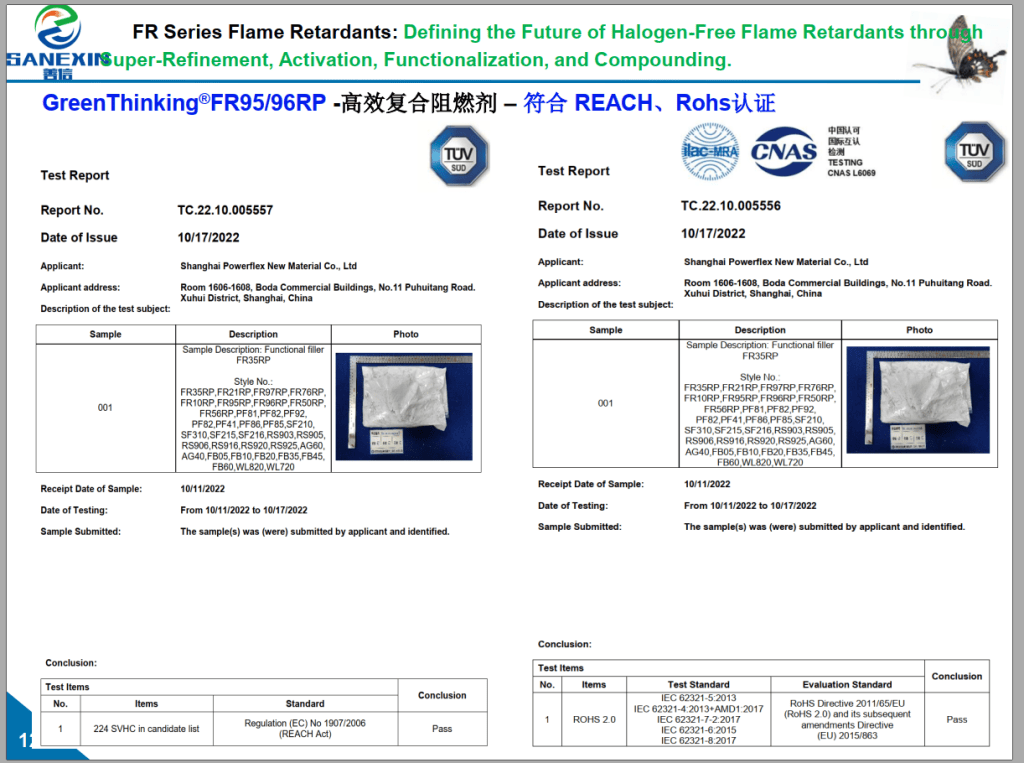
Global Market Access: Products compliant with TÜV SÜD tested RoHS 2.0 (Directive 2011/65/EU and amendment (EU) 2015/863) and REACH 224 SVHC candidates enjoy seamless export clearance into North American, European, Japanese, and Southeast Asian markets. As a trusted halogen free flame retardant manufacturer China, SaneZen Group ensures all products meet the highest international compliance standards.
4. Common Problems in Flame Retardant Rubber Compounding
Compounders and rubber engineers frequently encounter severe technical trade-offs when formulating fire-retardant elastomers. The 6 most common industry pain points include:
- Severe Mechanical Degradation: Loading high dosages of ATH or MDH causes drastic drops in tensile strength, tear strength, and ultimate elongation at break.
- Retarded Vulcanization & Extended Cycle Times: Conventional flame retardants often disrupt peroxide or sulfur vulcanization systems, dramatically extending TC90 cure times and reducing Mooney scorch safety.
- High Viscosity & Processing Difficulties: Poor filler dispersion leads to high compound Mooney viscosity, resulting in extrusion die swell, rough surface finishes, and difficult mold filling.
- Excessive Compression Set & Loss of Rebound Elasticity: Industrial seals and railway dampening pads lose their sealing pressure and elastic recovery under continuous thermal-mechanical stress.
- Heavy Intumescent Swelling & Soot Generation: Certain flame retardant systems swell excessively upon burning, leaving structural gaps and releasing abundant black soot/ash during combustion.
- Surface Blooming & Chemical Migration: Incompatible additives migrate to the rubber surface over time, leading to unsightly white blooming and degradation of surface aesthetics.
5. Root Cause Analysis: Why Conventional Flame Retardants Fall Short
The fundamental root cause of these compounding issues lies in poor interfacial compatibility, uncontrolled particle size distribution, and single-mode flame suppression mechanisms.
Inorganic fillers like raw ATH possess hydrophilic hydroxyl groups (-OH) on their surface. Elastomers such as EPDM, NBR, and SBR are hydrophobic non-polar or moderately polar matrices. Without specialized 100% surface treatment, raw inorganic particles agglomerate into micro-clusters. These agglomerates act as stress concentration points under tensile load, initiating micro-cracks that degrade tensile strength and elongation.
Furthermore, untreated surfaces absorb active vulcanization accelerators (such as sulfur donors, thiazoles, or peroxides), delaying the onset of crosslinking (TS2) and prolonging the optimum cure time (TC90). This absorption reduces overall crosslink density (MH – ML), directly resulting in poor compression set resistance and low rebound resilience. This is precisely how to achieve UL94 V0 rating in EPDM without losing tensile strength—by eliminating the interfacial incompatibility that undermines mechanical performance.
6. Technical Solution: Synergistic Flame Retardancy via Micro-Refinement & Surface Activation
SaneZen’s GreenThinking® FR99RP addresses these root causes through advanced powder engineering: Super-Refinement, Surface Activation, Functionalization, and Synergistic Compounding.
Platelet Structure & Surface Modification: FR99RP particles feature a high-aspect-ratio platelet morphology treated with a proprietary organic coupling layer. This ensures 100% organophilic surface compatibility, enabling complete wet-out and uniform dispersion in EPDM, NBR, and SBR matrices without agglomeration. This advanced formulation positions FR99RP as a superior halogen free flame retardant for EPDM NBR compound applications.
Dual-Action Flame Retardant Mechanism:
- Condensed Phase: When exposed to high heat, FR99RP decomposes endothermically, forming a dense, cohesive, ceramic-like protective char barrier on the polymer surface. This barrier insulates underlying rubber from thermal radiation and blocks oxygen/combustion gas diffusion.
- Gas Phase & Radical Scavenging: Simultaneously, FR99RP releases non-combustible water vapor and carbon dioxide to dilute flammable pyrolysis gases, while releasing active radical trapping agents that capture H· and OH· combustion radicals, terminating radical chain reactions.
Vulcanization Synergy: Because FR99RP’s surface is activated, it does not adsorb vulcanization accelerators or peroxides. As a result, the active crosslinking network remains fully intact, accelerating TC90 cure speed and maintaining high crosslink density.
7. Primary Application Fields
GreenThinking® FR99RP is widely utilized across demanding industrial sectors requiring UL94 V-0 or EN 45545 fire safety ratings:
- Railway Transportation: Gangway bellows, window seal profiles, vibration damping pads, floor mats, and cable conduit grommets. As an eco friendly halogen free flame retardant for railway rubber seals, FR99RP meets the stringent EN 45545-2 smoke toxicity and flammability requirements essential for mass transit safety.
- Automotive & EV Components: Battery pack seals, high-voltage wire insulation, under-hood rubber hoses, and thermal runaway barriers. FR99RP serves as a premier non toxic flame retardant for automotive EPDM battery pack seals, providing fire protection without compromising occupant safety or environmental compliance.
- Industrial Rubber Seals & Profiles: EPDM weatherstripping, NBR oil-resistant seals, HCR silicone gaskets, and expansion joints.
- Wire & Cable Compounds: Power cables, mining trailing cables, transit signal wiring, and flame-retardant sheathing.
- Mining & Conveyor Belts: Heavy-duty fire-resistant conveyor belting, roller coatings, and underground ventilation curtains.
- Engineering Plastics & TPEs: Flame-retardant thermoplastic elastomers, PVC flexible compounds, and CPE/VMQ mechanical goods.
8. Comparative Performance Analysis: FR99RP vs. FR98RP in Rubber Formulations
To demonstrate the empirical performance benefits of FR99RP, SaneZen’s Polymer R&D Laboratory conducted comparative testing against FR98RP across EPDM 70 Shore A, EPDM 50 Shore A, and NBR 70 Shore A base formulations.
Table 1: Technical Data Comparison in EPDM 70 Shore A Base Formulation
(Test Conditions: Rheometer at 180°C × 5 min; Mechanicals at 175°C × 6 min; Heat Aging at 100°C × 70h; Compression Set at 120°C × 24h)
| Test Item | FR98RP-80 (80 phr) | FR99RP-80 (80 phr) | FR98RP-100 (100 phr) | FR99RP-100 (100 phr) |
| Rheometer ML (lbf-in) | 0.92 | 0.90 | 1.09 | 1.04 |
| Rheometer MH (lbf-in) | 11.18 | 12.55 | 11.27 | 14.62 |
| Delta Torque MH-ML (lbf-in) | 10.26 | 11.65 | 10.18 | 13.58 |
| Scorch Time TS2 (sec) | 59 | 41 | 63 | 41 |
| Optimum Cure TC90 (sec) | 207 | 96 | 221 | 112 |
| Hardness (Shore A) | 74 | 74 | 78 | 76 |
| Tensile Strength (MPa) | 7.63 | 9.26 | 6.35 | 9.32 |
| Elongation at Break (%) | 406 | 421 | 417 | 497 |
| 100% Modulus M100 (MPa) | 2.64 | 2.77 | 2.59 | 2.69 |
| Specific Gravity (g/cm³) | 1.220 | 1.238 | 1.241 | 1.242 |
| UL94 Flammability Class | V-0 | V-0 | V-0 | V-0 |
| Limiting Oxygen Index LOI (%) | — | — | 42.3 | 35.4 |
| Heat Aging Tensile Change (%) | — | — | -7.56% | -3.54% |
| Compression Set (% @ 120°C/24h) | — | — | 52.94% | 31.43% |
| Rebound Resilience (%) | — | — | 37% | 47% |
Key Findings from EPDM 70 Shore A Testing:
- Cure Speed & Productivity: FR99RP dramatically shortens TC90 cure time (112 seconds at 100 phr vs. 221 seconds for FR98RP), cutting molding cycle time by nearly 50%. This makes FR99RP a genuine fast curing halogen free flame retardant additive for automotive rubber and high-volume industrial manufacturing.
- Tensile Strength Maintenance: At 100 phr loading, FR99RP maintains an outstanding tensile strength of 9.32 MPa compared to 6.35 MPa for FR98RP—a 46.7% tensile improvement. This directly demonstrates how to achieve UL94 V0 rating in EPDM without losing tensile strength through advanced surface activation technology.
- Compression Set Superiority: FR99RP achieves a low compression set of 31.43% at 120°C/24h, whereas FR98RP exhibits 52.94%, making FR99RP the definitive choice for dynamic seals.
- Char Quality: While FR98RP provides higher LOI, it swells heavily during combustion, producing volatile ash. FR99RP forms a solid ceramic-like char shield that effectively extinguishes flames without excessive intumescent distortion.
Table 2: Comparative Performance in NBR 70 Shore A Base Formulation
(Test Conditions: Rheometer at 180°C × 5 min; Mechanicals at 175°C × 5 min; 100 phr Flame Retardant Loading)
| Test Item (NBR 70 Shore A) | FR98RP-100 (100 phr) | FR99RP-100 (100 phr) |
| Delta Torque MH-ML (lbf-in) | 8.45 | 12.53 |
| Optimum Cure TC90 (sec) | 79 | 94 |
| Hardness (Shore A) | 76 | 75 |
| Tensile Strength (MPa) | 9.23 | 9.43 |
| Elongation at Break (%) | 455% | 522% |
| 100% Modulus M100 (MPa) | 2.55 | 2.94 |
| Specific Gravity (g/cm³) | 1.312 | 1.280 |
| UL94 Vertical Burning Rating | V-0 | V-0 |
| Rebound Resilience (%) | 24% | 33% |
9. Best Practices for Compounding and Processing GreenThinking® FR99RP
To maximize performance when incorporating GreenThinking® FR99RP into internal mixers (Banbury) or open two-roll mills, follow these engineering best practices:
- Mixing Sequence: Add FR99RP during the early stage of the masterbatch mixing cycle alongside zinc oxide, stearic acid, and reinforcing carbon black/white fillers. Early addition ensures complete dispersion in the base polymer matrix prior to oil injection.
- Plasticizer Integration: When formulating soft compounds (50-60 Shore A) requiring higher paraffinic oil or plasticizer levels, add plasticizers incrementally after FR99RP is incorporated to prevent powder agglomeration.
- Temperature Control: Keep internal mixer discharge temperatures between 100°C and 130°C to ensure optimal surface coupling action without premature vulcanization risk.
- Extrusion Settings: FR99RP enhances compound fluidity and dimensional stability. Extruder barrel temperatures can be set 5-10°C lower than standard ATH compounds, resulting in smooth surface profiles and lower energy consumption.
10. Future Trends in Eco-Friendly Flame Retardant Additives
The global rubber additives market is moving inexorably toward ultra-clean, halogen-free, non-antimony formulations with zero toxic smoke emissions. Future regulatory updates in Europe and North America will likely place tighter restrictions on heavy metal contaminants and volatile organic compounds (VOCs). SaneZen Group continues to pioneer micro-refinement, surface activation, and multi-element compounding technologies, ensuring our global partners stay ahead of regulatory demands while optimizing manufacturing efficiency. As a premier halogen free flame retardant factory China, SaneZen maintains state-of-the-art production facilities capable of meeting the most rigorous quality standards.
11. Key Takeaways for Technical Decision Makers
- UL94 V-0 Compliance: GreenThinking FR99RP enables EPDM, NBR, and SBR compounds to easily achieve UL94 V-0 flame retardancy without halogenated additives or antimony trioxide. This makes it the preferred halogen free flame retardant UL94 V0 EPDM compound solution for demanding applications.
- Superior Tensile Retention: FR99RP preserves polymer tensile strength (9.32 MPa in 70 Shore A EPDM at 100 phr) and delivers high elongation at break (~500%), answering the industry’s search for how to achieve UL94 V0 rating in EPDM without losing tensile strength.
- 50% Faster Vulcanization: FR99RP cuts cure time TC90 by nearly 50% compared to conventional flame retardants, significantly increasing factory molding productivity. As a fast curing halogen free flame retardant additive for automotive rubber, it enables high-volume production efficiency.
- Low Compression Set: FR99RP provides outstanding compression set resistance (31.43% @ 120°C/24h) and superior rebound resilience (47%), ideal for dynamic industrial seals.
- Full Global Certification: Fully certified under EU RoHS 2.0, REACH 224 SVHC, and PAHs standards by TÜV SÜD, providing full compliance for global export markets. As a trusted halogen free flame retardant supplier China, SaneZen ensures seamless regulatory compliance.
12. Frequently Asked Questions (FAQs)
Q1: How does GreenThinking FR99RP achieve UL94 V-0 without halogens or antimony trioxide?
A1: FR99RP utilizes a multi-mechanism synergistic compounding technology. Upon exposure to flame, its surface-treated platelet micro-structure undergoes endothermic decomposition, releasing heat-absorbing water vapor and carbon dioxide, while forming a dense ceramic-like protective char barrier that cuts off oxygen and heat diffusion.
Q2: Will FR99RP affect the vulcanization speed or scorch safety of my EPDM formulation?
A2: No. Unlike untreated inorganic powders that absorb crosslinking accelerators and delay cure, FR99RP’s 100% surface-activated coating prevents accelerator absorption. In fact, comparative rheometer tests show FR99RP shortens TC90 cure time from 221 seconds down to 112 seconds, optimizing cure kinetics while maintaining excellent scorch safety. This makes FR99RP an ideal fast curing halogen free flame retardant additive for automotive rubber applications where cycle time efficiency is critical.
Q3: How much FR99RP should I add to reach a UL94 V-0 rating in EPDM or NBR rubber?
A3: General usage ranges from 60 to 130 phr, depending on compound hardness, filler loading, and plasticizer content. As a rule of thumb, adding 6-8 phr increases hardness by 1 Shore A degree, and adding 3-5 phr elevates the Limiting Oxygen Index (LOI) by 1 unit. Our technical support team provides customized formulation optimization for your target specs.
Q4: How does FR99RP compare to traditional ATH (Aluminum Trihydrate) in physical properties and compression set?
A4: High loadings of ATH degrade tensile strength, increase compound density, and lead to poor compression set (>50%). FR99RP delivers significantly higher tensile strength (>9.0 MPa), lower compound density (~1.24 g/cm³), and superior compression set resistance (31.43% at 120°C/24h). As a low specific gravity flame retardant additive for rubber compounding, FR99RP helps achieve lightweight component designs without compromising fire safety.
Q5: Is GreenThinking FR99RP compliant with international environmental directives for export?
A5: Yes. FR99RP is officially tested and certified by TÜV SÜD to comply with EU RoHS Directive 2011/65/EU and amendment (EU) 2015/863, REACH Regulation (EC) No 1907/2006 (224 SVHC candidate list), PAHs limits, and WEEE rules. As a responsible halogen free flame retardant manufacturer China, SaneZen Group ensures all products meet rigorous environmental standards.
Q6: Can FR99RP be used in extruded rubber profiles requiring smooth surface aesthetics?
A6: Absolutely. Thanks to its platelet micro-structure and organophilic surface modification, FR99RP exhibits excellent compound fluidity and dispersion, preventing die buildup and producing smooth, bloom-free extruded profiles with tight dimensional tolerances.
Q7: Is FR99RP suitable for railway applications requiring eco-friendly flame retardancy?
A7: Yes. FR99RP is the preferred eco friendly halogen free flame retardant for railway rubber seals, meeting EN 45545-2 requirements for low smoke toxicity, low heat release, and flame spread resistance while maintaining excellent physical properties.
Q8: Can FR99RP be used in automotive battery pack seal applications?
A8: Yes. FR99RP is an effective non toxic flame retardant for automotive EPDM battery pack seals, providing fire protection without releasing toxic or corrosive gases during thermal events—critical for electric vehicle safety.
Q9: How does FR99RP perform in NBR compounds compared to other halogen-free options?
A9: FR99RP performs exceptionally well as a halogen free flame retardant for EPDM NBR compound formulations, delivering superior tensile strength (9.43 MPa), higher elongation (522%), and improved rebound resilience (33%) compared to conventional flame retardants at the same loading.
Q10: Where can I source FR99RP as a reliable halogen free flame retardant supplier China?
A10: SaneZen Group is a leading halogen free flame retardant supplier China and halogen free flame retardant manufacturer China with over a decade of experience in polymer additive technology. Contact our sales team for product samples, technical datasheets, and formulation support.
13. SaneZen R&D and Manufacturing Capabilities (Factory Strength)
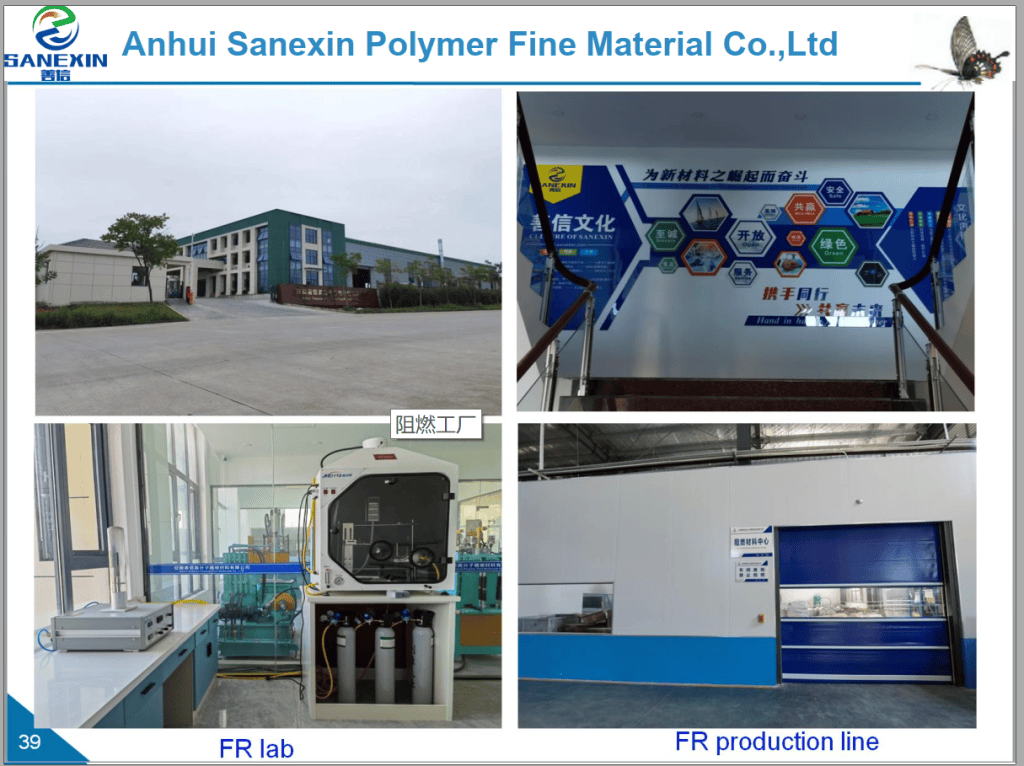
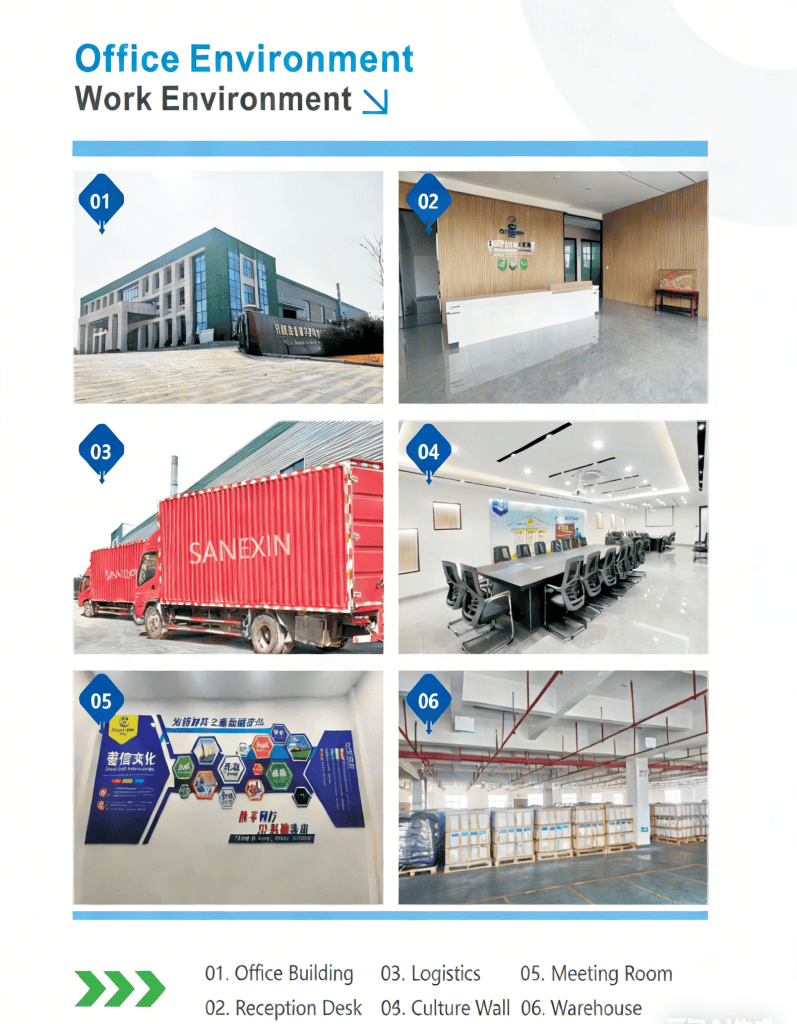
Anhui Sanexin Polymer Fine Material Co., Ltd. (SaneZen Group) is a high-tech enterprise dedicated to the research, development, and production of environmentally friendly polymer additives and flame retardant solutions. As a recognized halogen free flame retardant factory China, SaneZen Group operates with world-class manufacturing standards.
- Specialized R&D Center & Flame Retardant Lab: Equipped with state-of-the-art oxygen index meters, vertical/horizontal flame testers, automated moving die rheometers (MDR), universal tensile testing machines, heat aging ovens, and laser particle size analyzers.
- Automated Production Lines: Operating modern, automated compounding and surface-activation production lines in the Xuan Zhou Economic Development Zone, Anhui, ensuring high batch-to-batch consistency and low impurity content.
- Global Raw Material Selection: 100% of raw materials undergo strict surface activation, functionalization, and micro-refinement quality control under ISO 9001 and ISO 14001 systems.
- Complete Application Support: Beyond selling additives, SaneZen functions as a dedicated rubber solution provider. Our technical team—led by senior rubber chemical engineers—offers full formulation advice, recipe optimization, compounding trials, and custom flame retardant development for global clients.
14. Contact Us & Request Free Testing Samples
Need technical support or customized flame retardant formulations for your rubber compounds?
Whether you are developing fire-resistant profiles for mass transit, automotive battery pack seals, mining conveyor belts, or cable compounds, SaneZen’s technical experts are ready to assist you.
Contact us today to receive detailed technical datasheets (TDS), safety datasheets (SDS), formulation guidance, or free testing samples for your laboratory evaluation!
Company: SaneZen Group / Sane ZenChem (Shanghai) Co., Ltd.
Commercial Address: Room 1606-1608, Boda Commercial Buildings, No. 11 Puhuitang Road, Xuhui District, Shanghai, China (Zip: 200030)
Plant Address: Baishou Road, North District of Xuan Zhou Economic Development Zone, Xuan City, Anhui Province, China
Tel/WeChat/WhatsApp: +86-13671641995
Email: yorichen@sanezen.com | Website: www.sanezenrubber.com
Core Values: 至诚 Sincere | 开放 Open | 共赢 Win-Win
 English
  Spanish
  Russian