
What this page answers
A reinforcing filler is bought to replace something: carbon black, kaolin, talc or light calcium carbonate. That makes the purchase decision a comparison, and most filler comparisons are not comparable, because each supplier tests in its own compound at its own loading and reports the columns it wins.
This page reports one comparison that is comparable. Six fillers, including our own two and four competitors, were run at an identical 130 phr in the same EPDM compound, with the same oil, the same cure system and the same test methods. It also reports three application trials on a related grade: a tire inner liner where the filler replaced part of the carbon black, a CPE cable sheath where it replaced kaolin and talc at equal loading, and an EPDM braided hose where the reason for using it was neither strength nor cost.
The purpose is not to win every column. Two of the columns below do not favour us, and they are the two that decide whether a carbon black replacement filler is suitable for a heat resistant part.
The problem a filler is bought to solve
A rubber compound is mostly filler. In an EPDM extrusion compound at 130 phr of filler on 100 phr of polymer, the filler is more than half the volume, and its price, its density and its reinforcing efficiency set the compound cost per kilogram and per litre.
Four different purchases hide under the word filler, and they have different decision criteria.
The first is a reinforcing filler, used to reach a hardness and a strength that the polymer alone cannot reach. Carbon black is the benchmark, and the question is how much of it can be replaced before the properties fall.
The second is a low density reinforcing filler, used to reach a hardness at a lower compound density. Density is what a customer buys per unit volume, so a filler at 2.5 g/cm3 replacing one at 1.8 g/cm3 makes every part heavier and more expensive even if the price per kilogram is lower.
The third is a filler used for a specific property that has nothing to do with strength: air tightness in an inner liner, volume resistivity in a cable, whiteness in a light coloured part, or the absence of migration in a braided hose.
The fourth is a filler bought to reduce cost, where the whole argument is how many phr can be added before the compound stops being processable.
A single product rarely wins all four. That is why the comparison below has six columns rather than one.
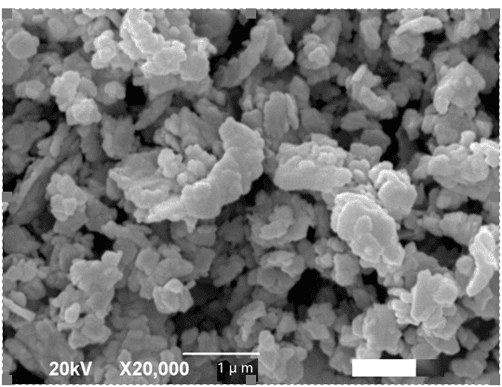
Figure 1. Particle morphology at 20,000 times, with a 1 micrometre scale bar. The stacked angular structure is what the data sheet describes as flake shaped.
The compound that makes the comparison fair
The six fillers were compared in an EPDM 512E compound at 130 phr, with the same paraffin oil, the same cure system and the same mixing procedure. Every one of them is sold as a functional filler for EPDM compound, and the point of the trial is to find out how differently six products in that description behave in one recipe.
| Material, phr | Level |
| EPDM 512E | 100 |
| Filler under test | 130 |
| Paraffin oil Sanepar 916 | 30 |
| Zinc oxide | 5 |
| Stearic acid | 1 |
| PEG 4000 | 1 |
| Dispersant D212 | 1 |
| Sulphur S-80 | 1.5 |
| AG60 | 5 |
| Total | 274.5 |
Cure was measured at 180 C for 5 minutes, slabs were cured at 175 C for 6 minutes, ageing was 168 hours at 100 C, and compression set was 70 hours at 70 C. Volume resistivity was measured to IEC 60811. The same recipe, the same day, the same operator: that is what makes the numbers below worth reading against each other.
The six-way comparison
| Property | PF82 | PF81 | Competitor A | Competitor B | Competitor C | Competitor D |
| Mooney viscosity ML(1+4) | 74.0 | 81.6 | 81.7 | 80.0 | 76.0 | 82.1 |
| ML, dN.m | 1.07 | 1.08 | 1.57 | 1.06 | 0.95 | 1.16 |
| MH, dN.m | 10.32 | 10.66 | 10.12 | 11.03 | 11.47 | 12.53 |
| TS2, seconds | 77 | 70 | 55 | 73 | 73 | 80 |
| TC90, seconds | 235 | 202 | 217 | 224 | 215 | 246 |
| Hardness, Shore A | 59 | 59 | 60 | 62 | 61 | 60 |
| Modulus at 100 percent, MPa | 2.34 | 2.13 | 2.40 | 3.26 | 2.79 | 1.85 |
| Tensile strength, MPa | 14.21 | 10.27 | 16.14 | 11.03 | 8.26 | 7.67 |
| Elongation at break, percent | 646 | 540 | 637 | 540 | 523 | 539 |
| Specific gravity, g/cm3 | 1.340 | 1.336 | 1.309 | 1.324 | 1.330 | 1.329 |
| Compression set, 70 h at 70 C, percent | 26.83 | 24.82 | 41.38 | 18.75 | 21.69 | 27.53 |
| Hardness change after ageing, points | +8 | +8 | +10 | +7 | +6 | +9 |
| Tensile strength change after ageing, percent | -57.9 | -39.5 | -44.8 | -15.4 | -42.9 | -40.2 |
| Elongation change after ageing, percent | -45.5 | -41.7 | -40.7 | -53.5 | -45.6 | -44.6 |
| Volume resistivity, ohm.cm | 3.6 x 10^15 | 1.3 x 10^15 | 4.8 x 10^14 | 3.0 x 10^15 | 2.6 x 10^15 | 2.7 x 10^14 |
Competitor A is the German product, B the American one, and C and D are two mid-market products. Naming them would be a legal exercise rather than a technical one, so the columns are labelled by origin and the numbers are as measured.
What the comparison actually shows
Start with processing, because it is the column that decides whether a filler can be used at 130 phr at all.
The Mooney viscosity range across the six is 74.0 to 82.1, and PF82 sits at the bottom of it. A nano reinforcing filler for rubber that drops Mooney viscosity at equal loading buys a wider processing window: faster extrusion, less die swell, lower dump temperature, and the option of adding more filler before the compound stops flowing. Two of the six are more than seven points higher, which at this loading is the difference between a compound that extrudes smoothly and one that needs the profile re-designed.
Processing position is not the same as property position, and this is where the honest part starts.
Tensile strength at 130 phr runs from 7.67 to 16.14 MPa. PF82 at 14.21 MPa beats PF81, competitor B, C and D, and loses to competitor A by 1.93 MPa. That is a real gap and it belongs in the article rather than in a footnote. The German product is a harder filled system in this compound, with a modulus at 100 percent elongation of 2.40 against 2.34, and a higher state of cure. If the requirement is the highest possible tensile strength at 130 phr of filler, competitor A is the right purchase and we would say so.
Elongation runs the other way, and it is where PF82 wins clearly: 646 percent against 637 for competitor A and 523 to 540 for the rest. For an extruded profile or a hose that has to be pulled off a mandrel, elongation at break is often the property that decides whether a compound is workable, and it is a 12 to 20 percent advantage here.
Then the two columns that do not favour us.
Compression set at 70 C for 70 hours measured 26.83 percent for PF82. Competitor B measured 18.75 and competitor C 21.69, both better. Competitor A measured 41.38, much worse. So PF82 sits in the middle of a wide spread, and for a sealing application at this loading the American product is the better choice.
Tensile strength retention after 168 hours at 100 C is the weakest result in the table: PF82 lost 57.9 percent against 44.8 for competitor A, 42.9 for C and 15.4 for B. That is a genuine limitation for a heat resistant part, and it is consistent with the hardness rise of 8 points, which is among the highest in the set. A filler that produces a compound with more bound rubber and a tighter network at 130 phr will also age harder.
The volume resistivity column is a separate win worth noting. At 3.6 x 10^15 ohm.cm, PF82 is the highest of the six by a factor of about seven over the German product and more than an order of magnitude over competitor D. An insulating filler for rubber is judged on exactly this, and it is the reason the grade exists as a separate product rather than as a grade of the general purpose filler.
Reading the table as a purchase decision
| If the requirement is | The column that decides | Which filler the data supports |
| Lowest compound viscosity at 130 phr | Mooney | PF82 |
| Highest tensile strength at 130 phr | Tensile | Competitor A |
| Highest elongation for an extrusion | Elongation | PF82 |
| Lowest compression set for a seal | Compression set | Competitor B |
| Highest tensile retention after ageing | Ageing | Competitor B |
| Highest volume resistivity | Volume resistivity | PF82 |
| Lowest density | Specific gravity | Competitor A |
The last row is the one that surprises buyers. Specific gravity across the six runs from 1.309 to 1.340, so the density difference between the lightest and heaviest filler in this set is 2.4 percent. On a compound at 1.34 g/cm3 that is about 32 kg per cubic metre, which on a large extruded profile is a material cost worth calculating, and it is not a function of price.
The inner liner case: air tightness, not strength
The second trial uses a different grade, PF87, in a tire inner liner where it replaced part of the carbon black rather than being added on top. An inner liner is the clearest case of a filler for tire inner liner compound being bought for one property only, and that property is not strength.
| Material, phr | Blank | With PF87 |
| Brominated butyl rubber | 80 | 80 |
| Natural rubber | 20 | 20 |
| Carbon black N660 | 60 | 50 |
| PF87 | – | 20 |
| Zinc oxide | 3.75 | 3.75 |
| Stearic acid | 1 | 1 |
| Naphthenic oil 4700 | 9 | 9 |
| Homogenising agent 40MS | 7 | 7 |
| Tackifying resin 1802 | 4 | 4 |
| Sulphur | 1 | 1 |
| Accelerator DM | 1.2 | 1.2 |
| Total | 186.95 | 196.95 |
| Property | Blank | With PF87 |
| Mooney viscosity ML(1+4) at 100 C | 56.3 | 53.6 |
| Mooney scorch t5 at 125 C, min | 29.8 | 29.3 |
| T35 at 125 C, min | 66.1 | 68.8 |
| ML, dN.m at 151 C | 1.12 | 0.98 |
| MH, dN.m at 151 C | 4.29 | 4.07 |
| TS1, min | 7.43 | 8.49 |
| T90, min | 20.17 | 21.30 |
| Hardness, Shore A | 55 | 55 |
| Specific gravity | 1.135 | 1.179 |
| Tear strength, kN/m | 33 | 32 |
| Tensile strength, MPa | 10.1 | 10.9 |
| Elongation at break, percent | 758 | 752 |
| Tensile strength after 48 h at 100 C, MPa | 9.3 | 9.9 |
| Tear strength after ageing, kN/m | 29 | 26 |
| Flex cracking, 500,000 cycles, grade | 0 | 0 |
The physical properties are essentially unchanged: hardness identical, tear down 1 point, elongation down 6 points, tensile up 8 percent. The aged result holds the same pattern, with tensile up and tear down 3 points.
The property this trial was run for is at the bottom of the list.
| Permeability | Blank | With PF87 | Change |
| Permeance, m3/(m2.day.Pa) | 12.73 | 11.32 | -11.1 percent |
| Permeability coefficient, x 10^14 cm2/(s.Pa) | 16.53 | 15.43 | -6.7 percent |
Two figures, two different meanings, and the difference between them is worth explaining because it is the mistake made in most inner liner claims.
Permeance is a property of the test film: it includes the thickness. The permeability coefficient is a property of the material, normalised for thickness. Here permeance fell 11.1 percent while the coefficient fell 6.7 percent, which means part of the permeance improvement comes from the specimen being thicker, not from the material being tighter. The specific gravity rose from 1.135 to 1.179, and at equal mass per unit area a denser compound is a thinner film, or at equal thickness a heavier one. A filler to improve air tightness has to do it through the material and not through the film thickness, so how to improve air tightness of a tire inner liner is a question about the coefficient, and the 6.7 percent figure is the one to carry into a calculation. The 11.1 percent is the number a film measured at a fixed mass would show, and it should be quoted with that condition attached.
The second honest note on this trial is the cure. T90 moved from 20.17 to 21.30 minutes, so the compound cures more slowly with 20 phr of this filler in place of 10 phr of N660. That is a rate loss of about 5 percent on a long inner liner cycle, and it has to be recovered somewhere: either in the cure system or in the line speed.
The cable sheath case: equal replacement against kaolin and talc
The third trial is the one that is easiest to use commercially, because it is a straight substitution at equal loading in a production type compound: 40 phr of PF87 in a CPE cable sheath, against 40 phr of a Haicheng talc and 40 phr of a kaolin.
| Filler at 40 phr in CPE | Tensile strength, MPa | Oxygen index, percent | Specific gravity |
| PF87 | 12.7 | 38.5 | lowest of the three |
| Talc, Haicheng 2500 | 10.1 | 35.4 | higher |
| Kaolin, Xinjingtai | 9.6 | 35.3 | higher |
The tensile result is 26 percent above the talc compound and 32 percent above the kaolin compound. The kaolin replacement in rubber compound case is the one that matters, because kaolin is the incumbent in most CPE cable sheaths.
The oxygen index result is the more interesting one, because it was not designed in. At equal loading, the PF87 compound measured 38.5 against 35.4 and 35.3. Flake structured minerals with a high aspect ratio lengthen the diffusion path for fuel and heat through the char, and a reinforcing filler for CPE cable sheath that raises the oxygen index at equal loading lets the formulator reduce something else: less ATH, or less of the flame retardant package, or a thinner sheath for the same rating.
The density result is the third part of the case and the source of the cost saving. A compound at a lower specific gravity uses less material per metre of cable, and cable is sold by the metre.
These are summary results from a production type trial rather than a full property set, and the individual ageing and compression set results behind them are not in this page. Treat the three columns as the trial’s conclusion and the rest as something to establish in your own compound.
The braided hose case: neither strength nor cost
The fourth trial is worth including because the reason for the purchase is not in any of the columns above.
A filler for extruded rubber hose is bought against a different requirement again: the compound has to come out of the die straight and keep its dimensions, and the surface has to stay clean. In an EPDM extruded braided hose at 65 to 70 Shore A, the compound used 100 phr of light calcium carbonate and 10 phr of N550, and 80 phr of PF87 replaced the kaolin in the incumbent compound. The problem being solved was not strength. It was that small molecules in the compound migrated to the surface and stained the braid, so the hose arrived at the customer with a discoloured sleeve.
| Material, phr | Level |
| EPDM | 100 |
| Light calcium carbonate | 100 |
| Carbon black N550 | 10 |
| PF87 | 80 |
| Paraffin oil | 50 |
The result was reported as no small molecule migration, no contamination of the braid and no discolouration, with better elasticity and recovery by hand. There are no numbers attached to that in the source material, and it is stated here as a qualitative observation from a production trial rather than as a measurement.
How to stop plasticiser migration in a braided hose is a question about solubility and about tortuosity. A plasticiser migrates when it is present above its solubility limit and when the path out of the compound is short. A flake filler raises the path length, and a compound with a higher filler volume needs less plasticiser for the same hardness, so both terms move in the right direction.
Dosage, hardness and the arithmetic that matters
All three grades share the same dosage convention: 30 to 150 phr, used as a replacement for reinforcing fillers and inert fillers rather than as an addition, with roughly 8 to 10 phr raising hardness by 1 Shore A.
That single number is the most useful line on any of the data sheets, because it converts a hardness target into a loading. A customer who wants 65 Shore A from a compound at 59 Shore A with 130 phr of filler needs about 50 to 60 phr more, which is a different compound and not a formulation tweak.
| Requirement | Loading arithmetic | What to watch |
| Hold hardness while replacing N550 one for one | Replace by volume, not by weight | Density difference changes the volume fraction |
| Raise hardness by 1 Shore A | 8 to 10 phr more | Elongation falls about 1 to 2 percent per point |
| Reduce cost by 10 percent | Replace 15 to 25 phr of the incumbent | Mooney rises unless the filler is softer |
| Hold Mooney while adding 30 phr | Choose the grade with the lower Mooney at equal loading | Check TS2, because a softer compound can scorch earlier |
The reason a high loading filler for rubber is worth paying attention to is that the loading is where the saving is. At 130 phr the filler is already more than half the compound volume, and the difference between a filler that can go to 160 phr and one that cannot is a difference in the cost per kilogram of compound that dwarfs the difference in price per kilogram of filler.
How to keep hardness when replacing carbon black with a mineral filler is the question that decides most substitutions, and the answer is to compare fillers by volume fraction and by the hardness increment, not by weight. A mineral filler at 2.5 g/cm3 needs about 25 percent more weight than an N550 at 1.8 g/cm3 to occupy the same volume, and the hardness increment per phr differs between the two.
What these trials do not establish
Four gaps, stated so that the tables above are not read as more than they are.
The six-way comparison is one compound, one loading and one cure. A different polymer or a different filler loading will reorder the columns, and the ageing result in particular is sensitive to the cure system. The order of the six should be expected to hold in a similar EPDM extrusion compound and not assumed in an NBR or a CR one.
The inner liner trial replaced 10 phr of N660 with 20 phr of PF87, so it is a partial replacement at a different density. How much filler can replace carbon black in an EPDM compound without a hardness change is answered by the volume arithmetic above and by a trial in your own compound, not by this result.
The cable sheath trial reports three summary values. It is enough to justify a sample and not enough to write a specification.
And the braided hose result is qualitative. Migration is measurable, by surface analysis or by a colour measurement after a defined ageing period, and a customer who needs a number should ask for that test rather than accept an observation.
Two errors in our own data sheets
PF88’s data sheet carries a line that reads “PF91 can Substitute various filling materials”, which is a copy from a different product’s sheet. The dosage paragraph under it is correct for PF88, but the product name is not, and a buyer comparing the two sheets will notice.
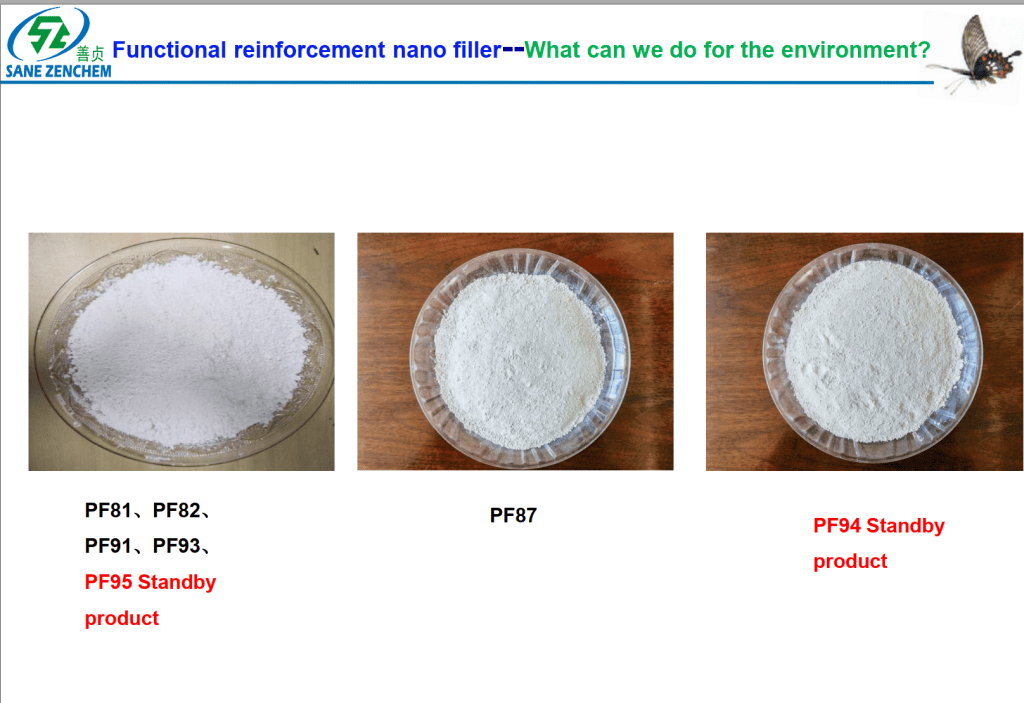
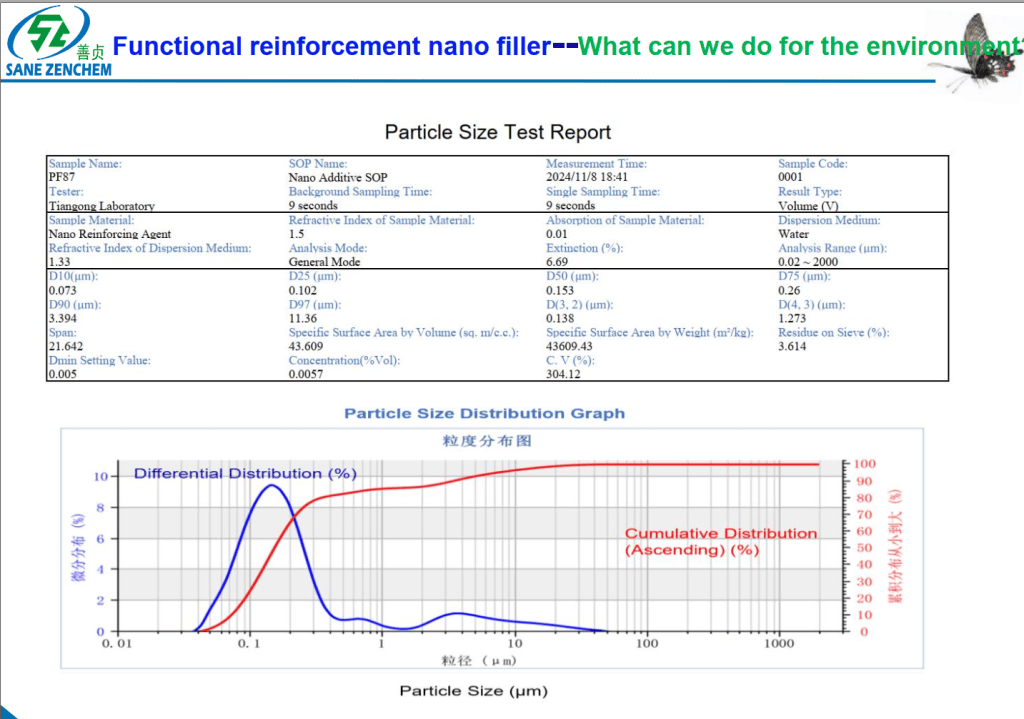
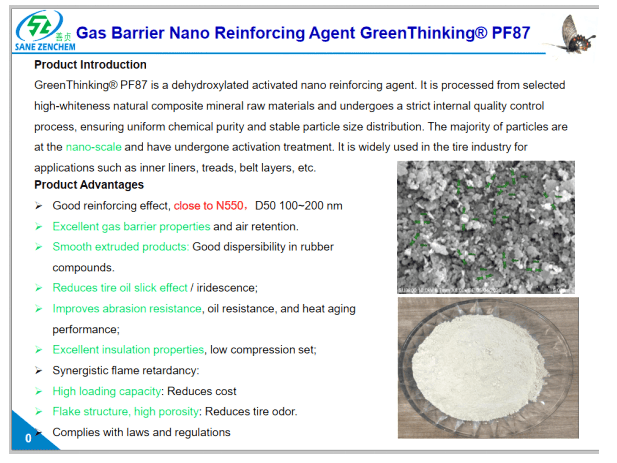
The same sheet describes the grades as having particles “in the ultra-fine nano range” while PF87’s sheet states that most particles are distributed at the fine nanoscale, over 100 nm. PF87’s median particle size is 153 nm with a D10 of 73 nm, and PF82’s median size is 800 nm. Those are three different size classes and they should not be described with one phrase.
Both are worth correcting, because a technical buyer reads the numbers and not the adjectives, and a sheet that contradicts itself on particle size invites the question of what else was copied.
FAQ
How much filler can replace carbon black in an EPDM compound
Replace by volume and then check hardness, not the other way round. In the EPDM compound here, six fillers were run at an identical 130 phr, which is a volume fraction of roughly 45 percent, and all six produced a workable compound with hardness between 59 and 62 Shore A. The limit is set by the property column that matters to you, not by a universal phr number.
How to replace kaolin with a nano filler at equal loading
Run the substitution at equal phr first, because it is the comparison the purchasing department can price. At 40 phr in a CPE cable sheath, PF87 gave 12.7 MPa against 9.6 for the kaolin compound, an oxygen index of 38.5 against 35.3, and a lower specific gravity. Equal phr is not equal volume, so the second trial should be at equal volume fraction.
Why does a nano filler reduce compound cost
Three ways, and they are not equal in size. The filler price per kilogram is usually lower than the carbon black it replaces. The density may be lower, which reduces material per part. And a filler that lowers Mooney viscosity allows a higher loading before the compound becomes unprocessable. The third is usually the largest and the least often quoted.
How to keep hardness when replacing carbon black with a mineral filler
Compare at equal volume fraction, then use the 8 to 10 phr per Shore A rule to close the gap. A mineral filler at 2.5 g/cm3 needs more weight than an N550 at 1.8 g/cm3 for the same volume, so a one for one replacement by weight will come out harder than expected. Measure the first trial and correct from there.
Filler dosage to increase hardness by one Shore A
Eight to ten phr for the PF series at the recommended loading range. That figure is a rule of thumb from production experience, not a physical constant, and it depends on where in the 30 to 150 phr range you start: the same 10 phr near the top of the range raises hardness less than it does near the bottom.
How to improve air tightness of a tire inner liner
Improve the permeability coefficient, and quote it instead of permeance. In the inner liner trial here, permeance fell 11.1 percent and the coefficient fell 6.7 percent when 20 phr of PF87 replaced 10 phr of N660, because the specimen thickness also changed. The coefficient is the material property and the one that survives a thickness change.
Why does a filler improve oxygen index in a cable sheath
A flake filler with a high aspect ratio lengthens the path that fuel and heat have to travel through the char layer, so the char insulates better for the same mass. In the CPE trial here, 40 phr of PF87 gave an oxygen index of 38.5 against 35.4 for talc and 35.3 for kaolin at identical loading.
How to stop plasticiser migration in a braided hose
Reduce the free plasticiser and lengthen the diffusion path. A higher filler volume means less oil for the same hardness, and a flake filler raises the path length through the compound. In the EPDM braided hose trial here, 80 phr of PF87 in place of kaolin eliminated migration to the braid, reported qualitatively.
Which filler gives the lowest compound density
The one with the lowest specific gravity, which in the six-way comparison was competitor A at 1.309 against 1.340 for PF82. The spread across six fillers was 2.4 percent, so density is a real but secondary lever compared with the filler price and the loading.
How to compare fillers at equal loading in one compound
Same recipe, same day, same operator, one filler per compound, and report every column rather than the ones that win. The comparison in this article used 130 phr of each filler in an EPDM 512E compound at 180 C cure, with the same oil and cure system, and it is the one way the six numbers can be read against each other.
What is the Mooney viscosity effect of a nano filler
It depends on the surface area and the structure more than on the particle size. At 130 phr in the same compound, the six fillers ran from 74.0 to 82.1 Mooney, an 11 percent spread. Lower is easier to process and allows a higher loading; a filler that lowers Mooney at equal hardness is the one that buys capacity.
How to raise volume resistivity with a mineral filler
Use a non-conductive mineral with no surface hydroxyl groups and a low impurity content, and keep the loading high enough to displace any conductive pathway. In the comparison here, PF82 measured 3.6 x 10^15 ohm.cm against 4.8 x 10^14 for the German product, a factor of seven, in the same compound at the same loading.
Filler for a light coloured rubber part
Whiteness, and the absence of iron and transition metal impurities that discolour on ageing. Conventional whiteness is stated as 71 for PF87, 80 for PF82 and higher for PF88, which is made from a high whiteness mineral. A reinforcing filler for light coloured rubber should be specified with a whiteness value and a heavy metal limit, not with a colour name, because the colour name is a marketing description and the whiteness value is measurable. A high whiteness reinforcing filler in this range is stated at 71 to 80 on the conventional scale, and the difference between those two figures is visible in a white part.
Why does a filler shorten cure time
A surface treated filler that does not adsorb accelerators leaves the cure system intact, and a filler that raises the compound’s thermal conductivity can bring the whole batch to temperature faster. In the inner liner trial the cure went the other way, from 20.17 to 21.30 minutes, which shows the effect is system specific and has to be measured.
How to test filler dispersion in a rubber compound
Cut a face and rate it against a photographic standard under a light microscope at 50 to 100 times, and report the percentage of undispersed area. Do it on the same day for the blank and the candidate, with one operator. A filler at 130 phr that is not dispersed is worse than a cheaper one that is, because the undispersed agglomerate is both a stress concentration and a volume with no reinforcement in it.
Technical support
Filler substitution is arithmetic first and a trial second. Send us the compound you are running, the filler you want to displace, its current loading and the property you cannot lose. We will tell you the volume fraction you need, the hardness you will land on, and which of the columns above is likely to be your constraint before a sample is sent.
Contact
Plant address: Baishou Road, North District of Xuan Zhou Economic Development Zone, Xuan Cheng City, Anhui Province, China
Commercial address: Room 1606-1608, Boda Commercial Building, No. 11 Puhuitang Road, Xuhui District, Shanghai, China 200030
Tel: + 86 – 136 7164 1995
Email: yorichen@sanezen.com
Website: www.sanezenrubber.com
The fillers discussed on this page are supplied as the GreenThinking PF series by SaneZenChem, a nano mineral filler supplier and rubber filler China manufacturer working with hose, cable, tire and general rubber producers.
 English
 Spanish
 Russian