As the global rubber industry pivots toward high performance, cost-efficiency, and environmental sustainability, nano-reinforcing fillers have emerged as critical materials for enhancing physical properties, processing efficiency, and value-added potential. Based on technical data and application practices of the GreenThinking® series (PF81, PF87, PF91, PF94) by SaneZen Group, a leading name among Rubber Functional filler Manufacturers China and Rubber reinforcing filler Manufacturers China, this article analyzes reinforcement mechanisms and economic value. It serves as a scientific guide for engineers aiming to reduce rubber compound cost with filler while maintaining high quality.
I. Industry Pain Points: Technical and Cost Bottlenecks of Traditional Fillers
The performance of rubber products depends heavily on the design of the filler system. While Carbon Black and Precipitated Silica (White Carbon Black) remain mainstream, they present clear limitations:
- Carbon Black: Offers excellent reinforcement but limits products to black or dark colors. High loading leads to high energy consumption and significant heat build-up.
- Precipitated Silica: Provides superior reinforcement but contains high surface hydroxyl groups, requiring expensive silane coupling agents.
- Traditional Inorganic Fillers (e.g., Kaolin, Calcium Carbonate): Although low in cost, they offer weak reinforcement.
For enterprises seeking a White Carbon Black Alternative, the GreenThinking® PF series offers a Cost Effective Rubber Filler solution to overcome the dual pressure of “cost reduction” and “efficiency enhancement”.
II. GreenThinking® PF Series: Systematic Innovation in Nano-Fillers
SaneZen Group has introduced the GreenThinking® PF series. These products are derived from high-whiteness natural composite minerals, processed through strict ore selection and nano-grinding.
Core Technical Features:
- Surface Dehydroxylation & Activation: Eliminates surface polarity, improving compatibility with non-polar rubbers (NR, EPDM, SBR).
- Nano-scale Particle Control: As a premium fine particle size reinforcing filler, PF87 features a D50 of 150 nm, approaching the reinforcement level of precipitated silica.
- High Whiteness & Low Impurities: As a premier High Whiteness Rubber Filler, the series features whiteness (GE) up to 94%, making it an ideal non black filler for colored rubber or transparent products. Low LOI (<0.3%) ensures thermal stability.
Lamellar Structure: Facilitates the interlocking of rubber molecular chains to improve gas barrier properties of rubber and enhancement efficiency.
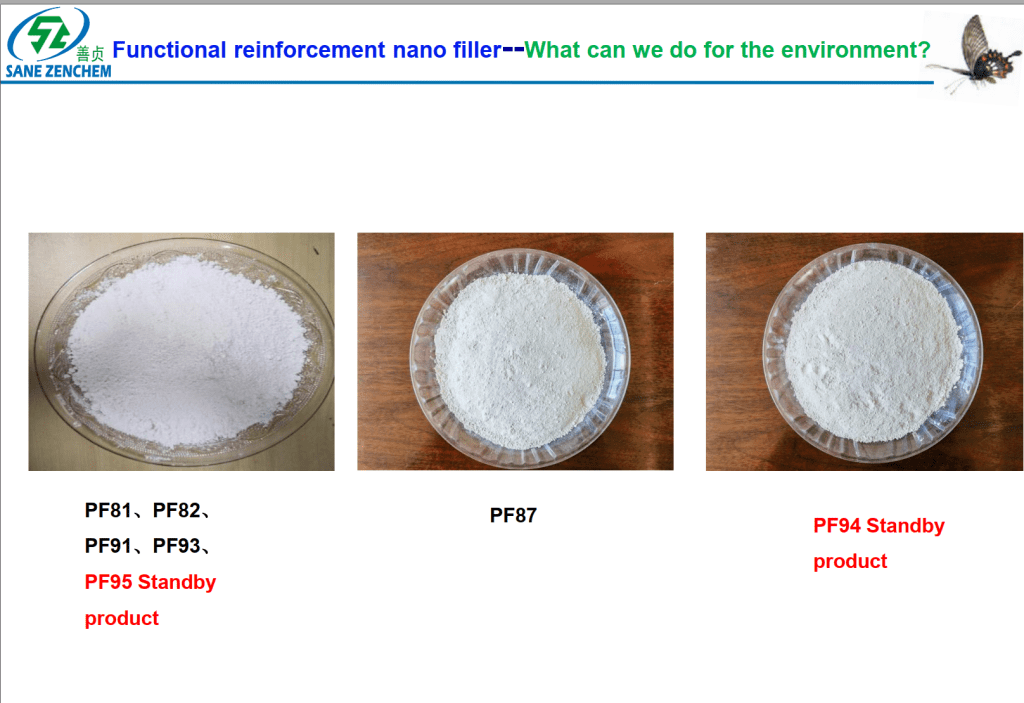
III. Product Comparison and Selection Guide
| Grade | Core Characteristics | Median Particle Size (D50) | Reinforcement Level | Typical Applications |
| PF81 | Best cost-performance; white; general purpose | ~800 nm | Slightly better than N660 | Cost-sensitive bulk goods: seals, gaskets, footwear. |
| PF87 | Finest particle size; high reinforcement | 150 nm | Close to N550 | High-strength parts; also acts as a nano rubber filler for tire inner liner applications. |
| PF91 | High insulation; high whiteness; heat aging resistance | ~790 nm | Better than N550 | Electronic rubber components; light-colored parts. |
| PF94 | Best overall physicals; high modulus; low compression set | — | Better than N550 | Dynamic load products: vibration dampers, oil seals. |
IV. Performance Verification: Data-Driven Technical Advantages
- Reinforcement (PF81 vs. N660): In NBR formulations, PF81 achieves a tensile strength of 11.96 MPa (vs. 11.87 MPa for N660) and elongation of 310% (vs. 277% for N660).
- Particle Size (PF87 vs. Silica): PF87 features a concentrated distribution with a D50 of 153 nm. In mixing, it reduces energy consumption by approximately 15% and eliminates the need for silane.
- Insulation (PF91): PF91 provides superior volume resistivity and faster curing (TC90: 147s).
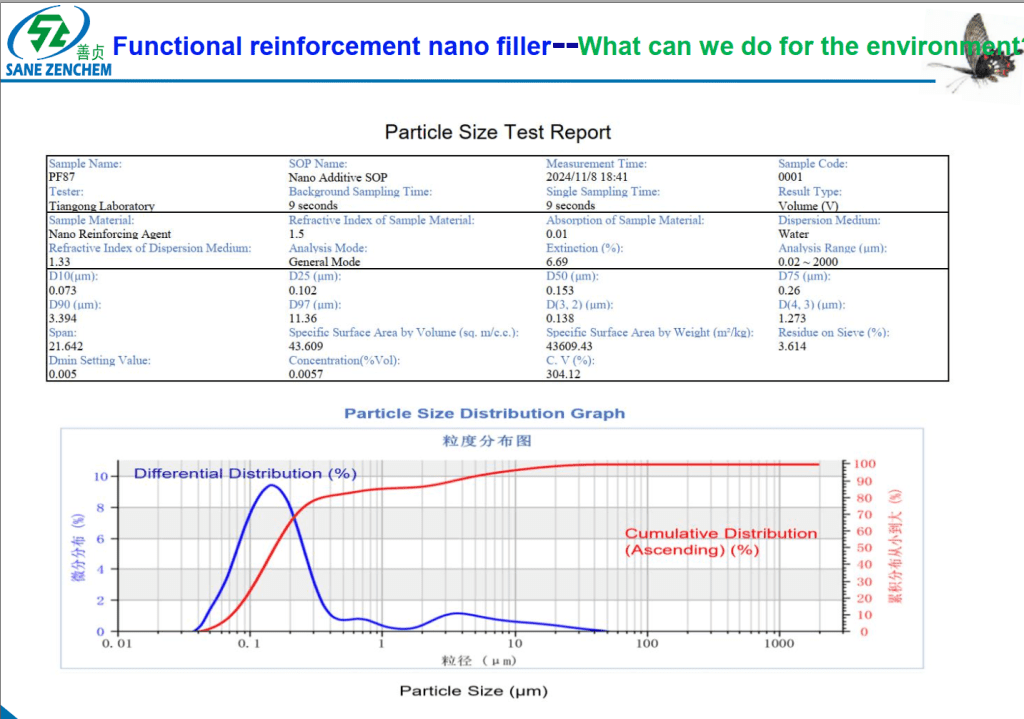
consistent reinforcement and dispersion compared to standard industrial fillers.
V. Frequently Asked Questions (FAQs)
Q1: Can PF series fillers completely replace carbon black in high-performance recipes?
A: The PF series is designed to replace semi-reinforcing carbon blacks effectively while significantly reducing costs. For applications requiring extreme abrasion resistance, we recommend a hybrid system to balance cost and performance.
Q2: Does switching to PF series require specialized mixing equipment?
A: No. PF series fillers feature pre-activated surfaces and a lamellar structure that improves flowability, allowing processing with standard internal mixers (Banbury) or open mills. In many cases, they reduce Mooney viscosity for easier injection.
Q3: Is a silane coupling agent necessary when using PF87 to replace silica?
A: No. Unlike precipitated silica, the PF series undergoes surface dehydroxylation and activation during manufacturing, allowing excellent dispersion in non-polar rubbers like EPDM or NR without silane.
Q4: Can PF87 be used as a nano rubber filler for tire inner liner to improve performance?
A: Yes, the fine particle size and lamellar structure of PF87 make it an excellent choice to enhance airtightness and structural integrity in tire components.
VI. Contact Us
SaneZen Group is committed to providing high-performance, eco-friendly material solutions. As premier Rubber Functional filler Suppliers China, Rubber reinforcing filler Manufacturers, and Rubber reinforcing filler Suppliers, we are ready to support your production needs.
- Phone: +86 136 7164 1995
- Email: yorichen@sanezen.com
- Address: Room 1606, Boda Business Building, No. 11 Pujiangtang Road, Xuhui District, Shanghai, China
- Website: www.sanezenrubber.com
VII. Conclusion
By integrating nano-scale particle control and surface activation, the GreenThinking® PF series overcomes traditional trade-offs. SaneZen Group provides a systematic solution to help your business achieve technical leadership and improved profitability.
 English
  Spanish
  Russian