1. Current Situation & Background: Identifying Structural Deviations in Service Life
The rubber industry widely uses lifetime prediction models based on the Arrhenius principle for thermal ageing extrapolation [e.g., ISO 11346]. These models assume a linear logarithmic relationship of degradation reaction rates within the service temperature range. However, extensive bench tests and field returned part analyses of NBR PVC rubber blends reveal a non negligible fact: even when initial static mechanical properties fully comply with relevant material specifications [e.g., ASTM D2000], the performance decay curve under long term, multi stress coupling conditions still deviates significantly from laboratory single factor thermal ageing predictions. This is why leading NBR PVC rubber blends Manufacturers, NBR PVC rubber blends Suppliers and every qualified NBR PVC rubber blends Factory now emphasise multi stress validation over simple oven ageing.
Typical observations include a faster than predicted increase in hardness, together with a non linear accelerated drop in elongation retention during mid to late service life. This gap becomes particularly pronounced when oil media and dynamic loads act together. For oil pipes, sheaths or sealing products with a design life of more than 10 years, selecting materials based only on standard oven ageing data essentially underestimates the performance decay rate under combined stresses – a systemic risk. To address this, many Custom Rubber compound Manufacturers, Custom Rubber compound Suppliers and Custom Rubber compound Factory teams now develop tailored formulations that explicitly target long term coupled stress resistance.
2. Coupled Stress Matrix Analysis: Where Failure Risks Are Amplified
Analysis of the service environment for typical products such as hoses, cable sheaths and rollers shows that the following four stresses act on the rubber compound almost simultaneously:
- Heat: long term operating temperatures are typically in the 70–100 °C range;
- Oxygen: couples with heat, triggering chain oxidation;
- Oil/solvent: media such as ASTM Oil No. 1, ASTM Oil No. 3, and Fuel C cause swelling or extraction;
- Dynamic flexing & abrasion: create micro cracks on sheaths and hose covers, which become channels for ozone attack.
The coupling effect of these stresses is far more complex than single factor action. For example, when oil media are combined with thermo oxidative ageing, small oil molecules swell the compound, diluting the effective concentration of antioxidants and increasing oxygen diffusivity in the matrix, thus dramatically shortening the oxidation induction period. This explains why NBR PVC blend reduces antioxidant consumption – the PVC phase creates a physical barrier that lowers the rate at which antioxidants are extracted or consumed, allowing the blend to maintain protection much longer than pure NBR under hot oil conditions. Therefore, the core evaluation criteria for such products should shift from “original tensile strength” to retention of shear modulus after hot oil ageing and evolution of compression set over time.
Experimental data shows that for a medium high acrylonitrile content (33 % AN) NBR PVC blend for long life oil resistant products, after ageing in ASTM Oil No. 3 at 100 °C for 70 h, volume change reaches +19.54 % and hardness drops by 5 Shore A points. Without targeted plasticiser and crosslinking network design, such swelling can reduce dynamic modulus to a level unable to maintain sealing stress or structural stability of the sheath. By contrast, a properly formulated NBR PVC compound with low volume swell in hot oil limits volume change to well below 10 % after extended ageing, preserving dimensional stability and sealing force.
3. Deep Dive into Micro Mechanisms: Structure–Property Relationship of NBR PVC Blends
The unique advantages of NBR PVC rubber blends come from molecular level complementarity between the two polymers and restructuring of the crosslinking network. The performance gain is not simply PVC hardening, but a functional synergy.
- Physical barrier effect: PVC domains form micro regions in the matrix, creating a tortuous path (labyrinth effect) for oxygen and ozone molecules. These micro regions do not participate in oxidation, slowing down the advancement of the oxidation front. This is why engineers replace pure NBR with NBR PVC for better weather resistance – the physical barrier reduces ozone attack without relying solely on chemical antiozonants.
- Interfacial coupling: with a sulfur donor + thiuram accelerator system, co crosslinking or strong physical anchoring occurs at the NBR/PVC interface, preventing phase separation under external forces or swelling. This is the molecular basis for storage stability and smooth extrusion surfaces. It also enables the development of an NBR PVC blend that passes dynamic flex fatigue test, because the stable interface suppresses crack initiation and propagation under repeated flexing.
- Synergy between sacrificial protection and oil resistant matrix: the NBR matrix provides resistance to non polar to moderately polar oils, while PVC micro regions share part of the anti ozone function, reducing the migration/consumption rate of conventional antiozonants (e.g., PPDs), thus prolonging protection.
| Aspect | Conventional Pure NBR | NBR/PVC Blend Technology |
| Phase morphology | Single phase, antioxidant works via solubility & migration | Dual phase continuous/dispersed, PVC phase provides physical barrier |
| Ozone resistance mechanism | Entirely dependent on chemical antioxidant consumption | Physical barrier + chemical protection, lower overall consumption rate |
| Dimensional stability after oil ageing | Swelling linearly related to crosslink density & AN% | PVC micro regions restrict extraction of low MW plasticisers, more controlled volume change |
| Extrusion surface | Limited by Mooney & gel | Two phase slip & homogeneous dispersion reduce die swell, smooth surface |
| Tear strength change after 100 °C ageing | Often a large drop | Drop mitigated by physical barrier effect |
The table below compares the microstructural and macro performance differences between this technical approach and a conventional pure NBR + high loading antioxidant system:
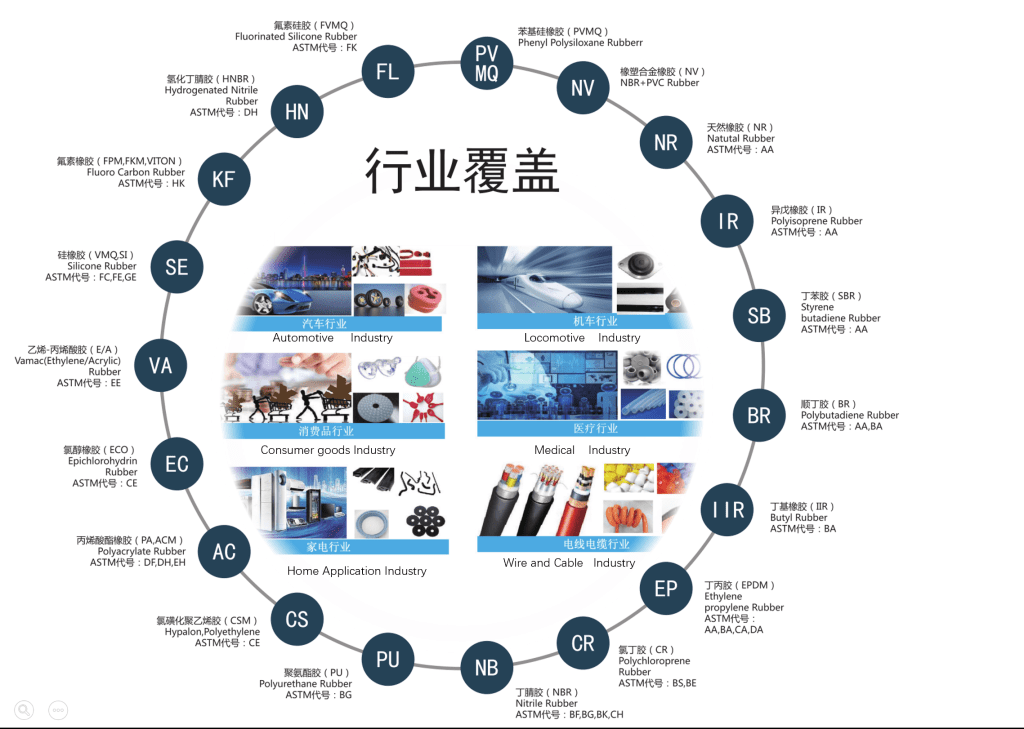
This structural differentiation allows the blend system to retain NBR’s excellent oil resistance while greatly expanding its weather and ozone resistance limits – without sacrificing hardness or extrusion efficiency. For demanding applications such as offshore platforms, the best rubber for cable sheath in offshore environment is often a well designed NBR/PVC blend, because it combines oil resistance, weather resistance, flame retardancy and stable electrical properties.
4. Empirical Boundaries of Standardised Tests: What Are We Really Measuring?
For NBR PVC rubber blends, conventional accelerated ageing tests (e.g., 100 °C × 70 h in air or oil) are effective for screening severely deficient formulations, but they have clear limitations when predicting very long service life.
First, single temperature accelerated ageing cannot distinguish whether the oxidation mechanism changes at the PVC phase interface. Above 100 °C, plasticiser migration and exudation patterns from PVC micro regions are completely different from those at 80 °C, causing extrapolation failure. Second, standard oil tests [ASTM D471] use static immersion, ignoring the physical extraction effect of flowing oil, pressure pulsations, etc. in real service. The actual volume change is often higher than the lab value.
Therefore, a more engineering valuable approach is not to obtain a “pass” oil immersion report, but to plot the performance degradation slope curve at the target temperature. That is, test key properties (hardness, modulus, volume, compression set) at multiple time points – 70 h, 168 h, 336 h, 500 h – and observe whether the curve flattens or shows an inflection point. Data show that for a phase optimised NBR PVC blend with stable compression set after heat ageing, the compression set value after 100 °C × 70 h typically remains between 40 45 %, and after 336 h the increase per additional 70 h becomes very small, indicating a stabilised network. Such stability is critical for gaskets, seals and sheath applications where bolt load retention is required over years of hot operation.
5. Process Consistency Control: Manufacturing Determines the Lower Limit of Material Performance
Lab performance data are based on ideal dispersion and precisely controlled curing. In mass production, however, dispersion quality and batch to batch Mooney fluctuation are the primary causes of product quality variation. This is why working with reputable NBR PVC rubber blends Manufacturers, NBR PVC rubber blends Suppliers and a reliable NBR PVC rubber blends Factory is essential – they provide documented Mooney stability and Payne effect data.
NBR PVC rubber blends are sensitive to mixing shear. If the temperature window and shear strength at the initial mixing stage are not properly controlled, the PVC phase cannot be fully plasticised and refined to the ideal domain size. Minor issues lead to micro roughness on extruded surfaces; severe cases leave unmelted micron sized particles in the compound, acting as fatigue crack initiation sites. Batch to batch Mooney variation directly causes dimensional deviations in injection/extrusion and inconsistent cure. Therefore, for pre blended masterbatches like the NV series, the core of process validation is to confirm Mooney stability (e.g., actual batch deviation of ML1+4@100 °C) and the Mooney rise during secondary processing.
When introducing such materials, it is recommended not only to examine cure and initial properties, but also to work with the supplier to monitor the Payne effect (strain softening curve) of the compound, quantifying the degree of filler and blend phase networking – thereby controlling the ceiling of dynamic fatigue performance from the source. This is directly linked to achieving an NBR PVC blend that passes dynamic flex fatigue test consistently across production batches.
6. Life Cycle Value Engineering: How to Quantify the Technology Dividend
For products that are difficult to replace frequently – such as oil hoses, submarine cable sheaths, and large rollers – material procurement cost is often overestimated as a proportion of total cost of ownership. What truly erodes profit is unplanned downtime, replacement labour, and the associated reputation risk.
Assume that after switching to an NBR PVC blend for long life oil resistant products for a hydraulic hose cover, ozone crack resistance extends from 1,200 h to >3,000 h, and volume change after oil ageing is reduced by 5 percentage points. This shifts the probability curve of early hose failure to the right. Converting each percentage point reduction in failure probability into equipment availability gain and warranty cost reduction gives a technical value far exceeding any difference in compound price.
Furthermore, in safety critical or environmental applications (e.g., offshore platform cables, railway flame retardant sheaths), even small performance drifts can cross safety red lines. Data show that a properly phase optimised NBR PVC blend with stable compression set after heat ageing offers good inherent flame retardancy and antistatic properties, combined with low compression set (approx. 40 45 % after 100 °C × 70 h) and low temperature retraction (TR10 down to -48 °C) – forming a technology package with a built in safety margin. The value of this package cannot be priced per kilogram. For offshore cable applications, the best rubber for cable sheath in offshore environment is often an NBR/PVC blend that also passes cold bending and UV exposure tests without cracking.
7. Technical FAQ: Three Common Questions from Formulators Switching to NBR/PVC Blends
Q1 – My current pure NBR + high antioxidant system passes the 80 pphm ozone test. Why do I still need an NBR/PVC blend?
A: Passing a single point ozone test is not difficult. What is difficult is maintaining a reliable ozone protection life under the combined effects of oil extraction and dynamic flexing. Pure chemical antioxidants are rapidly depleted under high temperature and oil extraction – their protection life decays exponentially. The physical barrier mechanism of NBR PVC rubber blends does not rely on antioxidant consumption rate, so it provides more stable performance retention in the later stages of actual service. This is exactly why NBR PVC blend reduces antioxidant consumption – the PVC phase lowers the effective demand for migrating antiozonants. If your product only needs to pass a type test, your current approach may be adequate. If you require no cracking throughout the entire service life, a dual physical chemical protection system is more reliable. In many cases, engineers replace pure NBR with NBR PVC for better weather resistance while also gaining improved hot oil volume stability.
Q2 – Will low temperature performance be significantly sacrificed after switching to an NBR/PVC blend?
A: It depends on the combined design of acrylonitrile content and PVC ratio. Taking TR10 as a low temperature retraction reference, a low AN grade (~23 % AN) can reach -48 °C, while a high AN grade (50 % AN) gives -43 °C. Compared to a pure NBR of comparable oil resistance, this low temperature performance does not show a step change drop, because crosslinking network adjustment and plasticiser matching compensate for the rigidity of PVC. Moreover, a well formulated NBR PVC compound with low volume swell in hot oil can simultaneously maintain good low temperature flexibility if the plasticiser system is correctly chosen. If your product specification has explicit low temperature elasticity requirements, you can select the appropriate grade based on AN% and hardness level – there is no need to avoid the blend approach.
Q3 Our extruder has a limited L/D ratio, and we are concerned about poor feeding and plastication of the blend. What can we do?
A: For NBR PVC rubber blends, the key is to avoid too low a temperature in the feeding zone and to pre warm the compound to 40 50 °C before extrusion. Pre blended masterbatches (e.g., NV series) are designed with processability in mind: Mooney viscosity is controlled in a narrow window (e.g., 55±10) and the blend is uniformly pre mixed, eliminating the need for extra open mill breakdown. If your L/D ratio is indeed small, consider slightly reducing the screw flight clearance in the feed zone, increasing the compression ratio, and confirming the Mooney and Mooney relaxation data of the batch with your material supplier to match the plastication capability of your equipment. Many Custom Rubber compound Manufacturers offer tailored Mooney grades specifically for low L/D extruders, ensuring that even a Custom Rubber compound Factory with older equipment can process high quality blends.
8. Summary & How to Source These Materials
The technical principles and performance data presented in this report are based on general research into NBR PVC rubber blends (e.g., NV2355, NV3355A, NV5090). To bring these advantages into your production line, you need reliable partners. Leading NBR PVC rubber blends Manufacturers and NBR PVC rubber blends Suppliers maintain strict process control to deliver consistent Mooney, dispersion and cure characteristics. A professional NBR PVC rubber blends Factory will provide full traceability and batch to batch repeatability. Furthermore, if your application requires a completely bespoke solution, experienced Custom Rubber compound Manufacturers, Custom Rubber compound Suppliers and a dedicated Custom Rubber compound Factory can adjust AN content, PVC ratio, plasticiser type and crosslinker package to meet your exact service conditions – whether you need an NBR PVC blend for long life oil resistant products, an NBR PVC compound with low volume swell in hot oil, an NBR PVC blend that passes dynamic flex fatigue test, or an NBR PVC blend with stable compression set after heat ageing. For offshore cables, ask for the best rubber for cable sheath in offshore environment; for improved weathering, simply replace pure NBR with NBR PVC for better weather resistance.
Contact Information:
- Technical Hotline: +86 136 7164 1995
- Email: yorichen@sanezen.com
- Website: www.sanezenrubber.com
 English
  Spanish
  Russian