
| Target reader | Rubber Technologist, Tire Production Engineer |
| Author | James Li International Business Director & Application Engineer https://www.linkedin.com/in/james-li-2b2025436/?isSelfProfile=true |
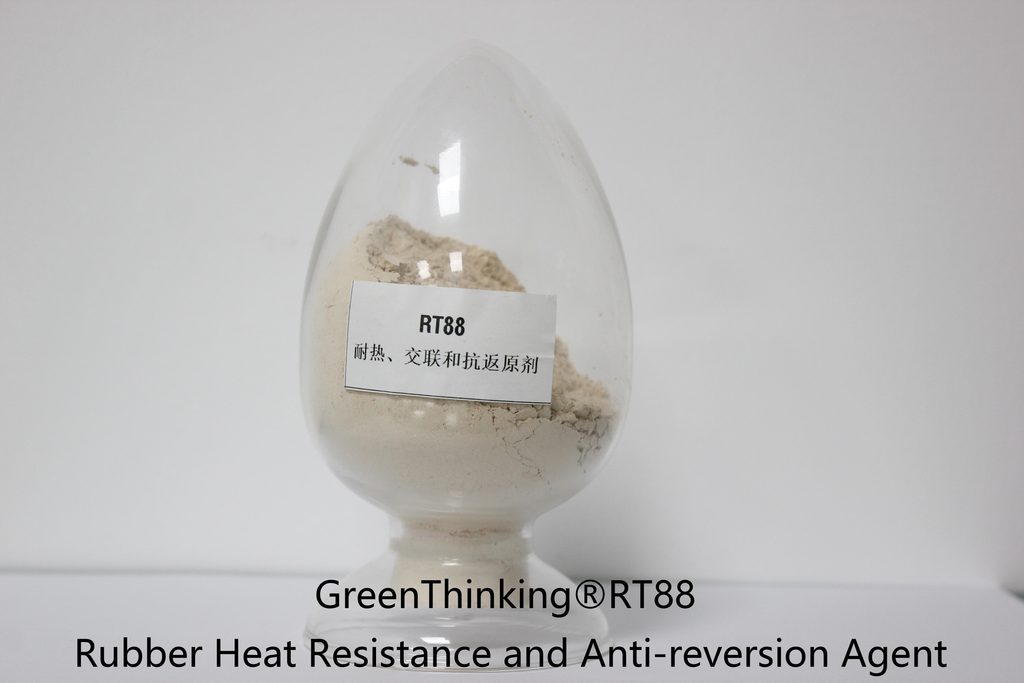
| Products related | GreenThinking®RT88 Rubber Heat Resistance and Anti-reversion Agent |
| Schema tags | Heat Resistance |
| Release date | October 8, 2026 |
Why is it necessary to improve the heat resistance of rubber products?
Improving the heat resistance of rubber products is primarily about ensuring that they maintain their elasticity, strength, sealing properties, and service life under high temperature or hot-oxygen environments, preventing premature aging, cracking, hardening, or failure.
The main reasons can be understood from several aspects:
- High temperatures accelerate rubber aging.
Rubber is prone to molecular chain breakage, cross-linking structure changes, oxidative degradation, and plasticizer volatilization at high temperatures, resulting in hardening, brittleness, cracking, stickiness, decreased strength, and reduced elasticity. Improving heat resistance means delaying these aging processes.
- Many operating conditions are inherently hot.
Automotive engine compartments, cooling systems, turbocharger lines, braking systems, conveyor belts, hydraulic hoses, cable sheaths, and seals may all be exposed to high temperatures for extended periods. If their heat resistance is insufficient, these components are prone to leakage, deformation, breakage, or malfunction.
- Directly affects safety and reliability
If rubber parts lose their elasticity or crack at high temperatures, it may cause sealing failure, pipeline rupture, reduced insulation performance, increased vibration and noise, and even equipment failure and safety accidents.
- Determines lifespan and maintenance costs
The better the heat resistance, the higher the performance retention rate of rubber products under long-term high-temperature conditions, the lower the replacement frequency, and the lower the equipment downtime and maintenance costs.
- Adapting to new materials and new application scenarios
The fields of new energy vehicles, aerospace, electronics, industrial automation, food and medical are placing increasingly higher demands on the heat resistance, oil resistance, and aging resistance of rubber materials. Improving heat resistance helps to expand the application range of rubber products and also facilitates the development of higher value-added formulations and material systems.
What are the consequences if rubber products have poor heat resistance?
When rubber products have insufficient heat resistance, the consequences are usually not “gradually deteriorating”, but rather the decline in material performance will lead to the failure of functions such as sealing, load bearing and insulation, and further cause leakage, shutdown, safety accidents and economic losses.
- Materials level: Molecular structure is destroyed
High temperatures can accelerate the thermal-oxidative aging of rubber, chain breakage, further cross-linking, and plasticizer volatilization.
Common symptoms include:
Hardening and brittleness: Reduced elasticity, making it prone to cracking when subjected to pressure or bending;
Stickiness and softening: decreased strength and worsened dimensional stability;
Surface cracking, blistering, and discoloration: indicate that the material has shown obvious signs of aging.
Decreased tensile strength and elongation at break: especially decreased elongation at break, which often means that the rubber has become embrittled;
Increased permanent compression set: Seals that have been compressed for a long time cannot return to their original shape, resulting in decreased sealing force;
Volatile emissions: May cause contamination in electronics, food, vacuum, or precision environments.
- Seals: The first part to fail.
When sealing rings, O-rings, oil seals, gaskets, hose fittings, etc., lack sufficient heat resistance, common problems include:
The elastic recovery ability decreases, and the sealing surface does not fit tightly;
The permanent compression set increases, and the initial clamping force decreases.
Surface hardening and cracking create leakage channels;
When combined with oil, water, steam, or chemical media, it ages even faster.
The consequences could include oil leaks, water leaks, air leaks, coolant leaks, and a drop in hydraulic system pressure, which could lead to equipment shutdowns or safety accidents in severe cases.
- Hose and tubing: can progress from leaks to bursts
Rubber hoses with poor heat resistance will first harden, crack, and powder the outer layer at high temperatures, and may then exhibit the following:
The lining layer is aging, leading to increased media penetration.
The reinforcing layer is corroded or fatigued, resulting in a decrease in its load-bearing capacity;
Leakage at the joint;
In severe cases, bulges and ruptures may occur.
The risk of such failures is even higher in hydraulic, cooling, fuel, steam, or chemical pipelines.
- Shock absorbers and transmission components: performance degrades rapidly.
Products such as shock absorbers, buffer blocks, couplings, drive belts, and timing belts rely on the elasticity and fatigue life of rubber. Insufficient heat resistance:
Reduced elasticity leads to poorer shock absorption.
Dynamic heat generation intensifies, creating a vicious cycle of “the hotter it gets, the worse it gets”;
Shortened fatigue life, prone to premature cracking;
Increased equipment vibration and noise affect the overall stability of the machine.
- Cables and electrical components: Degradation of insulation and reliability
If cable sheaths, insulation gaskets, connector seals, etc., have poor heat resistance, the following may occur:
Deterioration of insulation performance;
The sheath is cracked and deformed;
Dielectric strength and volume resistivity decrease;
Low-molecular-weight substances are released at high temperatures, affecting surrounding components.
- Impact on production and costs
Insufficient heat resistance will directly lead to:
Replacement frequency increased;
Unplanned shutdown;
Increased costs for leak handling and maintenance;
Customer complaints and batch stability issues;
In chemical, automotive, energy, and aerospace industries, it may also lead to more serious safety risks.
- In extreme cases, it could trigger a major accident.
Although small in size, seals can become the starting point for system failure once their design temperature limits are exceeded. In the aerospace field, the loss of elasticity of O-rings at cryogenic temperatures was directly related to the Challenger disaster; the Indian GSLV-F10 rocket also failed due to insufficient pressure in the liquid hydrogen tank caused by damage to the soft seals inside the valves. These cases illustrate that the requirements for temperature, elasticity, and long-term reliability of seals are far greater than what can be reflected in their physical dimensions.
How to improve the heat resistance of rubber products?
Improving the heat resistance of rubber products usually requires consideration of several aspects, including raw rubber selection, vulcanization system, anti-aging system, fillers and plasticizers, blending modification, and process control.
- Choose raw rubber with matching heat resistance rating.
The molecular structure of raw rubber itself determines its upper limit of heat resistance. Generally speaking, rubbers with high main chain saturation, suitable polarity, and high bond energy have better heat resistance.
Common heat resistance levels can be referenced as follows:
| raw rubber | Approximate heat resistance range | Applicable features |
| NR, SBR, BR | ≤80~100℃ | It has good elasticity but poor heat resistance. |
| NBR | ≤100~120℃ | Good oil resistance, but limited heat resistance. |
| EPDM | ≤130~150℃ | It has good resistance to heat, oxygen, ozone, and hot water. |
| HNBR | ≤150~180℃ | Oil resistance, heat resistance, and aging resistance are superior to NBR. |
| FKM | ≤200~250℃ | Good heat resistance, oil resistance, and chemical resistance. |
| VMQ | ≤200~250℃ | It has good resistance to high and low temperatures, but its strength is relatively low. |
| FFKM | ≥260℃ | Extreme operating conditions, very high cost |
When selecting a model, temperature should not be the only factor considered; the medium, sealing method, dynamic/static properties, compression set, and cost should also be taken into account.
- Optimize the vulcanization system to improve the thermal stability of crosslinks.
The type of cross-linking bond has a significant impact on heat resistance; the thermal stability is approximately as follows:
C-C bond > monosulfide bond > disulfide bond > polysulfide bond
Possible approaches:
Ordinary NR, SBR, NBR, etc.: Shift from conventional sulfur systems to efficient sulfurization systems (EV) or semi-efficient sulfurization systems (SEV) to reduce polysulfide bonds and lower sulfurization reversion.
When high heat resistance is required: Peroxide vulcanization is used to form CC crosslinks, which usually results in better heat resistance and compression set.
EPDM, HNBR, FKM, etc.: Peroxide, bisphenol or special vulcanization system can be selected, and the balance should be based on compression set, tear strength and processing safety.
If necessary, add co-crosslinking agents, such as TAIC, TMPTMA, and BMI, to improve crosslinking density and high-temperature stability.
- Establish a high-efficiency heat-resistant and anti-aging system
Rubber mainly faces thermo-oxidative aging at high temperatures, so an anti-aging system is crucial.
Choose antioxidants with low volatility, high molecular weight, and good heat resistance, such as amines, phenols, RD, 4020, MB, etc.
Combining antioxidants with different mechanisms, such as free radical scavenging type + peroxide decomposition type, is usually more effective than using a single antioxidant.
For high-temperature operating conditions, attention should be paid to the consumption rate of antioxidants at high temperatures, and if necessary, the retention rate should be verified through aging tests.
- Adjusting the filler and plasticizer system
Fillers and softeners can affect thermal conductivity, dispersion, compression set, and high-temperature volatilization.
When high heat resistance is required, silica, zinc oxide, magnesium oxide, and inorganic mineral fillers can be used in part, as they are generally more heat-resistant than carbon black.
If carbon black must be used, it is advisable to choose a grade that is more favorable for thermal stability and compression set, and to reduce local hot spots through dispersion optimization.
Using silane coupling agents to improve the interface between silica or fiber fillers and the rubber matrix can reduce stress concentration and aging initiation points.
Plasticizers should be selected with high boiling point, low volatility, and low migration to avoid precipitation at high temperatures that could lead to hardening, shrinkage, or performance degradation.
- The upper limit of heat resistance is improved through blending and special modification.
When a single type of rubber cannot meet the requirements of the working conditions, blending or modification can be considered:
If NBR is insufficient in heat resistance, it can be upgraded to HNBR, or used in combination with heat-resistant adhesives.
EPDM can be blended with FKM, VMQ, etc. to improve heat resistance, oil resistance or aging resistance, but attention should be paid to compatibility and vulcanization matching.
Adding aramid pulp, short fibers, and nanofillers can improve mechanical retention and dimensional stability at high temperatures.
For sealed products, special attention should be paid to high-temperature compression set, and initial hardness and tensile strength should not be considered alone.
- Control the mixing, vulcanization, and post-vulcanization processes.
The manufacturing process also affects the final heat resistance performance:
Control the temperature and shear during mixing to avoid premature thermal degradation.
The degree of vulcanization should be close to the optimal cross-linking state; under-vulcanization or over-vulcanization will reduce the heat resistance life.
For FKM, silicone rubber, and some HNBR, two-stage vulcanization/post-vulcanization can be used to make the crosslinking network more stable and reduce volatiles and compression set.
For thick products, attention should be paid to the temperature gradient to avoid excessive internal sulfurization and insufficient surface sulfurization.
What are the uses of rubber products with high heat resistance?
High heat-resistant rubber products are mainly used in applications with high temperatures, harsh environments, and where the consequences of sealing or insulation failure are severe. Common applications can be understood by industry.
- Automobiles and New Energy Vehicles
Engine oil seals, crankshaft oil seals, valve stem seals;
O-rings for the fuel system, fuel hoses, and fuel injector seals;
Turbocharger hoses, intake and exhaust system gaskets;
Transmission seals, hydraulic system seals;
New energy vehicle battery pack sealing rings, motor oil cooling seals, high-voltage connector sleeves, and cooling pipes.
These types of parts need to be heat-resistant, and often also oil-resistant, coolant-resistant, or fuel vapor-resistant.
- Aerospace and Defense
Aircraft engine seals, hydraulic system seals;
Fuel system hoses, rocket propellant contact gaskets;
O-rings and seals for missiles, rockets, and spacecraft;
Aerospace electronic component packaging and high-altitude instrument sealing.
Aviation rubber parts often need to meet the requirements of wide temperature range, fuel resistance, hydraulic oil resistance, aging resistance and long service life.
- Petrochemicals and Energy
Pump and valve seals, mechanical seals, flange gaskets;
Pipe lining, reactor seals, storage tank expansion joints;
Packer sleeves and blowout preventer components for deep well oil production;
Oil and gas transmission hoses, oilfield cable sheaths.
These types of operating conditions commonly involve high-temperature oil, acidic media, steam, high pressure, and long-term operation, which places high demands on the stability of materials.
- Electronics, Semiconductors and Power
Vacuum seals for semiconductor equipment; seals for etching equipment;
Chemical gas pipeline sealing, wafer carriers;
High-temperature wire and cable insulation sheath;
Transformers, substation insulation components, and high-voltage connectors.
In addition to heat resistance, this area often requires low precipitation, high cleanliness, good insulation, and resistance to plasma/corrosive gases.
- Industrial equipment and sealing insulation
Sealing gaskets and flange gaskets for high-temperature equipment;
Oven, baking oven, and hot air blower door seals;
High-temperature conveyor belts, hot air ducts, and exhaust hoses;
Industrial pump and valve protection, shock-absorbing pads, and heat insulation pads.
These types of applications are mostly used in continuous high-temperature environments, requiring dimensional stability and resistance to hardening and cracking.
- Food, Medical and Home Appliances
Food-grade sealing strips and conveyor belt connectors;
Medical device seals, high-temperature sterilization components;
High-temperature sealing and insulating sleeves for home appliances.
These types of scenarios typically prioritize heat resistance, elasticity retention, low odor, and safety, while oil resistance requirements may not be as high.
- Rail transit, wind power and high-end equipment
Vibration damping components for high-speed trains and locomotives;
Wind power equipment sealing and protective components;
Robotic media-resistant components and high-temperature contact parts for automated equipment.
These fields have high requirements for material fatigue life, weather resistance, and long-term reliability.
Typical compatibility directions of different heat-resistant rubbers
| Material | Approximate heat resistance level | Typical uses |
| EPDM | Approximately 130~150℃ | Radiator hoses, door and window seals, hot water/steam resistant seals |
| HNBR | Approximately 150~180℃ | Oil seals, drive belts, fuel/hydraulic seals, oilfield seals |
| FKM | Approximately 200~250℃ | Engine seals, fuel systems, chemical pumps and valves, aerospace seals |
| VMQ | Approximately 200~250℃ | High-temperature insulation, food and medical sealing, wide-temperature-range sealing |
| FFKM | Temperatures can reach over 260°C | Semiconductors, highly corrosive materials, and extreme high-temperature sealing |
To be continued.
Please feel free to contact us if you have any technical questions.
James Li
International Business Director & Application Engineer
Tel: +86 21 6487 9251-133 Fax: 021 5106 2693
Mobile/Whatsapp/Wechat: +86 159 0194 6969
Email: jamesli@sanezen.com
 English
  Spanish
  Russian