Surface discoloration and blooming are common issues encountered during storage and service of rubber products, especially tires. The root cause lies in the molecular structural vulnerability of amine antioxidants — their amine groups (—NH₂, —NH—) undergo irreversible electron transfer in oxidative environments, generating colored quinoid structures. This article systematically analyzes the discoloration mechanism from the perspectives of intermolecular forces and electron migration, and proposes a technical solution based on a polyether copolymer that acts as an electron donor compensator. By continuously supplying electrons from abundant ether bonds (—C—O—C—) to the amine groups of antioxidants, the solution inhibits oxidative discoloration while preserving the existing processing technology, delivering a significant improvement in surface appearance. As a specialty rubber additive manufacturer and a specialty rubber additive manufacturer China, we bring decades of compounding expertise to every customer collaboration.
1. Industry Paradox: Better Protection, Heavier Discoloration
The rubber industry has long been confronted with a structural contradiction: the antioxidants that offer the best protection are precisely the ones that cause the most severe discoloration and staining.
Amine antioxidants, particularly *p*-phenylenediamines (PPDs), dominate the antioxidant consumption due to their outstanding protection against thermo-oxidative aging, ozone aging, and fatigue aging. Among them, 4020 (6PPD) and 4010NA (IPPD) are the most widely used mainstream grades. However, the amine groups (—NH₂, —NH—) in these antioxidants, upon exposure to atmospheric oxygen and ultraviolet light, gradually change from colorless to purple and eventually to brown. Their oxidation products further transform into quinoid structures, intensifying discoloration. This is precisely the challenge that a rubber anti discoloration additive for amine antioxidant systems is designed to address.
Phenolic antioxidants, on the other hand, have low staining propensity but offer far inferior protection compared to amines. The trade-off between protective performance and appearance quality has long troubled rubber compounders and product engineers. The industry urgently needs a rubber compounding additive to prevent oxidative discoloration that can break this trade-off without sacrificing aging protection.
2. Mechanistic Tracing: From Electron Migration to Color Formation
2.1 Electron Pathway of Amine Oxidation
The core functional group of amine antioxidants is the amino group. Under the combined action of heat, oxygen, and UV light, the lone pair electrons on the nitrogen atom are readily abstracted, forming radical cations. Subsequent molecular rearrangements or coupling reactions generate conjugated quinoid or imine structures. These conjugated systems absorb specific wavelengths in the visible region, resulting in a continuous colour change from purple to brown.
The essence of this process is: the amine group loses electrons in an oxidative environment, converting the antioxidant molecule from an “electron donor” to a “colored chromophore”. This explains how to prevent rubber products from turning purple and brown — by protecting the amine group from losing electrons in the first place.
2.2 Hierarchy of Intermolecular Forces
From the perspective of intermolecular interactions:
- Ionic bonds: the strongest force, found in inorganic salts.
- Covalent bonds: weaker than ionic bonds, present in organic compounds such as C—C, C—N, C—S, and C—O.
- Hydrogen bonds: the weakest, occurring intramolecularly (e.g., caprolactam) or more commonly intermolecularly, relying on interactions between electron-donating groups and electron-deficient sites.
Once the amine group in an antioxidant is oxidized and loses electrons, the antioxidant activity is lost. The core strategy is to continuously supply electrons to the amine group, keeping it in the reduced state.
2.3 Electron Compensation Mechanism of Ether Bonds
Polyether compounds contain a large number of ether bonds (—C—O—C—), with oxygen atoms bearing abundant lone-pair electrons. When polyether molecules come into sufficient contact with antioxidant molecules in the rubber matrix, the surplus electrons on the ether bonds can, through intermolecular donor-acceptor interactions, continuously transfer to the electron-deficient amine groups of the antioxidant, preventing their oxidation to colored species (e.g., —NO⁻, —NO₂⁻).
The mechanism is essentially: using the electron-rich nature of polyethers to compensate for the electron loss from amine groups, thereby extending the effective life of the antioxidant and inhibiting discoloration. This is the science behind an effective amine antioxidant color stabilizer for industrial rubber manufacturing, enabling rubber products to maintain their appearance throughout their service life.
3. Technical Solution: Electron-Donor-Compensating Anti-Discoloration Agent
3.1 Product Configuration and Physicochemical Parameters
Based on the above mechanism, a rubber anti discoloration additive for amine antioxidant systems (GreenThinking® CR200) has been developed. It is a white powder mixture produced by copolymerizing polyether compounds and subsequently adsorbing them onto precipitated silica.
| Parameter | Specification |
| Appearance | White powder |
| Ash content (850°C, 2 h) | 35% – 40% |
| Carrier | Precipitated silica |
| Active ingredient | Polyether copolymer |
| Recommended dosage | 2 phr (adjustable) |
The silica carrier ensures uniform dispersion of the active polyether component during rubber mixing, preventing local over-concentration or deficiency that would compromise the compensation efficiency. As a trusted specialty rubber additive manufacturer and specialty rubber additive manufacturer China, we have optimized this formulation for consistent performance across diverse rubber processing environments.
3.2 Performance Comparison with Conventional Approaches
| Aspect | Conventional (amine antioxidant only) | This Solution (antioxidant + anti-discoloration agent) |
| Thermo-oxidative protection | Excellent | Excellent (antioxidant activity sustained) |
| Ozone resistance | Excellent | Excellent (unaffected) |
| Surface discoloration | Severe (purple → brown) | Significantly inhibited |
| Blooming tendency | Moderate to high | Reduced |
| Impact on processing | — | None |
| Applicable products | Dark-colored products only | Dark-colored and appearance-sensitive products |
This solution functions as both a rubber surface color stabilizer for tires and industrial goods and a rubber product surface fading prevention agent, delivering measurable appearance improvements without compromising the protective performance that amine antioxidants provide.
3.3 Process Compatibility and Ease of Use
The product is a powder additive that can be directly incorporated during rubber mixing at the benchmark dosage of 2 phr, without requiring any modification to the existing curing system or processing temperature profile. The silica carrier exhibits good compatibility with the rubber matrix and does not adversely affect vulcanization characteristics or physical-mechanical properties. The addition method is simple, the dosage is easy to control, and it can be rapidly adapted to current production processes.
4. Critical Manufacturing Control: Dispersion Determines the Performance Ceiling
4.1 Effect of Micro-scale Non-uniformity on Fatigue Life
The micro-scale dispersion state of the anti-discoloration agent directly influences the electron compensation efficiency. If the polyether component forms agglomerates in the rubber matrix, the antioxidant molecules in the local area will not receive sufficient electron supply and will still undergo oxidative discoloration. This leads directly to increased variability in appearance quality within the same batch — some areas remain good while others discolour prematurely.
Recommendation: During the mixing process validation stage, attention should be paid to the dispersion effectiveness of the anti-discoloration agent. If necessary, mixing time, rotor speed, or addition sequence can be adjusted to optimize dispersion uniformity.
4.2 Dose-Effect Relationship
The recommended dosage is 2 phr. It should be noted that if the antioxidant dosage exceeds its solubility limit in the rubber, blooming will occur. The addition of this product does not alter the base dosage of the antioxidant; instead, it extends the effective period through the electron compensation mechanism, thus not increasing the risk of blooming. Therefore, it offers both anti-discoloration and anti-blooming benefits — effectively functioning as a rubber compounding solution for PPD antioxidant staining problems and helping users prevent rubber surface blooming and discoloration without losing protection.
5. Evidence of Validity and Critical Thinking on Standardised Testing
The industry commonly relies on accelerated aging tests to evaluate discoloration performance of rubber products. However, it must be recognised that extrapolations from accelerated tests often deviate from the actual discoloration trajectory under real-service conditions.
- “Passing at time zero” does not equal “controllable appearance over the whole life cycle.” More important is the degradation slope — i.e., the evolution rate of antioxidant activity decay and discoloration degree over time — rather than merely focusing on the initial qualification certificate.
- Industry observations show that after adding an anti-discoloration agent to sidewall compounds, the appearance of finished tires after three months of storage improves markedly, and sidewall discoloration is effectively resolved. This is where a tire sidewall discoloration prevention compounding agent proves its value in real-world applications.
- The core innovation of this technical approach is: not replacing the antioxidant, but maintaining its activity and inhibiting its discoloration through electron-donor compensation — meaning that appearance can be improved without sacrificing protective performance. This is the key to how to keep black rubber products looking new throughout their service life.
6. Frequently Asked Technical Questions (FAQ)
Q1: Will the electron-donor-compensating anti-discoloration agent reduce the original protective effect of the amine antioxidant?
No. Its mode of action is compensation, not replacement. By continuously supplying electrons from the ether bonds to the amine groups, it inhibits oxidative discoloration while maintaining the active structure of the antioxidant molecules. The protective performance remains unaffected; on the contrary, because the antioxidant activity is sustained for a longer period, the effective protection cycle may be extended. Data indicate that amine antioxidants lose their activity when the amine groups are oxidised and lose electrons, whereas the continuous supply of surplus electrons from abundant ether bonds effectively prevents their oxidation to colored species (—NO⁻, —NO₂⁻), thereby prolonging the antioxidant’s service life. This is the science behind an effective additive to stop amine antioxidant discoloration in rubber compounds.
Q2: Is this solution applicable to all types of rubber products?
This product is a general-purpose appearance-improving material for rubber products. It is suitable for anti-discoloration in various rubber articles, with particularly notable improvement for issues such as discoloration and blooming in tires. The silica carrier is compatible with common rubber types, including natural rubber (NR), styrene-butadiene rubber (SBR), and polybutadiene rubber (BR), without interfering with existing processing flows. It is compatible with a wide range of rubber processing technologies and does not adversely affect production processes. This versatility makes it an ideal rubber surface color stabilizer for tires and industrial goods across diverse manufacturing environments.
Q3: How can the effectiveness of this solution be rapidly verified in a practical formulation?
A controlled comparative experiment is recommended: prepare two compounds based on the same formulation — one with and one without the product (at 2 phr). Vulcanise test pieces under identical conditions, then expose them to natural light or accelerated aging conditions, and periodically measure the colour difference (ΔE value). Typically, significant visual differences can be observed within 1 to 3 months. At the same time, physical-mechanical properties (tensile strength, tear strength, hardness, etc.) should be monitored to confirm that protective performance has not been adversely affected. The product exhibits stable performance and uniform composition, ensuring consistency in use.
Q4: Can this additive serve as a solution for rubber hose and seal surface color change after aging?
Yes. Solution for rubber hose and seal surface color change after aging is one of the key application scenarios for this product. Rubber hoses and seals, particularly those containing PPD antioxidants, are prone to surface discoloration during storage and service. By continuously supplying electrons to the amine groups of antioxidants through the ether bond mechanism, this additive effectively inhibits the oxidative discoloration that causes hoses and seals to turn purple or brown over time. Field observations confirm that products incorporating this additive maintain significantly better surface appearance after extended storage periods.
Q5: How does this product help with 6PPD and IPPD discoloration in tire sidewalls?
For how to help 6PPD and IPPD antioxidants cause tire sidewall browning — to clarify, the issue is that 6PPD and IPPD antioxidants cause browning through oxidation. This product addresses the problem by functioning as a 6PPD and IPPD discoloration inhibitor for rubber compounds. The polyether copolymer component continuously supplies electrons to the amine groups of 6PPD and IPPD molecules, preventing their oxidation to colored quinoid structures. This directly inhibits the purple-to-brown discoloration process that commonly affects tire sidewalls during storage and service. The result is extended appearance retention without compromising the excellent aging protection that 6PPD and IPPD provide.
Q6: What makes this product different from other offerings in the market as a rubber compounding solution for PPD antioxidant staining problems?
As a rubber compounding solution for PPD antioxidant staining problems, this product addresses the root cause of staining rather than merely masking the symptoms. Unlike surface coatings or pigments that cover discoloration, this additive works at the molecular level to prevent the discoloration from occurring in the first place. The ether bond electron compensation mechanism is unique to this technology — it does not replace the PPD antioxidant but rather extends its effective life by maintaining it in its active, reduced state. This means users can prevent rubber surface blooming and discoloration without losing protection, achieving both appearance quality and long-term durability. Our position as a specialty rubber additive manufacturer and specialty rubber additive manufacturer China ensures consistent quality and technical support for customers worldwide.
7. Why Choose Us
Choosing a functional filler supplier is not only about purchasing a mineral powder. It is about selecting a technical partner that understands polymer compounding, physical failure mechanisms, and long-term product performance. As a leading specialty functional filler and performance additives manufacturer, and a dedicated specialty rubber additive manufacturer with operations in China, we bring decades of compounding expertise to every customer collaboration.
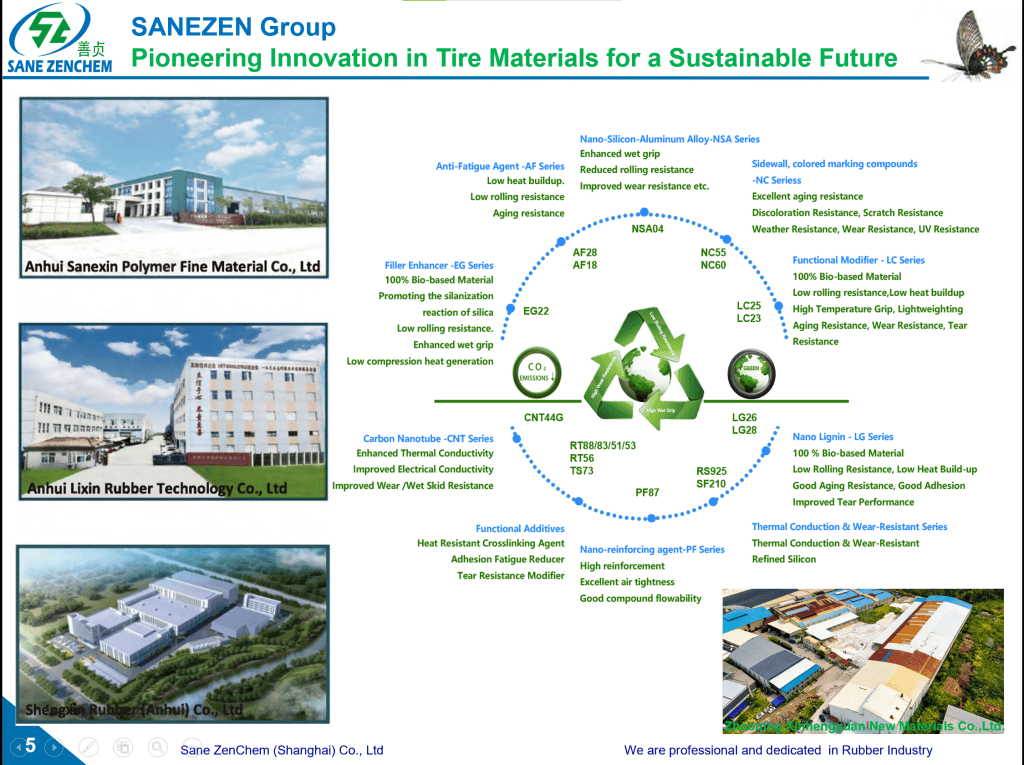
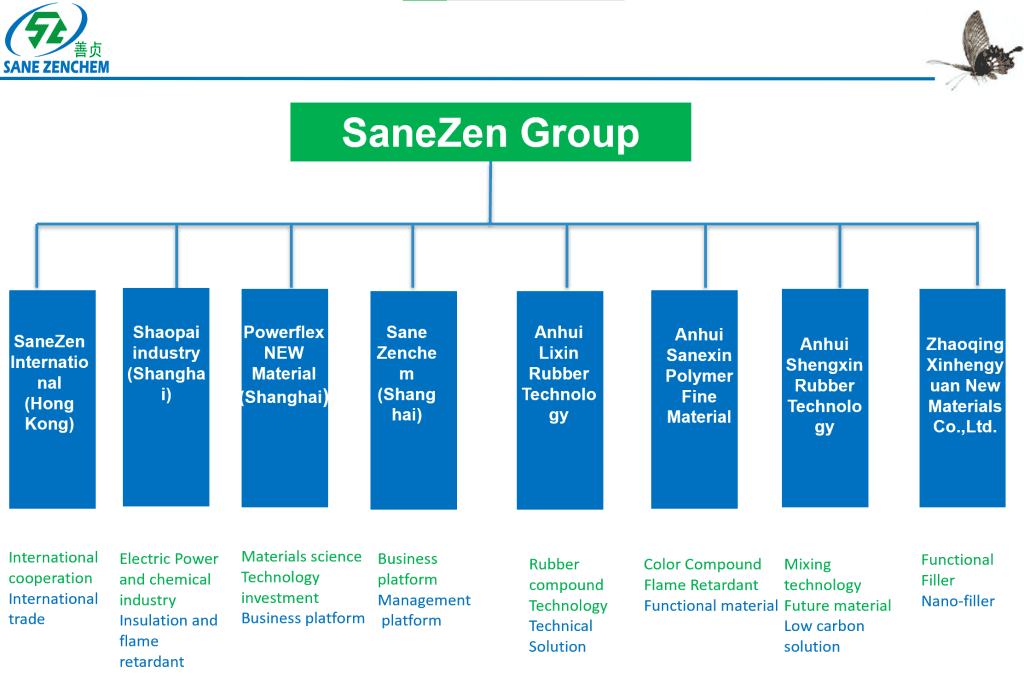
SaneZenChem operates five manufacturing facilities specialising in:
- Rubber Compounds
- Silicone Rubber Compounds
- Specialty Functional Fillers
- Flame Retardants
- Polymer Performance Additives
Because we formulate and manufacture rubber and silicone compounds ourselves, every specialty product we develop originates from solving real production challenges rather than laboratory concepts alone. This application-driven approach allows us to deliver practical solutions that create measurable improvements in customer products — from eliminating processing viscosity spikes and preventing micro cracking, to ensuring high dielectric strength in harsh electrical environments. Our unique dual position as both a direct compounder and a premier specialty functional filler manufacturer means we are uniquely equipped to support rubber, epoxy, and electrical insulation manufacturers in achieving longer service life, processing efficiency, and ultimate reliability. As a specialty rubber additive manufacturer China, we offer global quality with local support.
8. Contact Us
Factory Address:
No. 22 Meizigang Road, North District, Economic Development Zone, Xuanzhou District, Anhui Province, China
Business Office Address:
Room 1606-1608, Boda Business Building, No. 11 Puhuitang Road, Xuhui District, Shanghai 200030, China
Mobile: +86-136 7164 1995
Email: yorichen@sanezen.com
Website: www.sanezenrubber.com
 English
  Spanish
  Russian