
What this page answers
A self-supporting run-flat tire carries the vehicle on a reinforced sidewall insert after pressure loss, typically at 80 km/h for 80 km. The compound in that insert is asked to do something no other tire compound has to do: hold a high hardness so the sidewall does not collapse, and survive the heat and flexing that the collapsed sidewall generates, at the same time.
Those two requirements work against each other. Hardness comes from filler and crosslink density, and both of them make a compound more brittle and hotter under flex. This page reports what happened when an anti fatigue agent for rubber based on a polyfunctional maleimide was added to a run-flat support compound: a 26-fold increase in flex cracking resistance in the laboratory, a 33-fold increase at factory scale, and a zero-pressure durability result that went from 60 minutes to 165 minutes on the same tire size. It also reports the dosage at which the same additive made processing worse, because that is where the useful limit sits.
What the support compound actually has to do
In a normal tire, the sidewall is held in shape by inflation pressure. In a self-supporting run-flat tire, the sidewall insert carries the load when the pressure is gone, which means the insert becomes a structural member with a bending stiffness requirement.
Three things follow from that. The insert has to be hard enough, around 75 to 80 Shore A in the compounds here, to resist buckling under a 65 percent load at zero pressure. It has to be thick enough to carry the bending moment without exceeding its strain limit. And it has to survive the temperature that develops in a deflated sidewall, which is the part that is often underestimated.
A deflated sidewall flexes through a much larger amplitude than an inflated one, at a frequency set by road speed, and the compound dissipates part of that energy as heat. In a thick insert, the heat cannot escape quickly. The result is a slow, hot, high-strain fatigue cycle, and the failure mode is a crack that starts somewhere in the insert and grows until the insert no longer supports the load.
That is why zero pressure tire durability is a fatigue test more than a strength test, and why a run flat tire support compound additive has to be judged on fatigue life rather than on hardness alone. A compound that is 2 MPa stronger but loses its fatigue resistance will fail earlier, and a compound that is 5 points softer but keeps its fatigue resistance may run for hours.
Why the obvious answers do not work
The obvious way to raise fatigue life in a support compound is to reduce hysteresis, which means less filler or a different filler system. But less filler means lower hardness, and lower hardness means the insert buckles earlier, so the compound has to be thickened, which raises the heat build-up again.
The second obvious answer is a better anti-reversion agent, on the theory that the insert is curing for a long time at temperature in a thick section and losing crosslink density. That helps, and it is what the reference compound in this work already contains, but it does not address the crack growth that happens in service.
The third is to raise crosslink density for stiffness and accept the fatigue penalty, which is the direction most support compounds historically took. That is why the reference compound in this study has a flex cracking resistance of 398 cycles at factory scale, a number that describes a material with almost no margin.
What the additive is, and how it differs from an anti-reversion agent
The product here is a maleimide crosslinking agent for rubber, described as a high durability modifier containing polyfunctional maleimide compounds with a multi-benzene ring structure. Its softening point is not higher than 70 C, its initial melting point measures 67.7 C, its relative molecular mass is 390 or above, its loss on heating at 105 C for 2 hours is 0.48 percent, and its ash mass fraction is 0.00429.
The comparison that matters is against the anti-reversion agent it was tested as a replacement for, so the two are set out side by side.
| Item | Anti-fatigue agent RT56 | Anti-reversion agent PK900 |
| Appearance | Light yellow powder | Greyish white powder |
| Initial melting point, C | 67.7 | 82.5 |
| Loss on heating, 105 C for 2 h, percent | 0.48 | 0.17 |
| Relative molecular mass | 390 or above | 324 |
| Ash mass fraction | 0.00429 | 0.00037 |
| Reaction with the network | Alder-Ene addition, participates in vulcanisation | Diels-Alder only, does not participate in vulcanisation |
| Functional group activity | Multiple, strongly active | Side methyl groups, electron donating, weak double bond activity |
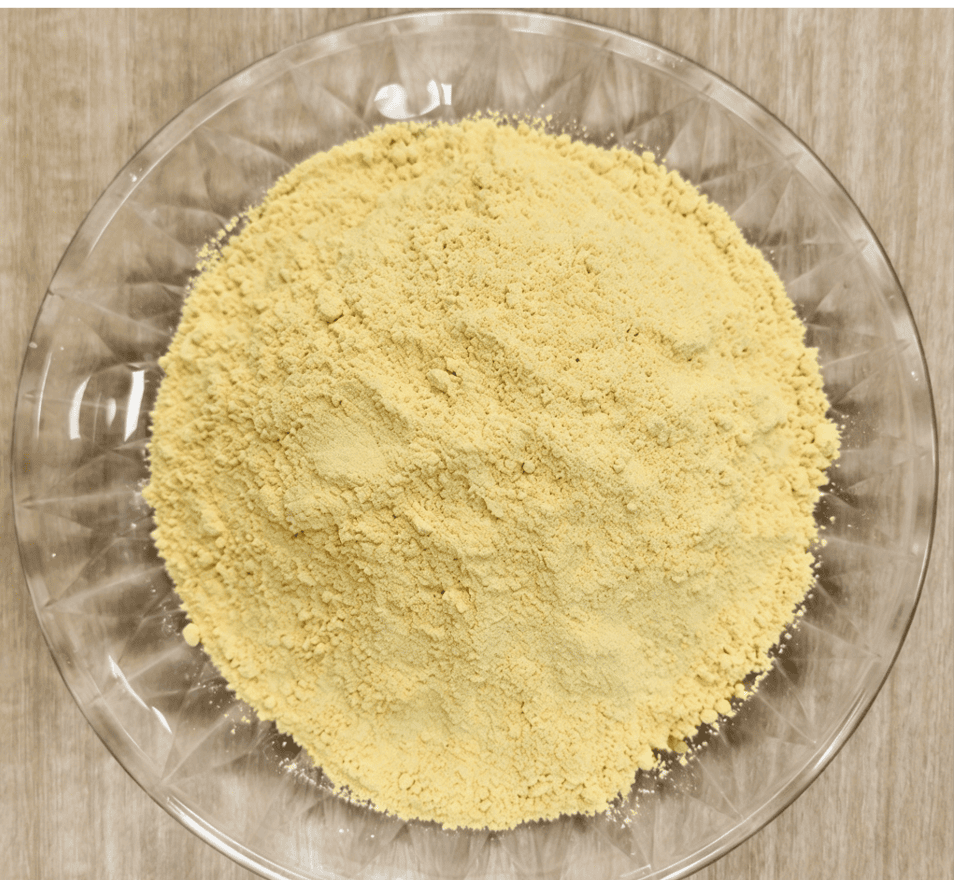
Figure 1. The anti-fatigue agent as supplied, a pale powder, added at 1.25 phr in this work.
The chemical distinction is the whole argument, and it explains the property differences later in the data. An anti-reversion agent works by reacting with the diene system after reversion has begun, replacing lost sulphur crosslinks with thermally stable carbon to carbon links. It does not participate in the original vulcanisation, so it cannot change the network that is built, only repair what is lost.
A polyfunctional maleimide with an Alder-Ene reaction is a multifunctional rubber crosslinking agent in the literal sense: it can enter the network during vulcanisation, which means it changes the network rather than repairing it. Three consequences follow: crosslink density can rise, the network can include thermally stable links from the start, and the multi-benzene ring structure interacts with carbon black in a way that improves dispersion.
That last point is not a side effect. A carbon black dispersion additive for rubber is not normally what a fatigue agent is sold as, but in a compound with 80 phr of N550 the dispersion state controls how much of the filler is acting as a stress concentrator. Better dispersion means fewer initiation sites, and fewer initiation sites means longer fatigue life at the same hardness. That is the mechanism behind a rubber additive for flex crack resistance that also happens to be sold as a cure modifier.
The laboratory screen: five formulations
The screen used a natural rubber and butadiene rubber support compound at 80 phr carbon black N550, with the original formulation containing 0.5 phr of the anti-reversion agent. Three formulations replaced that 0.5 phr with 0.625, 1.25 and 2.5 phr of RT56, which means the comparison is a substitution at low dosage rather than an addition. One further formulation kept the original compound and added 1.25 phr of RT56 on top.
| Material, phr | 1# original | 2# | 3# | 4# | 5# |
| Natural rubber TSR20 | 70 | 70 | 70 | 70 | 70 |
| Butadiene rubber CB24 | 30 | 30 | 30 | 30 | 30 |
| Carbon black N550 | 80 | 80 | 80 | 80 | 80 |
| Zinc oxide | 8 | 8 | 8 | 8 | 8 |
| Stearic acid | 2 | 2 | 2 | 2 | 2 |
| Process oil V700 | 2 | 2 | 2 | 2 | 2 |
| Anti-reversion agent PK900 | 0.5 | – | – | – | 0.5 |
| Anti-fatigue agent RT56 | – | 0.625 | 1.25 | 2.5 | 1.25 |
| Tackifying resin SL-T421 | 2 | 2 | 2 | 2 | 2 |
| Antioxidants and accelerators | 5.8 | 5.8 | 5.8 | 5.8 | 5.8 |
| Insoluble sulphur and CTP | 3.1 | 3.1 | 3.1 | 3.1 | 3.1 |
| Property | 1# | 2# | 3# | 4# | 5# |
| Mooney viscosity ML(1+4) at 100 C | 95 | 94 | 102 | 110 | 100 |
| Mooney scorch t5 at 130 C, min | 11.0 | 11.8 | 11.4 | 7.8 | 10.4 |
| FL, dN.m | 3.9 | 3.7 | 3.8 | 4.0 | 3.5 |
| Fmax, dN.m | 42.8 | 43.2 | 39.8 | 36.8 | 37.1 |
| ts2, min | 2.8 | 2.9 | 3.4 | 2.7 | 3.3 |
| t90, min | 6.8 | 6.9 | 11.0 | 9.0 | 10.0 |
The scorch and viscosity columns are the reason this screen is worth reading in full. At 2.5 phr, formulation 4#, the Mooney viscosity rises to 110 and the scorch time falls to 7.8 minutes, a 3.2 minute loss against the original. A support compound at 95 Mooney is already difficult, and at 110 with 7.8 minutes of scorch it becomes a processing risk in a plant. That is why 2.5 phr was dropped despite the highest laboratory fatigue result.
| Property | 1# | 2# | 3# | 4# | 5# |
| Hardness, Shore A | 80 | 80 | 81 | 80 | 76 |
| Modulus at 100 percent, MPa | 9.60 | 9.30 | 10.90 | 10.30 | 8.24 |
| Tensile strength, MPa | 18.12 | 18.11 | 19.25 | 18.48 | 18.95 |
| Elongation at break, percent | 139 | 137 | 183 | 177 | 210 |
| Tear strength, kN/m | 40 | 35 | 42 | 38 | 43 |
| Rebound, percent | 66 | 65 | 61 | 63 | 69 |
| Carbon black dispersion grade | 7 | 8 | 8 | 7 | 8 |
| Flex cracking cycles | 224 | 31 | 5,543 | 6,062 | 5,949 |
| Compression fatigue temperature rise, C | 28.5 | 32.0 | 31.2 | 31.7 | 24.9 |
| Compression fatigue permanent set, percent | 1.49 | 2.23 | 4.38 | 5.81 | 2.59 |
The flex cracking column is where the case is made. 224 cycles for the original compound, 5,543 for a 1.25 phr substitution and 5,949 for a 1.25 phr addition. Both are a factor of about 25, and both are far outside what a dosage change of one part in a hundred normally produces.
The dispersion grade rises from 7 to 8 on the same scale, which is one step and a modest one, but it is consistent with the mechanism and it appears in every formulation that contains the additive. Three of the four formulations containing RT56 reached grade 8, against grade 7 for the original.
Formulation 2# at 0.625 phr is the anomaly worth reporting. Flex cracking collapses to 31 cycles, far worse than the original, while everything else is almost unchanged. That is not a smooth dose response, and it suggests either a measurement artefact or a network effect at very low dosage. We report it as it stands and would want a repeat before drawing a conclusion; it is also the reason the recommendation below does not start at the bottom of the range.
Formulation 5#, the 1.25 phr addition, is the one with the most workable balance. Hardness drops 4 points to 76, the compression fatigue temperature rise falls from 28.5 to 24.9 C, elongation rises from 139 to 210 percent, rebound rises from 66 to 69 percent and flex cracking is 26 times the original. That combination is why 3# and 5# went forward to the factory trial.
Factory scale-up: the numbers that matter most
The factory trial used a low temperature single stage mixing process, which is a different compound history from the laboratory two stage mix. The two formulations taken forward were the 1.25 phr substitution (3#) and the 1.25 phr addition (5#).
| Property | 1# original | 3# substitution | 5# addition |
| Mooney viscosity ML(1+4) at 100 C | 95 | 80 | 86 |
| Mooney scorch t5 at 130 C, min | 8.6 | 16.6 | 11.4 |
| FL, dN.m | 3.2 | 2.4 | 2.9 |
| Fmax, dN.m | 39.7 | 31.5 | 33.1 |
| ts2, min | 2.9 | 5.0 | 3.3 |
| t90, min | 8.2 | 13.1 | 7.9 |
| Hardness, Shore A | 79 | 77 | 75 |
| Modulus at 100 percent, MPa | 8.21 | 7.89 | 8.24 |
| Tensile strength, MPa | 13.41 | 18.58 | 18.99 |
| Elongation at break, percent | 146 | 218 | 215 |
| Tear strength, kN/m | 36 | 35 | 43 |
| Rebound, percent | 60 | 61 | 70 |
| Flex cracking cycles | 398 | 25,884 | 13,349 |
| Compression fatigue temperature rise, C | 34.7 | 29.3 | 23.9 |
| Compression fatigue permanent set, percent | 3.02 | 6.55 | 2.69 |
At factory scale the processing direction reverses, and that is the most useful finding in the whole programme. Mooney viscosity falls from 95 to 80 and 86, scorch time rises from 8.6 to 16.6 and 11.4 minutes, and the compound becomes easier to process rather than harder. The laboratory screen had shown the opposite at 2.5 phr, and the factory compound at 1.25 phr went the other way.
The likely explanation is the dispersion effect on a single stage mix. In a single stage process the filler sees less total work than in a two stage process, so a compound with a better dispersion aid has more to gain. The viscosity drop is consistent with the carbon black being less networked rather than with the additive acting as a lubricant, and the dispersion grade of 8 in all three factory compounds supports that.
Tensile strength rises from 13.41 to 18.99 MPa and elongation from 146 to 215 percent in the 5# compound, at a hardness 4 points lower. A rubber fatigue resistance additive that raises strength and elongation while lowering hardness is doing something other than adding crosslink density, and the combination is what a support compound wants: softer for comfort, tougher for durability.
Compression fatigue temperature rise falls from 34.7 to 23.9 C, a 10.8 C reduction or 31 percent. That is the number that predicts whether a deflated sidewall overheats, and it is the single most important factory result in this table for the compression fatigue temperature rise rubber question.
Flex cracking needs care in reading. Formulation 3# reached 25,884 cycles and then fractured, while 5# reached 13,349 cycles at a grade 6 crack, which is the point at which the test is normally stopped. So 3# ran longer before breaking and 5# was stopped earlier at a defined crack level; the two numbers are not the same measurement. Read 3# as “did not survive the test but took 65 times longer to break”, and 5# as “reached a defined crack grade at 33 times the original life”.
The finished tire: durability, speed and zero pressure
Three compounds were built into 235/45R18 98W run-flat tires and tested. This is where a support compound stops being a data sheet.
| Test | Condition | 1# original | 3# substitution | 5# addition |
| Durability | 340 kPa, staged load to 120 percent | 50 h | 69 h | 80 h |
| High speed | 360 kPa, staged to 310 km/h | 90 min | 99 min | 115 min |
| Zero pressure durability | 0 kPa, 80 km/h, 65 percent load | 60 min | 73 min | 165 min |
The zero-pressure result is the headline, and it is worth stating carefully. 60 minutes for the original compound, 73 for the substitution and 165 for the addition. In a test at 80 km/h, 165 minutes is about 220 km of running on a completely deflated tire, against about 80 km for the original. The specification for this tire is met by all three; what changes is the margin.
The durability and high-speed results move in the same direction but by smaller amounts, 50 to 80 hours and 90 to 115 minutes. Those tests are load and speed tests on an inflated tire, so they are less sensitive to the support compound than the zero-pressure test, which is exactly what the mechanism predicts.
Two cautions on this table. A single tire per formulation was tested, so these are indicative results rather than statistically supported ones; the direction is consistent across three tests and three compounds, which is why we present them, but the magnitudes should be confirmed with a larger sample before a specification is changed. And the zero-pressure test is a laboratory durability test at a defined load and speed, not a road test, so the 165 minutes is a test result and not a warranty claim.
Why hardness falls, and why that is acceptable
Every formulation containing RT56 lost hardness: 80 to 76 in the laboratory at 1.25 phr addition, 79 to 75 at factory scale. For a support compound that looks like the wrong direction, because hardness is what resists buckling.
There are two reasons it is acceptable here, and one condition attached.
The first is that elongation and tensile strength rose enough to compensate. The 5# factory compound is 4 points softer but 42 percent stronger in tension and 47 percent higher in elongation, so the insert deflects more before it fails. The 200 percent modulus of the original compound was 17.45 MPa and the 3# compound was 17.88 MPa, so the stiffness at high strain was preserved even though the hardness at low strain fell. That is a compound that feels softer at small deflection and holds its shape at large deflection, which is what a comfort oriented support compound wants.
The second is the heat build-up. A softer compound under a fixed strain does less work per cycle, so the 10.8 C temperature drop is partly a hardness effect. In the previous article in this series we saw the same mechanism in a tread compound, where hardness reduction made constant stress heat build-up worse and constant strain heat build-up better. The compression fatigue test used a fixed stroke, so this result is the constant strain case.
The condition is that if the tire design relies on a specific hardness for buckling resistance, the dosage has to be set against that requirement rather than against the fatigue result. A tire support compound formulation with a hardness floor should treat the RT56 dosage as a trade against the floor, not as an additive to maximise.
Dosage, addition and the heat treatment
| Item | Recommendation |
| General dosage range | 1 to 8 phr on 100 parts of rubber |
| Dosage used in this work | 1.25 phr, as a substitution or as an addition |
| Dosage that failed on processing | 2.5 phr, scorch fell to 7.8 min and Mooney rose to 110 |
| Addition point | With the rubber and carbon black at the start of the mix, 60 seconds before the other additives |
| Optional heat treatment | 160 C for 1 minute, to develop the full effect |
| Alternative addition point | Final mixing or masterbatch stage if only modulus and hardness are wanted |
| Cure system | Compatible with sulphur and accelerator systems, no change required |
| Packaging | 20 kg per bag |
The instruction to add it with the rubber and the carbon black rather than with the small chemicals is specific to this product and it follows from the mechanism. The benzene ring structure has to be present while the filler is being dispersed to affect the filler-polymer interaction, and a how to add a maleimide co agent in an internal mixer question is really a question about order of addition. Added at the end, it will still participate in the cure, but the dispersion benefit is lost.
The optional 160 C heat treatment for one minute is worth testing rather than assuming. In a plant with a single stage mix the compound may already reach that temperature, in which case the step is unnecessary; in a plant mixing at low temperature, it may be the difference between the laboratory result and the factory result.
The dosage that failed is as useful as the dosage that worked. At 2.5 phr the laboratory compound became unprocessable, and at 1.25 phr the factory compound became easier to process than the original. Anyone scaling this up should start at 1.25 phr, not at the middle of the 1 to 8 phr range.
Failure analysis: what a support compound does when it goes wrong
| Symptom | Usual cause | What to check |
| Zero-pressure test ends early with a crack in the insert | Fatigue crack growth at the highest strain location | Flex cracking cycles and compression fatigue temperature rise, not hardness |
| Insert runs hot and fails at the inner surface | Heat cannot escape from a thick section at high hysteresis | Compression fatigue temperature rise, and rebound |
| Compound is unprocessable after adding the fatigue agent | Dosage above the practical limit for this compound | Mooney viscosity and scorch at 130 C, and the addition point |
| Hardness falls below the design floor | Dosage set on fatigue result without a hardness constraint | Modulus at 100 and 200 percent, and the buckling calculation |
| Aged properties worse than the original despite better flex life | The formulation raised fatigue at the cost of ageing resistance | Aged tensile and elongation after 72 h at 100 C |
| Scorch shorter than the original at high dosage | Exothermic interaction at high loading, or dispersion problems | Scorch at the temperature the compound actually reaches |
The fifth row is the one that decided the choice between the two factory formulations. At factory scale, formulation 3# had the longer flex life but a worse aged result: after 72 hours at 100 C its tensile strength was 12.15 MPa with 86 percent elongation, against 14.72 MPa and 123 percent for the 5# compound, and 9.62 MPa and 75 percent for the original. So 5# preserved both fatigue life and ageing resistance, which is the combination a production part needs.
Where the case is strong and where it is not
The case is strong for a thick, highly filled, dynamically loaded natural rubber compound at 75 to 80 Shore A, where the failure mode is fatigue crack growth and heat build-up. That covers run-flat support compounds, engine mounts and other anti-vibration parts, and it is the reason a rubber additive for engine mount compound is a natural extension of this data.
It is also relevant where adhesion to metal or cord has to survive ageing, because the same additive is described as improving interfacial adhesion. In the nitrile adhesion work we reported separately, a metal salt resin raised steel cord pull out substantially; the mechanism here is different, and a rubber to steel cord adhesion additive claim for this product should be supported by its own pull out data rather than inferred from the fatigue work.
The case is weaker in three situations. Where the part is thin and runs cool, the fatigue benefit will be small because the failure mode is not fatigue. Where the compound is already at the top of its hardness range with no room to lose 4 points, the dosage has to be reduced to the point where the benefit may not justify the cost. And where the governing requirement is low compression set at high temperature, the substitution route in formulation 3# showed that set can worsen: 3.02 percent for the original against 6.55 percent for 3#.
Cost, and how to argue it
A support compound at 1.25 phr of a specialty additive is a low addition level, and the cost argument does not rest on material price.
It rests on the three test results that changed. Zero-pressure durability went from 60 to 165 minutes, which is the difference between meeting a minimum and having margin. Durability went from 50 to 80 hours. High speed went from 90 to 115 minutes. Any one of those, expressed as scrap reduction or as the ability to pass a customer audit without a concession, is worth more than the additive.
There is a second cost that is easy to miss. The factory compound with 1.25 phr was easier to process than the original, with Mooney at 80 to 86 against 95 and scorch at 11.4 to 16.6 minutes against 8.6. In a plant running a support compound at 95 Mooney, that is a reduction in a processing constraint that has a value of its own.
FAQ
How to improve flex fatigue life of a run flat tire
Raise the fatigue resistance of the support compound rather than its stiffness, because the failure is crack growth in a hot thick section. In this work a polyfunctional maleimide at 1.25 phr raised flex cracking resistance from 398 to 13,349 cycles at factory scale and from 224 to 5,949 in the laboratory, with a 10.8 C reduction in compression fatigue temperature rise.
Why does a run flat support compound overheat
Because a deflated sidewall flexes through a much larger amplitude than an inflated one, and a thick insert cannot shed the resulting heat quickly. Hysteresis converts the deformation into heat, and the temperature rise accelerates the fatigue that caused it. Reducing hysteresis and reducing hardness both help; in this work the temperature rise fell from 34.7 to 23.9 C with 1.25 phr of the additive.
How to reduce compression fatigue heat build up in rubber
Reduce hysteresis at the strain amplitude the part actually sees, and check whether the part is load controlled or deflection controlled before choosing a direction. This test used a fixed 4.45 mm stroke and 2 MPa load at 55 C. Under a fixed stroke, a softer compound does less work per cycle, which is why the temperature rise fell here while hardness also fell.
Anti fatigue agent dosage in a natural rubber compound
Start at 1.25 phr rather than the middle of the published 1 to 8 phr range. In this work 1.25 phr gave the most workable balance of fatigue life, processing and ageing, while 2.5 phr raised Mooney viscosity to 110 and cut scorch to 7.8 minutes, which is unprocessable in a support compound. Confirm the addition point as well, because the additive works most effectively when it is present during filler dispersion.
Difference between an anti reversion agent and an anti fatigue agent
An anti-reversion agent reacts after reversion has started and does not participate in the initial vulcanisation, so it repairs the network rather than shaping it. A polyfunctional maleimide with an Alder-Ene reaction enters the network during vulcanisation, so it can raise crosslink density, add thermally stable links from the start and interact with the filler. In this work it replaced the anti-reversion agent at the same 0.5 phr level and outperformed it.
How to improve zero pressure durability of a run flat tire
Improve the fatigue resistance and the heat build-up of the support compound together, and verify on the finished tire because the compound test is only a proxy. In this programme zero-pressure durability at 80 km/h and 65 percent load went from 60 to 165 minutes, against a specification that all three compounds met. The margin, not the pass, is what changed.
Why does hardness drop when adding a fatigue agent
Because the maleimide changes the filler-polymer interaction and lowers the effective crosslink contribution of the filler network at low strain, while raising strength and elongation. In the factory compound here hardness fell from 79 to 75 while tensile strength rose from 13.41 to 18.99 MPa and elongation from 146 to 215 percent. Modulus at 200 percent elongation was essentially unchanged, so the loss is at low strain.
How to keep aging resistance while raising fatigue life
Choose the addition route rather than the substitution route, and check aged properties rather than only flex life. The substitution formulation had the longer flex life but aged worse, at 12.15 MPa and 86 percent elongation after 72 hours at 100 C. The addition formulation held 14.72 MPa and 123 percent, against 9.62 MPa and 75 percent for the original.
Rubber additive that improves carbon black dispersion
Look for a dispersion grade change measured on the same scale, in the same compound, before and after. Here the carbon black dispersion grade moved from 7 to 8 in three of the four formulations containing the additive, and the Mooney viscosity fell from 95 to 80 to 86 in the factory compounds. A one step improvement is modest, and it is consistent with the multi-benzene ring structure coupling to the filler.
How to raise rubber to steel cord adhesion without cobalt
Use an adhesion chemistry that does not depend on the cobalt catalysed brass to sulphide reaction, and measure pull out before and after ageing. The compound in this article was not tested for cord adhesion, so the claim should not be extended to it. In our separate nitrile work, a reactive metal salt resin at 3.2 phr took steel cord pull out from 56 to 421 on the source scale, against 141 for a cobalt and resorcinol system.
Alder Ene reaction in rubber vulcanization
It is a pericyclic addition in which an ene compound reacts with an enophile through a cyclic transition state, forming a new carbon to carbon bond without the free radical route a peroxide would take. In a rubber network it allows a multifunctional additive to become part of the crosslink structure during cure rather than after it, which is the difference between this product and a Diels-Alder anti-reversion agent.
How to test flex cracking resistance of a rubber compound
Use a De Mattia or a constant strain flex test, record the cycles to a defined crack grade and state whether the specimen fractured instead of reaching that grade. In this work the factory specimen at 3# fractured at 25,884 cycles while 5# reached a grade 6 crack at 13,349, so the two figures are not directly comparable and the report should say which happened.
Why did scorch time drop at high dosage
Because a multifunctional additive at 2.5 phr changes the cure kinetics as well as the network, and the exothermic interaction can bring the onset forward. In the laboratory screen the original compound had 11.0 minutes of scorch at 130 C, 2.5 phr had 7.8 minutes, and 1.25 phr as an addition had 10.4 minutes, so the effect appears above about 1.25 phr rather than across the range.
How to add a maleimide co agent in an internal mixer
Add it with the rubber and the carbon black at the start of the first stage, mix for about 60 seconds, then add the remaining additives. The optional heat treatment of 160 C for one minute develops the full effect. Do not add it with the sulphur in the final stage unless modulus and hardness are the properties you are targeting, because the dispersion benefit is lost.
How to balance stiffness and fatigue in a support compound
Set a hardness floor from the buckling calculation, then choose the dosage that meets it with the highest fatigue result, rather than choosing the fatigue result and accepting the hardness. Here 1.25 phr of the addition route gave 75 Shore A, 18.99 MPa tensile, 215 percent elongation and a 10.8 C lower temperature rise, which is the balance point this compound supports.
Technical support
Support compound work is a three way trade between hardness, heat build-up and fatigue life, and the right point on that trade depends on the tire size, the load case and the customer’s zero-pressure requirement. If you are developing a support compound, send the current formulation and the zero-pressure test result. If the failure is a crack in the insert, the answer is likely to be fatigue life. If it is a hot inner surface, the answer is likely to be hysteresis. They are not the same problem.
Why Choose Us
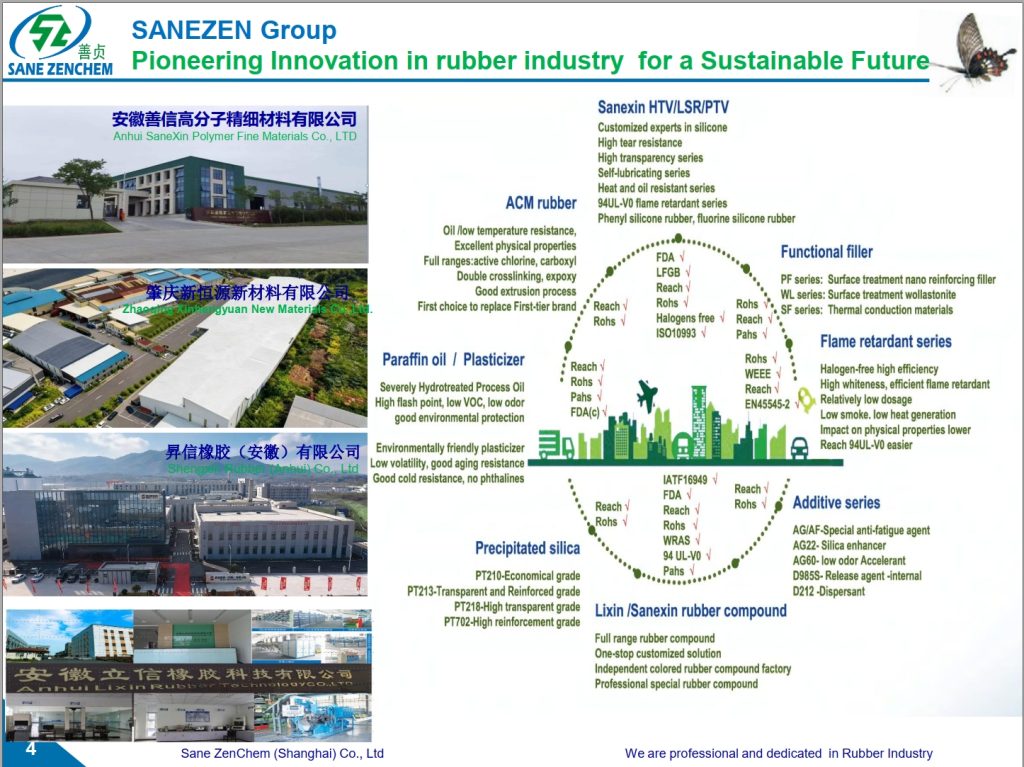
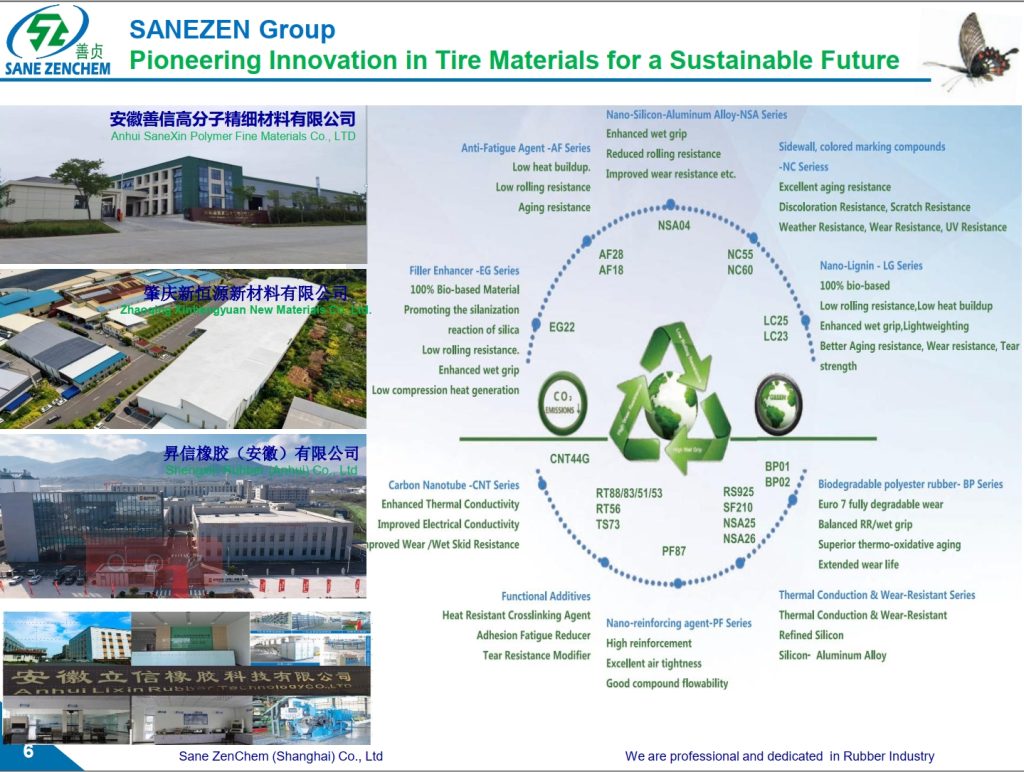
Choosing a functional filler supplier is not only about purchasing a mineral powder. It is about selecting a technical partner that understands polymer compounding, physical failure mechanisms, and long-term product performance. As a leading specialty functional filler and performance additives manufacturer, we bring decades of compounding expertise to every customer collaboration.
SaneZenChem operates five manufacturing facilities specialising in:
• Rubber Compounds
• Silicone Rubber Compounds
• Specialty Functional Fillers
• Flame Retardants
• Polymer Performance Additives
Because we formulate and manufacture rubber and silicone compounds ourselves, every specialty product we develop originates from solving real production challenges rather than laboratory concepts alone. This application-driven approach allows us to deliver practical solutions that create measurable improvements in customer products – from eliminating processing viscosity spikes and preventing micro cracking, to ensuring high dielectric strength in harsh electrical environments. Our unique dual position as both a direct compounder and a premier specialty functional filler manufacturer means we are uniquely equipped to support rubber, epoxy, and electrical insulation manufacturers in achieving longer service life, processing efficiency, and ultimate reliability.
Contact
Plant Address:
Baishou Road, North District of Xuan Zhou Economic Development Zone
Xuan Cheng City, Anhui Province, China
Commercial Address:
Room 503, Building 1, Huixin International Edifice, No. 150 Puhuitang Road, Xuhui District, Shanghai, China 200030
Tel: +86 136 7164 1995
Email: yorichen@sanezen.com
Website: www.sanezenrubber.com
 English
 Spanish
 Russian