
What this page answers
Silicone rubber is usually specified for one property, which is temperature, and then bought on another, which is price. That works until the part is a seal that takes a permanent set, a gasket that tears on assembly, or a tube that collapses in fuel. Then the specification has to be written properly.
This page sets out how the grades in a silicone range differ, using the measured data from our own series rather than a general description. It covers hardness from 16 to 82 Shore A, tear strength from 8 to 49 kN/m, compression set from 7 to 26 percent, continuous service from 200 to 315 C, oil and fuel resistance, flame retardancy to UL94 V-0 and EN 45545, and liquid silicone for injection moulding. It also lists the four places where our own data sheets contain errors, because a buyer comparing tables deserves to know which numbers to trust.
Why silicone gets specified for the wrong property
A silicone part is normally chosen because the service temperature is beyond what an organic rubber will survive. That is a valid reason and it is the reason the material exists. The problem is what happens next: the purchasing decision moves to the grade with the lowest price at the required hardness, and the properties that will actually fail the part are never measured.
Three failures account for most silicone complaints in the field, and none of them is a temperature failure. A seal takes a permanent set because the compression set of the chosen grade is 25 percent and the application needed 12. A moulded part tears at a thin wall because the grade has 12 kN/m tear strength and the geometry puts a stress concentration there. A part turns yellow or loses strength after secondary curing because the post-cure was written for a different grade.
So the specification should start from the failure mode, not from the temperature.
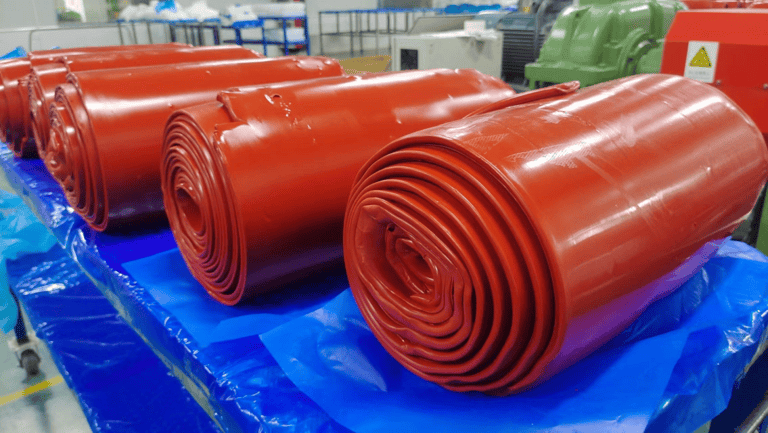
Figure 1. Silicone compound as supplied, pigmented and rolled before packing. Colour and hardness are set in the mixer, not at the press.
The four numbers that decide whether a silicone part survives are hardness, tear strength, compression set and rebound. The four that are usually argued about instead are price, colour, lead time and whether the grade is called “general purpose”.
The four numbers, and how they interact
| Number | What it predicts in service | What moves it |
| Hardness, Shore A | How the part seats, seals and resists extrusion | Filler loading; every other property moves with it |
| Tear strength, kN/m | Whether the part survives assembly, demoulding and a nick | Polymer molecular weight, filler structure, vinyl content |
| Compression set, percent | Whether a seal still seals after a thousand hours hot | Crosslink type and density, post-cure, filler loading |
| Rebound, percent | Heat build-up under dynamic load, and how a part feels | Crosslink density, filler, phenyl content |
The reason these four have to be read together is that hardness drags everything with it. Push hardness up to resist extrusion and compression set usually improves while elongation and rebound fall. Push hardness down for a soft feel and tear strength falls with it, because there is less polymer per unit volume to carry the stress.
That is why a silicone rubber hardness range 30 to 80 is not a single product line but a family of compromises, and why the same hardness from two different series can behave very differently. A 50 Shore A grade in a general purpose series and a 50 Shore A grade in a high tear series differ by more than their price.
General purpose: what “balanced” actually means
The three general purpose series in our range cover 29 to 80 Shore A and are differentiated by process rather than by property: the first for moulding, the second for extrusion, the third for platinum curing. Mechanically they are close, which is the point of a general purpose grade.
| Grade | Shore A | Tensile, MPa | Elongation, percent | Tear, kN/m | Rebound, percent |
| SR130U | 29 | 8.0 | 712 | 13 | 73.2 |
| SR150U | 51 | 8.3 | 420 | 16 | 65.9 |
| SR170U | 70 | 8.1 | 248 | 20 | 56.6 |
| SR230U | 31 | 7.1 | 690 | 12 | 73.9 |
| SR250U | 50 | 9.0 | 390 | 17 | 68.5 |
| SR270U | 69 | 8.6 | 238 | 18 | 56.5 |
| SR280U | 79 | 7.7 | 186 | 16 | 52.0 |
| SR350U | 50 | 7.2 | 430 | 14 | 64.9 |
| SR380U | 80 | 7.1 | 202 | 17 | 55.2 |
Read down the hardness column and then across. Tensile strength barely moves between 29 and 80 Shore A, staying in a band of 7 to 9 MPa, while elongation falls by a factor of nearly four and rebound falls by 20 points. That is the shape of a filler-loaded elastomer: adding filler raises hardness and lowers the strain at break, while the tensile strength plateaus.
Two practical consequences follow. A soft grade is not weaker in tensile terms, it is more extensible, so a design that needs a soft part and a strong part is asking for a grade with high elongation rather than high tensile strength. And the rebound drop across the range is why a 70 Shore A silicone part runs hotter under vibration than a 30 Shore A part of the same compound family, which matters in a mount and does not matter in a static gasket.
Where the mechanical grades separate
Above the general purpose range, the differences become worth paying for. The SR4XXU series and the SR7XXU series both target higher mechanical properties, and the second one does it with better tear strength at the same hardness.
| Grade | Shore A | Tensile, MPa | Elongation, percent | Tear, kN/m | Note |
| SR430U | 33 | 9.8 | 812 | 15 | High elongation at low hardness |
| SR460U | 60 | 12.1 | 495 | 22 | Highest tensile in the range |
| SR470U | 70 | 11.2 | 360 | 27 | 70 Shore A with usable tear |
| SR515U | 16 | 5.6 | 1210 | 14 | Softest grade, extrusion |
| SR550U | 50 | 8.8 | 573 | 17 | Balanced, good demoulding |
| SR570U | 70 | 8.5 | 383 | 19 | Standard 70 Shore A alternative |
| SR730U | 32 | 11.7 | 948 | 22 | High strength at low hardness |
| SR750U | 50 | 12.1 | 701 | 28 | Closest balance of strength and tear |
| SR770U | 70 | 11.2 | 532 | 34 | Highest tear at 70 Shore A |
The comparison worth making is SR570U against SR770U, both at 70 Shore A. Tensile strength rises from 8.5 to 11.2 MPa and tear from 19 to 34 kN/m at the same hardness, which is a different polymer and filler architecture rather than a different loading. For a part with a thin wall, a sharp corner or a metal insert, that difference is the difference between a moulding that survives demoulding and one that does not.
Tear: the number that gets specified last and fails first
Tear strength is the property that decides whether a silicone part survives handling, and it is the one most often left out of a purchase specification because it is not printed on the drawing.
| Grade | Shore A | Tensile, MPa | Elongation, percent | Tear, kN/m |
| SR3240U | 41 | 9.5 | 850 | 30 |
| SR3250U | 49 | 10.0 | 700 | 35 |
| SR3270U | 71 | 10.5 | 450 | 36 |
| SR3280U | 82 | 9.8 | 300 | 30 |
| SR3350U | 52 | 11.0 | 820 | 45 |
| SR3360U | 60 | 11.2 | 570 | 48 |
| SR3370U | 72 | 10.8 | 520 | 49 |
A high tear strength silicone rubber in this range reaches 45 to 49 kN/m at 50 to 72 Shore A, against 17 to 22 kN/m for a general purpose grade at the same hardness. That is a factor of two and a half, and it does not come with a penalty in tensile strength or elongation.
Why silicone tears easily in the first place is worth stating, because it changes how you design the part rather than which grade you buy. Silicone has a low tear energy compared with natural rubber, so a nick or a mould defect propagates instead of blunting. The material cannot be made to behave like NR, so the two levers are to buy the highest tear grade that the application can afford, and to remove the stress concentrations that start the tear. A radius that would be acceptable in EPDM is often too sharp in silicone.
The high tear series also carries FDA food contact compliance in our data, which is relevant for the baby products, drinking water tubing and food moulds that make up a large part of this market.
Compression set: the seal property that decides the warranty
Compression set is measured by compressing a specimen by 25 percent, holding it at temperature for 22 hours, releasing it, and measuring how much of the deformation did not come back. It is the most reliable single predictor of whether a gasket still seals after a year.
| Grade | Shore A | Compression set, percent | Rebound, percent | Tensile, MPa |
| SR515U | 16 | 16 | 54 | 5.6 |
| SR530U | 30 | 17 | 60 | 8.1 |
| SR550U | 50 | 22 | 53 | 8.8 |
| SR570U | 70 | 24 | 45 | 8.5 |
| SR830U | 34 | 10 | 67 | 5.6 |
| SR850U | 50 | 9 | 66 | 8.9 |
| SR870U | 71 | 11 | 53 | 8.9 |
| SR2230U | 29 | 21 | 77 | 6.0 |
| SR2250U | 52 | 23 | 66 | 7.2 |
| SR2270U | 70 | 21 | 49 | 9.5 |
The SR8XXU series is the one to look at if the requirement is low compression set silicone rubber. At 50 Shore A it measures 9 percent against 22 percent for a general purpose grade at the same hardness, and its rebound is 13 points higher. That combination is what a dynamic seal needs: low set so the lip keeps contact, high rebound so it recovers between strokes.
The SR22XXU series goes the other way on rebound, reaching 77 percent at 29 Shore A, and it is rated to 225 C. A high rebound soft grade is the right choice for a part that flexes continuously, such as a diaphragm, and the wrong choice for a static gasket where set matters more than resilience.
Two cautions belong here. Compression set depends on the test temperature, so a 22 hour result at 177 C and a 22 hour result at 70 C are not the same measurement and should never be compared. And compression set improves with a proper post-cure, which means a grade that measures 20 percent in our table can measure 12 percent in your plant if you post-cure it, and a grade measured without post-cure will look worse than it is.
Heat: four classes, not one number
Silicone is sold as a high temperature material, but the classes inside that description are separated by 100 C, and the data that supports each class is different.
| Series | Continuous service | Peak | What supports the claim |
| General purpose SR1/2/3XXU | 200 C | short excursions above | Stability to 200 C, slight re-plasticisation on storage |
| SR22XXU, SR21XXUOR | 225 C | 250 C | 70 h at 225 C with property change recorded |
| SR12XXUTH | 300 C to 315 C | 315 C | 3, 7 and 10 day ageing at 300 C |
| SR32/35UDP (PVMQ) | 250 C | 300 C | Brittleness at -100 C, ageing 70 h at 225 C |
PVMQ is the grade family most people mean when they ask for a phenyl silicone rubber low temperature capability, and it is the one to specify when a part has to stay flexible below -60 C rather than merely survive it.
A heat resistant silicone rubber 300 C grade is a different material family, not a better version of a 200 C grade. In the SR12XXUTH data, a 71 Shore A grade ages for 10 days at 300 C and comes out at 85 Shore A with 3.8 MPa tensile and 100 percent elongation, against 8.5 MPa and 450 percent when new. That is a material that survives, not a material that holds its properties, and the distinction matters when a customer asks for a 300 C gasket and means a 300 C continuous duty.
The measured ageing sequence is more useful than the headline number, so it is worth carrying in a specification:
| SR1270UTH, ageing at 300 C | Hardness, Shore A | Tensile, MPa | Elongation, percent |
| As cured | 71 | 8.5 | 450 |
| Post cured | 72 | 9.5 | 410 |
| 3 days | 77 | 5.0 | 150 |
| 7 days | 83 | 4.4 | 110 |
| 10 days | 85 | 3.8 | 100 |
Oil, fuel and the fluorosilicone decision
Standard silicone swells in hydrocarbon oil, and no amount of compounding changes that enough for a fuel seal. Two families exist to deal with it, and they solve different problems.
| Grade | Shore A | Density, g/cm3 | Compression set, percent | Swell in ASTM 903 oil, percent | Swell in ASTM 901 oil, percent |
| SR2150UOR | 51 | 1.19 | 10.0 | 37 | 5.4 |
| SR2170UOR | 71 | 1.32 | 8.2 | 36 | 3.4 |
| SR2180UOR | 82 | 1.37 | 7.9 | 34 | 2.3 |
The SR21XXUOR series is an oil resistant silicone rubber compound rather than a fluorosilicone. In aggressive ASTM 903 oil at 150 C it still swells 34 to 37 percent by volume, which is a lot, and in the milder ASTM 901 oil it swells 2 to 5 percent. That profile suits a part that sees oil mist, oil splash or a lubricant film, and it does not suit a part immersed in hot hydrocarbon.
For immersion, the answer is fluorosilicone.
| Grade | Shore A | Tensile, MPa | Elongation, percent | Compression set, percent | Swell in Fuel C, percent |
| FS2230U | 30 | 9.7 | 498 | 7.5 | 25 |
| FS2250U | 50 | 10.4 | 358 | 6.8 | 18 |
| FS2270U | 71 | 10.0 | 254 | 6.9 | 16 |
| FS2280U | 79 | 9.1 | 200 | 7.4 | 15 |
| FS8250U | 50 | 9.9 | 320 | 17 | 21 (Fuel B) |
| FS8260U | 60 | 9.8 | 380 | 19 | 18 (Fuel B) |
For a silicone rubber for automotive seals, the starting point is a 50 to 70 Shore A grade with low set, and the choice between standard VMQ, oil resistant VMQ and fluorosilicone follows the fluid rather than the temperature. A fluorosilicone rubber for fuel resistance holds Fuel C swell to 15 to 25 percent by volume and keeps compression set under 8 percent, which is the combination a fuel line connector or an injector seal needs. The cost is roughly an order of magnitude above a standard grade, and the tear strength is ordinary, so it is used where nothing else works rather than as a general upgrade.
The comparison customers ask about is fluorosilicone against FKM. The honest answer is that FKM has better fuel and oil resistance and better tear strength, and fluorosilicone wins on low temperature, where it stays flexible to -60 C or below. If the part is a static fuel seal that never goes cold, FKM is the better material. If it is a cold-climate fuel system component, fluorosilicone is the material of the two that still seals at -40 C.
Flame retardant silicone, and the rail requirement
A flame retardant silicone rubber EN45545 grade exists because the rail industry asks a question that UL94 does not answer. UL94 V-0 is a laboratory vertical burn on a small specimen. EN 45545 assesses a finished part against smoke density, toxicity and heat release together, and a part can pass the first and fail the second.
| Grade | Shore A | Density, g/cm3 | Tensile, MPa | Elongation, percent | UL94 | Compression set, percent |
| SR6450UFR | 52 | 1.49 | 6.7 | 380 | V-0 | 25 |
| SR6470UFR | 72 | 1.52 | 7.2 | 175 | V-0 | 24 |
This series is halogen-free and reaches V-0 on a 2 mm specimen. Density at 1.49 to 1.52 g/cm3 is high for silicone, roughly 25 percent above a general purpose grade, and that is the cost of the flame retardant package. The series is positioned for R1 and R23 classifications in rail applications, with a service temperature up to 300 C and a ceramic ash that holds shape after burning.
The point about ceramic ash is the one that decides rail approvals. A silicone that burns to a powdery ash exposes the core of a cable. A silicone that burns to a ceramic shell keeps the core insulated for a while longer, which is what the fire test is measuring.
Liquid silicone: the injection moulding route
Liquid silicone rubber for injection molding is a two component system, supplied as A and B, mixed at the press and cured in a hot mould in seconds rather than minutes. The property profile is different from an HCR grade and, for a buyer, better in one respect and worse in another.
| Grade | Shore A | Tensile, MPa | Elongation, percent | Tear, kN/m | Compression set, percent |
| LSR6150 | 50 | 9.1 | 550 | 31 | not stated |
| LSR6170 | 71 | 9.0 | 335 | 26 | not stated |
| LSR7140 | 41 | 10.2 | 756 | 34 | 26 |
| LSR7150 | 51 | 10.4 | 675 | 38 | 26 |
| LSR7170 | 69 | 9.3 | 469 | 45 | 32 |
| LSR8250 | 50 | 9.0 | 500 | 30 | 20 |
LSR tear strength at 30 to 46 kN/m is higher than most HCR general purpose grades, because the polymer is cleaner and the filler dispersion is better. The limit is geometry: LSR needs a sealed mould, a cold runner or a valve gate, and it cannot make a large thick part economically. Where the part is small, high volume and needs a high tear strength, LSR is the better route and the material cost difference is smaller than the processing difference.
Pot life is the specification item that gets missed. Our LSR61XX series is stated at 5 days in a closed vessel at 20 C, and that figure falls as the temperature rises. A customer who specifies “pot life 5 days” without the temperature has specified nothing.
Failure analysis: what actually goes wrong
| Symptom | Usual cause | What to check |
| Seal takes a permanent set after weeks in service | Compression set of the grade is too high for the temperature | Re-specify on compression set at the service temperature, not at 177 C |
| Part tears at demoulding or on assembly | Tear strength too low, or a sharp corner in the tool | Move to a high tear series, then radius the corner |
| Part turns yellow or brittle after secondary curing | Post-cure temperature too high for the grade, or too long | Check the post-cure against the grade data, not against a generic recipe |
| Platinum cure does not cure or cures unevenly | Inhibition from sulphur, tin, amine or a mould release agent | Change gloves, clean the tool, check the release agent chemistry |
| Compound is hard and boardy after months in store | Structurisation, which is normal and reversible by milling | Check storage time and temperature, then re-mill before use |
| Extrudate is rough or dimensionally unstable | Grade intended for moulding, used on an extruder | Move to the extrusion series and adjust the die |
| Part swells and softens in contact with oil | Standard VMQ in a hydrocarbon environment | Move to SR21XXUOR for splash, fluorosilicone for immersion |
Two of these are worth more than the rest. The first row is the most common warranty claim in silicone sealing and it is almost always a specification error rather than a material failure, because the drawing said “silicone 70 Shore A” and never said a set limit. The fourth row is the most common processing complaint, and it is a contamination problem that no material change will fix.
Writing the specification
A silicone specification that works has five lines, and four of them are missing from most drawings.
| Line | Example | Why it matters |
| Hardness with tolerance | 50 Shore A, plus or minus 5 | A range of 45 to 55 covers normal batch variation |
| Compression set at service temperature | 22 h at 125 C, 25 percent deflection, 25 percent maximum | This is the warranty property |
| Tear strength minimum | 30 kN/m, ASTM D624 Die B | Protects against assembly damage |
| Post-cure condition | 4 h at 200 C in air | Changes set, hardness and volatiles |
| Colour and food contact | Natural, FDA 21 CFR 177.2600 | Decides the grade family, not a pigment addition |
The FDA food grade silicone rubber requirement is worth spelling out because it is often written as a word rather than a standard. Our LSR61XX and LSR71XX series are stated as compliant with FDA 21 CFR 177.2600, and the high tear series is stated as FDA compliant, while the EN 14350-2 volatile compound test applies to the drinking article rather than to the material. A customer who needs a food contact declaration should ask for the specific regulation that applies in their market.
The platinum cured silicone rubber route deserves one note in the specification. Platinum addition cure gives faster cure, no peroxide decomposition products and better compression set, but it is inhibited by sulphur, tin, amines and some plasticisers. A grade change from peroxide to platinum in an existing factory often fails at the first batch because the mixer or the gloves carried a contaminant, and the specification should say which cure system is intended so that the process can be prepared for it.
Where custom compounding fits
A custom silicone rubber manufacturer earns its place when the requirement falls between two standard grades, which in our experience is about a third of projects. Typical cases are a hardness that sits between two catalogue values, a colour match against a plastic part, a compression set target at a temperature the standard grade was not tested at, or a cost target that requires part of the filler to be changed.
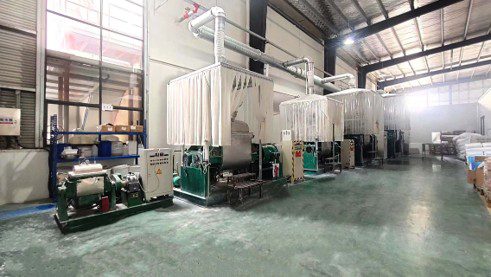
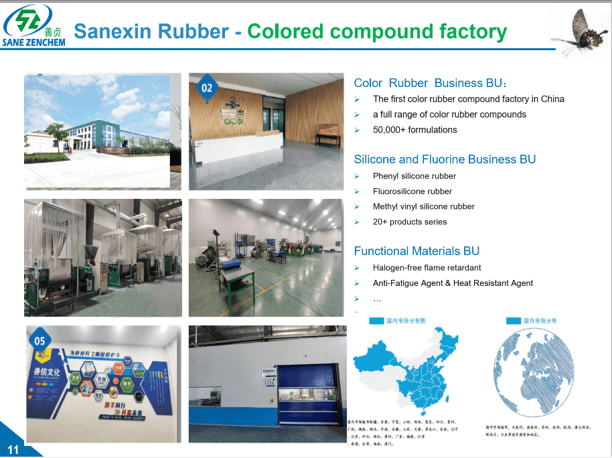
Because we mix our own compounds, the change is made in the mixer rather than in a specification sheet, and the sample that goes out is from the same batch record as the production. That is also why the four errors below are worth publishing: a supplier who has never mixed the material does not usually find them.
For a silicone compound for extrusion, including the soft 16 Shore A grade where elongation exceeds 1200 percent, the grade choice matters less than the die design and the cure line speed, and a compound that performs well in a press will often fail on a line. Ask for an extrusion trial rather than a press cure data sheet.
Four numbers in our own data sheets that need correcting
Publishing this is uncomfortable and it is the honest thing to do.
Our SR64XXUFR data sheet lists tear strength as 1.49 and 1.52 kN/m for the two grades. Those are the density values, copied into the wrong row. A silicone tear strength of 1.5 kN/m is not physically plausible; the true values are an order of magnitude higher and should be measured and reissued before a customer compares the grade on tear.
Our SR8XXU table lists compression set in N/mm, which is a unit for tear or for stiffness, not for a percentage. The values of 7 to 11 are percentages and the unit needs correcting.
Our LSR7170 tensile strength appears as 101 MPa, which is a typographical error for 10.1 MPa.
And our SR1XXU, SR2XXU and SR7XXU tables leave the compression set column as a dash. A buyer comparing these series against a competitor will read the dash as “not measured” and assume the worst. It should either be filled or explained.
FAQ
How to choose a silicone rubber grade for a seal
Start from compression set at the service temperature, not from hardness. A seal fails by taking a set, so the grade with the lowest set at the temperature the part sees is the starting point. In our range that is the SR8XXU series at 9 to 11 percent, against 21 to 24 percent for general purpose grades. Then check hardness for extrusion resistance and tear for assembly damage, in that order.
Why does silicone rubber tear so easily
Because its tear energy is low compared with a diene rubber, so a defect propagates rather than blunting. You cannot compound the problem away entirely, so the answer is two part: buy the highest tear grade the budget allows, which in our range reaches 45 to 49 kN/m in the SR33XXU series, and remove the sharp corners and thin walls that start the tear.
How to reduce compression set in silicone rubber
Three levers, in order of effect. Choose a grade with a low set to begin with, post-cure it properly, and keep the filler loading at the level the hardness requires rather than above it. Post-curing at 200 C for four hours removes the volatiles that would otherwise migrate out under compression, and it typically improves set by several points against the as-cured value.
What is the difference between VMQ and PVMQ
VMQ is vinyl methyl silicone, the standard material. PVMQ adds phenyl groups to the backbone, which improves low temperature flexibility and radiation resistance at the cost of some tensile strength and a higher price. Our SR32/35UDP series is PVMQ, non-brittle at -100 C after 3 minutes, and rated from -100 C to 250 C.
How much does silicone rubber swell in oil
A standard VMQ swells heavily, and even an oil resistant grade swells. Our SR21XXUOR series swells 34 to 37 percent by volume in ASTM 903 oil at 150 C and 2 to 5 percent in ASTM 901 oil at the same temperature. That is enough for splash and mist, and not enough for immersion. For immersion, a fluorosilicone holds Fuel C swell to 15 to 25 percent.
How to pick a silicone hardness for an O ring
Choose the softest hardness that still resists extrusion through the gap, because a softer grade seals at lower compression and takes less set. For a static groove with a well supported gap, 50 to 60 Shore A is usual. For a dynamic application or a wide gap, 70 Shore A. Below 30 Shore A the material is better used as a moulded gasket than as an O ring.
Why does silicone rubber turn yellow after curing
Two causes, and they are different problems. A peroxide cured grade can yellow from residual decomposition products, which is cosmetic. A grade that yellows and also hardens has been over-cured or post-cured above its rating, which is not cosmetic. Our high tear series is specified as high yellow resistance for applications where the colour is visible, such as consumer electronic cases.
How to specify pot life for liquid silicone rubber
Always state the temperature with the time. Our LSR61XX series is 5 days in a closed vessel at 20 C, and the figure shortens as the temperature rises. A specification that says “pot life 5 days” without the temperature cannot be verified and will be argued about at the first claim.
What temperature can standard silicone rubber handle
A general purpose grade is rated to 200 C continuously. Above that the material family changes: 225 C for the SR22XXU and SR21XXUOR series, and 300 to 315 C for the SR12XXUTH series, which is supported by ageing data at 300 C for 3, 7 and 10 days. Asking for a 300 C part and receiving a 200 C grade is the most common mismatch we see in quotations.
How to avoid structurization in silicone compound storage
Structurisation is a gradual stiffening of the raw compound in storage, and it is normal rather than a defect. Keep the compound cool, use it within the shelf life, and re-mill it before use if it has stiffened. It is reversible, which is why a compound that feels boardy after six months is not scrap. Our high tear and SR22XXU series are specified as resistant to structurisation, which extends the usable window.
Fluorosilicone versus FKM for fuel contact
FKM has better fuel resistance and better tear strength. Fluorosilicone is better in the cold, staying flexible to -60 C or below where FKM stiffens. For a static fuel seal in a warm location, FKM is the better material. For a cold climate fuel system component or an aerospace part that sees both low temperature and fuel, fluorosilicone is the one that keeps sealing.
How to choose a flame retardant silicone for rail
Do not choose on UL94 alone. A rail part is assessed on smoke density, toxicity and heat release together, and a V-0 material can still fail. Our SR64XXUFR series is halogen-free, reaches V-0 at 2 mm, and is positioned for EN 45545 R1 and R23 classifications with a 300 C service temperature. Ask for the classification report for the specific part geometry, not for the material alone.
Why does platinum curing get inhibited
Because platinum catalysts are poisoned by sulphur, tin, amines, phosphorus and some plasticisers and release agents. The cure simply does not start, or starts unevenly. The fix is process hygiene rather than formulation: dedicated gloves, a clean mould, a sulphur free release agent, and a check on any pigment or additive masterbatch that was changed recently.
How to post cure silicone rubber properly
Post-cure in air at a temperature 20 to 30 C above the service temperature, for a time that depends on section thickness, typically 4 hours at 200 C for a moulded part. Post-curing drives off volatiles and completes the crosslink, which improves compression set and reduces the risk of later outgassing. Post-curing above the grade’s rating does the opposite, hardening the part and cutting elongation.
How to test tear strength of silicone rubber
Use a crescent or Die B specimen to ASTM D624, on a post-cured sheet, and report the thickness with the result. Tear strength depends on specimen geometry and on whether the material was post-cured, so two laboratories quoting tear without those conditions are not comparable. Our own data uses Die B throughout, which is why the numbers can be read against each other.
Technical support
Silicone selection is usually decided by one property, and the whole argument is about which one. If you have a part that has failed in the field, send the failure mode, the service temperature and the current specification. If the failure is set, the answer is a different series. If it is a tear at demoulding, the answer is usually a grade change and a tool change together.
Contact
Plant address: No. 6, Xinqing Road, North Economic Development Zone, Xuanzhou District, Xuancheng City, Anhui Province, China
Commercial address: Room 1606-1608, Boda Commercial Building, No. 11 Puhuitang Road, Xuhui District, Shanghai, China 200030
Tel: +86 136 7164 1995
Email: yorichen@sanezen.com
Website: www.sanezenrubber.com
The compounds discussed on this page are supplied as the Sanesil SR and LSR series by SaneZenChem, a silicone rubber compound supplier and custom silicone rubber manufacturer serving seal, medical, food contact, rail and automotive customers.
 English
 Spanish
 Russian