Let the Data Speak – A Technical White Paper Based on Empirical Research
In tire compound formulation, the introduction of every raw material must withstand the triple challenge of performance, cost, and processability. For core functional components like the support compound of run-flat tires, material selection directly impacts driving safety and ride comfort.
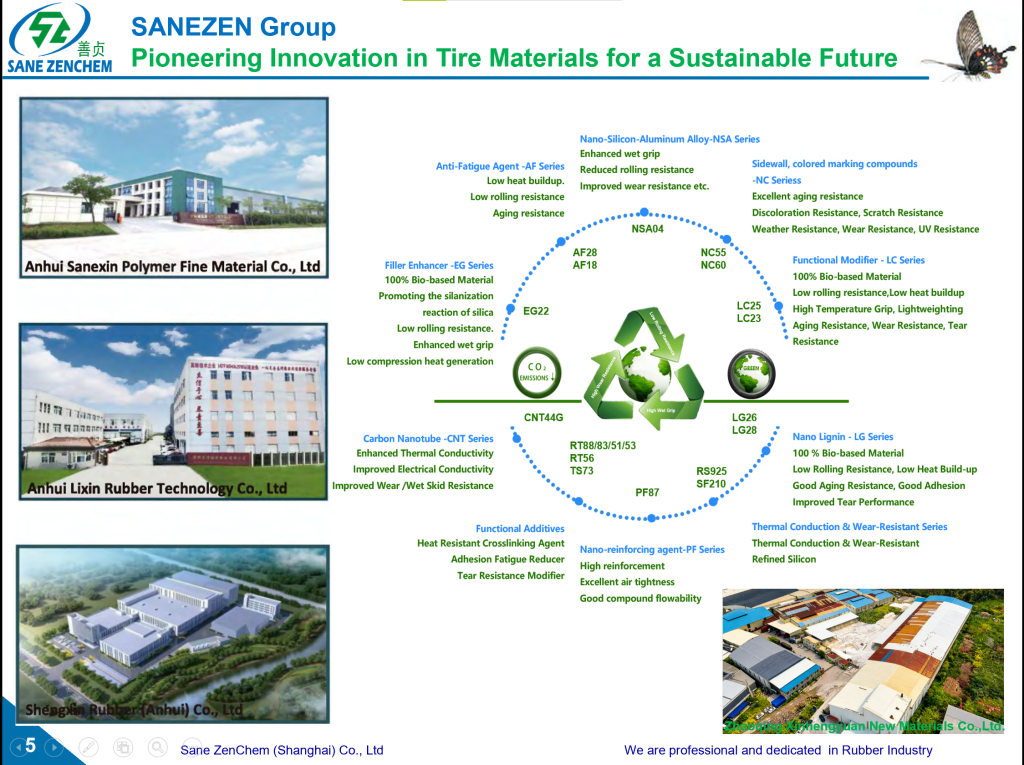
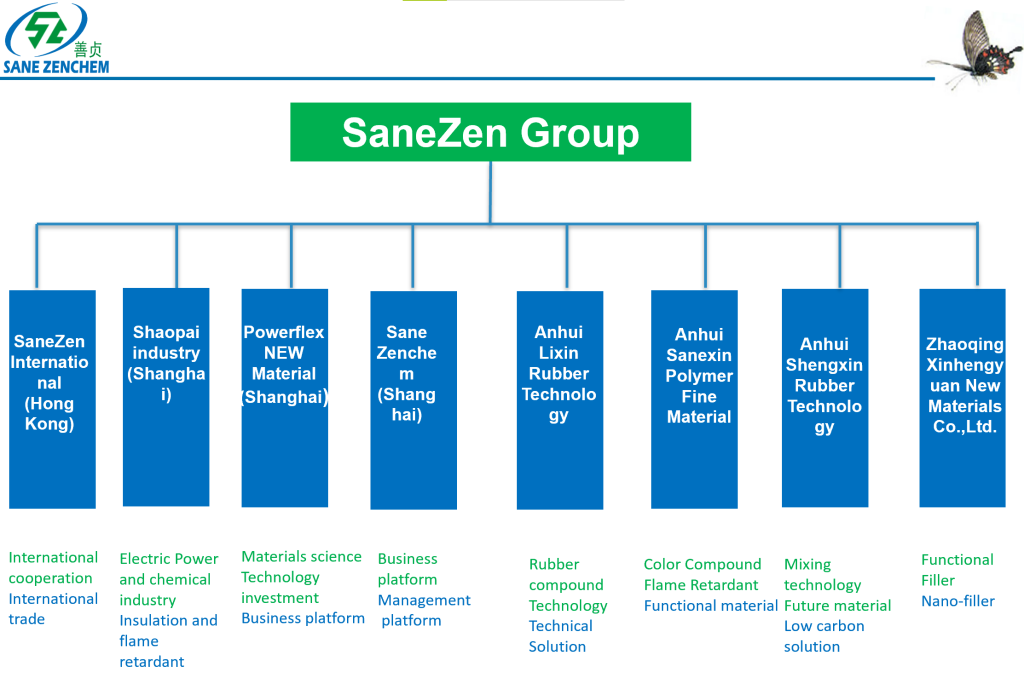
GreenThinking® RT56 is a high-performance rubber adhesion and anti-fatigue agent developed by Shanghai Xuanluo New Materials Co., Ltd. (a subsidiary of Sanezen Group). This paper, based on systematic applied research of RT56 in run-flat tire support compounds and supported by measured data, provides an in-depth analysis of its technical value and performance advantages.
I. The Mechanism of RT56: From Molecular Structure to Macroscopic Performance
The molecular structure of RT56 contains multifunctional maleimide compounds and multiple active benzene rings. This unique molecular design endows it with dual functionality:
First, participation in vulcanization crosslink reconstruction. RT56 can directly participate in the rubber vulcanization crosslinking process through the Alder-Ene reaction, reconstructing the crosslink network. Compared to traditional anti-reversion agents (e.g., PK900), RT56 possesses more active functional groups and exhibits higher reactivity. Due to the electron-donating effect of the side methyl group in PK900, its double bond activity is weaker, and it does not participate in the vulcanization reaction, only undergoing Diels-Alder reactions. In contrast, RT56 actively participates in constructing the crosslink network, forming a more stable crosslinked structure.
Second, optimizing carbon black dispersion. The multi-benzene ring structure of RT56 effectively modulates the interaction between carbon black and rubber, coupling with carbon black to improve its dispersion and reduce compound heat generation. Simultaneously, by inhibiting crack propagation, it significantly enhances the fatigue resistance of the compound.
II. Laboratory Data: Quantifying the Performance Advantages of RT56
To objectively evaluate the application effects of RT56, five groups of formulations were set up for comparative testing:
- Formulation 1# (Control Formula): NR 70, BR 30, Carbon Black N550 80, Anti-reversion Agent PK900 0.5 phr
- Formulation 2#: Replaced 0.5 phr PK900 with 0.625 phr RT56
- Formulation 3#: Replaced 0.5 phr PK900 with 1.25 phr RT56
- Formulation 4#: Replaced 0.5 phr PK900 with 2.5 phr RT56
- Formulation 5#: Added 1.25 phr RT56 to the control formula
2.1 Vulcanization Characteristics: Balancing Processing Safety and Crosslinking Efficiency
| Item | Formulation 1# | Formulation 2# | Formulation 3# | Formulation 4# | Formulation 5# |
| Mooney Viscosity [ML(1+4)100℃] | 95 | 94 | 102 | 110 | 100 |
| Mooney Scorch Time t5 (130℃)/min | 11.0 | 11.8 | 11.4 | 7.8 | 10.4 |
| Fmax/(dN·m) | 42.8 | 43.2 | 39.8 | 36.8 | 37.1 |
| t90/min | 6.8 | 6.9 | 11.0 | 9.0 | 10.0 |
Data Interpretation:
- Formulations 3# and 5# exhibited excellent overall vulcanization characteristics and were selected as candidate formulations for subsequent factory trials.
- The Mooney scorch time of Formulation 4# was shortened by more than 3 minutes compared to the control, indicating reduced processing safety and suggesting that the RT56 dosage requires optimization.
2.2 Mechanical Properties: Synergistic Enhancement of Strength and Elasticity
| Item | Formulation 1# | Formulation 2# | Formulation 3# | Formulation 4# | Formulation 5# |
| Tensile Strength/MPa | 18.12 | 18.11 | 19.25 | 18.48 | 18.95 |
| Elongation at Break/% | 139 | 137 | 183 | 177 | 210 |
| Tear Strength/(kN·m⁻¹) | 40 | 35 | 42 | 38 | 43 |
| Rebound Resilience/% | 66 | 65 | 61 | 63 | 69 |
| Carbon Black Dispersion Grade | 7 | 8 | 8 | 7 | 8 |
| Flex Cracking Cycles | 224 | 31 | 5,543 | 6,062 | 5,949 |
Data Interpretation:
- Formulations 3#, 4#, and 5# showed an over 24-fold increase in flex cracking cycles compared to the control, indicating a significant improvement in fatigue resistance.
- Formulation 5# exhibited a 51% increase in elongation at break, an improvement in carbon black dispersion grade from 7 to 8, and a 3-percentage-point increase in rebound resilience.
2.3 Compression Fatigue Performance: Optimization of Heat Generation and Permanent Set
| Item | Formulation 1# | Formulation 2# | Formulation 3# | Formulation 4# | Formulation 5# |
| Compression Fatigue Temp. Rise/℃ | 28.5 | 32.0 | 31.2 | 31.7 | 24.9 |
| Permanent Set/% | 1.49 | 2.23 | 4.38 | 5.81 | 2.59 |
Data Interpretation:
- The compression fatigue temperature rise for Formulation 5# was 3.6°C lower than the control, indicating lower heat generation, which is beneficial for extending tire service life. This directly addresses the industry query on how to improve tire durability and reduce heat generation.
- Formulations 3# and 5# demonstrated the best overall performance and proceeded to the factory trial stage.
III. Factory Scale-Up Trials: Validating Performance from Lab to Production Line
3.1 Processability: Enhanced Processing Safety
| Item | Formulation 1# | Formulation 3# | Formulation 5# |
| Mooney Viscosity [ML(1+4)100℃] | 95 | 80 | 86 |
| Mooney Scorch Time t5 (130℃)/min | 8.6 | 16.6 | 11.4 |
| ts2/min | 2.9 | 5.0 | 3.3 |
| t90/min | 8.2 | 13.1 | 7.9 |
Data Interpretation:
- Formulations containing RT56 showed reduced Mooney viscosity and extended scorch times, indicating significantly improved processing safety. As a leading NR compound additive factory or additive for NR compound manufacturer would appreciate, this enhances manufacturability.
- The t10, t50, and t90 data for Formulation 5# were close to the control formula, suggesting higher crosslink density and processability meeting production requirements.
3.2 Physical Properties: Breakthroughs in Strength and Fatigue Life
| Item | Formulation 1# | Formulation 3# | Formulation 5# |
| Tensile Strength/MPa | 13.41 | 18.58 | 18.99 |
| Elongation at Break/% | 146 | 218 | 215 |
| Tear Strength/(kN·m⁻¹) | 36 | 35 | 43 |
| Rebound Resilience/% | 60 | 61 | 70 |
| Flex Cracking Cycles | 3,982 | 25,884¹⁾ | 13,349²⁾ |
| Compression Fatigue Temp. Rise/℃ | 34.7 | 29.3 | 23.9 |
¹⁾ Fractured; ²⁾ Grade 6 crack
Data Interpretation:
- The flex cracking cycles for Formulation 3# increased 6.5 times compared to the control, demonstrating a leap in fatigue resistance. This makes it a highly effective additive to prevent tire sidewall separation in run flat tires.
- Formulation 5# showed a 41.6% increase in tensile strength, a 47.3% increase in elongation at break, and a 10-percentage-point increase in rebound resilience.
- The compression fatigue temperature rise for Formulation 5# was 10.8°C lower than the control, signifying a substantial reduction in heat generation. It acts as a powerful additive to reduce compression fatigue temperature rise in NR compound.
IV. Finished Tire Performance: The Ultimate Guarantee of Driving Safety
The optimized formulations were applied to 235/45R18 98W FRD866 run-flat tires for finished product performance testing, crucial for any additive for run flat tire evaluation.
4.1 Durability Performance
| Formulation | Accumulated Running Time |
| Formulation 1# | 50 hours |
| Formulation 3# | 69 hours |
| Formulation 5# | 80 hours |
- The durability performance of the Formulation 5# tire improved by 60% compared to the control.
- The durability performance of all tested formulation tires met national standard requirements.
4.2 High-Speed Performance
| Formulation | Accumulated Running Time |
| Formulation 1# | 90 minutes |
| Formulation 3# | 99 minutes |
| Formulation 5# | 115 minutes |
- The high-speed performance of the Formulation 5# tire improved by 27.8% compared to the control.
- The high-speed performance of all tested formulation tires exceeded national standard requirements.
4.3 Zero Pressure Durability (Core Run-Flat Indicator)
| Formulation | Accumulated Running Time |
| Formulation 1# | 60 minutes |
| Formulation 3# | 73 minutes |
| Formulation 5# | 165 minutes |
- The zero-pressure durability of the Formulation 5# tire improved by 175% compared to the control.
- This means that in a completely deflated state, a vehicle equipped with tires using the RT56 formulation can travel a significantly longer distance safely at 80 km/h, providing enhanced safety assurance for occupants. This directly demonstrates how RT56 can improve zero pressure endurance for self supporting tires and validates its role in the support compound formulation for run flat tire safety.
V. Technical Value Summary: Why RT56 Deserves Your Testing
5.1 Comprehensive Performance Enhancement
- Fatigue Resistance: Flex cracking cycles increased by over 6.5 times. This makes it an excellent choice for Rubber additive Manufacturers and Special Rubber chemical Manufacturers looking to offer high-value solutions.
- Tensile Strength: Increased by over 40%.
- Elongation at Break: Increased by over 47%.
- Heat Generation Control: Compression fatigue temperature rise reduced by over 10°C.
- Zero-Pressure Durability: Run-flat performance increased by 175%.
5.2 Processing Improvements
- Reduced Mooney viscosity, improving flow.
- Extended scorch time, enhancing processing safety.
- Improved carbon black dispersion grade, leading to better compound uniformity. It functions effectively as a carbon black dispersion agent for high hardness rubber.
- Its benefits are particularly relevant for demanding applications, as it can enhance rubber to metal bonding for automotive mounts and serve as an anti reversion agent for thick rubber articles.
5.3 Formulation Simplification Potential
- RT56 offers multi-functionality, potentially reducing the need for multiple separate additives. For manufacturers aiming to increase tread compound tear strength for truck tires, RT56 presents a streamlined solution.
- Fully compatible with conventional vulcanization systems, requiring no major adjustments to the original formula.
- Effective within a broad 1-8 phr dosage range, providing ample space for formulation optimization.
5.4 Value Leap in Safety
For run-flat tires, the performance of the support compound directly dictates the vehicle’s driving capability in a deflated state. RT56 enhances zero-pressure durability by nearly 2 times. This data translates to greater safety margins and more reliable driving assurance. For premium tire brands pursuing ultimate safety, RT56 offers not just an improvement in technical specifications, but a strategic upgrade in product competitiveness. As a key player among Rubber additive Manufacturers China and Special Rubber chemical Manufacturers China, Sanezen Group is proud to deliver this innovation.
VI. Conclusion: Let Data Be the Basis for Your Choice
In rubber compounding, nothing is more convincing than measured data. The systematic research on GreenThinking® RT56 in run-flat tire support compounds—from laboratory-scale trials to factory scale-up and finally to finished tire testing for durability, high-speed, and zero-pressure performance—completely demonstrates its technical value as a high-performance adhesion and anti-fatigue agent.
We invite you to verify the performance advantages of RT56 for yourself. Whether applied in run-flat tire support compounds, anti-vibration components, conveyor belts, or rubber-to-metal bonded parts, RT56 is an ideal choice to enhance product performance, simplify formulation systems, and strengthen your market competitiveness.
Let the data speak, let performance prove – GreenThinking® RT56 is worthy of your every test.
VII. Frequently Asked Questions (FAQs)
Q1: What is the recommended dosage range of GreenThinking® RT56 in run-flat tire support compounds?
A: Based on our systematic research, GreenThinking® RT56 exhibits excellent performance within a broad dosage range of 1 to 8 phr. For run-flat tire support compounds specifically, Formulation 5# (1.25 phr added to the existing formula) demonstrated optimal comprehensive performance, achieving a 175% improvement in zero-pressure durability. However, the ideal dosage may vary depending on your specific compound formulation and performance targets. We recommend conducting a dosage gradient test (starting from 1.0 phr to 3.0 phr) to determine the optimal addition level for your specific application.
Q2: Is RT56 compatible with existing vulcanization systems, and will it require major adjustments to my current formula?
A: Yes, RT56 is fully compatible with conventional vulcanization systems including sulfur-based and peroxide curing systems. As demonstrated in our factory scale-up trials, Formulation 5# showed t10, t50, and t90 data very close to the control formula, indicating excellent compatibility without requiring major adjustments to the original formulation. RT56 can directly replace traditional anti-reversion agents like PK900 or be added as a supplementary functional additive. Its multi-functional nature may even allow you to simplify your existing additive package by reducing the need for separate dispersing agents or anti-fatigue additives.
Q3: Besides run-flat tires, what other rubber applications can benefit from RT56?
A: While this white paper focuses on run-flat tire support compounds, RT56’s unique mechanism offers significant benefits across various rubber applications. It is highly effective in:
- Anti-vibration components: Enhances rubber-to-metal bonding and reduces compression set
- Conveyor belts: Improves flex fatigue resistance and layer adhesion
- Thick rubber articles: Acts as an anti-reversion agent, preventing property degradation during prolonged vulcanization
- Truck tire tread compounds: Increases tear strength and reduces heat generation
- High-hardness rubber products: Functions as a carbon black dispersion agent for improved uniformity
Q4: How does RT56 improve processing safety while enhancing final performance?
A: RT56 uniquely balances processing safety with performance enhancement. As shown in our factory trial data (Section 3.1), formulations containing RT56 exhibited reduced Mooney viscosity (improved flow) and extended scorch times (enhanced processing safety). This is attributed to its controlled reactivity mechanism—RT56 remains stable during mixing and early processing stages but actively participates in crosslink reconstruction during the vulcanization phase. The result is a wider processing window for manufacturers without compromising the final product’s mechanical properties or fatigue resistance.
VIII. Contact Us
Ready to experience the performance advantages of GreenThinking® RT56 for yourself? Our technical team is available to discuss your specific application requirements, provide samples for testing, or arrange a technical consultation.
Sanezen Industrial Co., Ltd.
Factory Address:
Baishou Road, North District Economic Development Zone,
Xuanzhou District, Xuancheng City, Anhui Province, China
Business Address:
Room 1606-1608, Boda Business Building,
No. 11 Puhuitang Road, Xuhui District,
Shanghai, China. Zip Code: 200030
Tel: +86 21 6487 9251
Fax: +86 21 5106 2693
Email: yorichen@sanezen.com
Website: www.sanezenrubber.com
For technical inquiries, please contact our R&D department directly. For sample requests or commercial inquiries, our sales team is ready to assist you. We look forward to partnering with you to enhance your rubber product performance with GreenThinking® RT56.