
1. Current Status and Background Research: Structural Deviation in Service Life
Currently, the performance certification of tires and rubber products mainly relies on standards such as ISO 11346 to estimate material service life via hot air aging, ozone aging, or a limited number of rig tests. However, extensive feedback from actual operating conditions indicates a significant structural deviation between theoretical predictions and actual service life. Even if initial static mechanical indicators—such as tensile strength, elongation at break, and Shore hardness—fully comply with specification requirements, the performance evolution trajectory of materials under the combined action of thermal, oxygen, and dynamic alternating stresses during long-term service still presents uncontrollable risks.
To bridge this gap, establishing a breakthrough rubber aging resistance sustainable modifier solution has become paramount for modern compounders. Research observations show that traditional carbon black/silica high-filling systems, while achieving initial reinforcement properties, are often accompanied by high dynamic heat generation and insufficient interfacial slippage. This causes materials to fluctuate between two failure modes: “premature damage before aging” or “over-cure embrittlement”. Consequently, merely focusing on qualified data at “0-moment” cannot truly evaluate the wet grip retention, rolling resistance stability, and tear resistance of tires throughout their full life cycle (e.g., 30,000–50,000 kilometers).
2. Coupled Stress Matrix Analysis: Deep Insights into Failure Risks
In real-world service environments, rubber materials endure the coupled stress of thermal-oxygen-dynamic loading. Single-dimensional testing (such as static thermal-oxygen aging) fails to simulate the following synergistic effects:
- Dynamic heat generation accelerating oxidation: Under high-frequency strain, hysteresis loss is converted into internal heat, making the core temperature of the rubber compound far exceed the ambient temperature. This further accelerates the oxygen diffusion rate and free radical chain reactions.
- Interfacial fatigue: Stress concentration points at the interface between filler agglomerates and the rubber matrix take the lead in forming microcracks under cyclic loading, ultimately leading to macroscopic failure.
Key degradation indicators typically manifest as:
- A decline in shear modulus retention rate (reflecting interface bonding failure);
- An increase in compression permanent set rate (reflecting irreversible destruction of the network structure);
- An increment in tanδ at 60°C (predicting rolling resistance deterioration).
This deterioration presents a core technical challenge regarding how to reduce tire rolling resistance naturally while maintaining high structural durability. Therefore, an ideal modification scheme must act as a low heat build up tire formulation additive to simultaneously intervene in the aforementioned coupled stress paths, rather than merely improving a single static indicator.
3. Microscopic Mechanism Deep Dive: Molecular Structure Support for Performance Gains
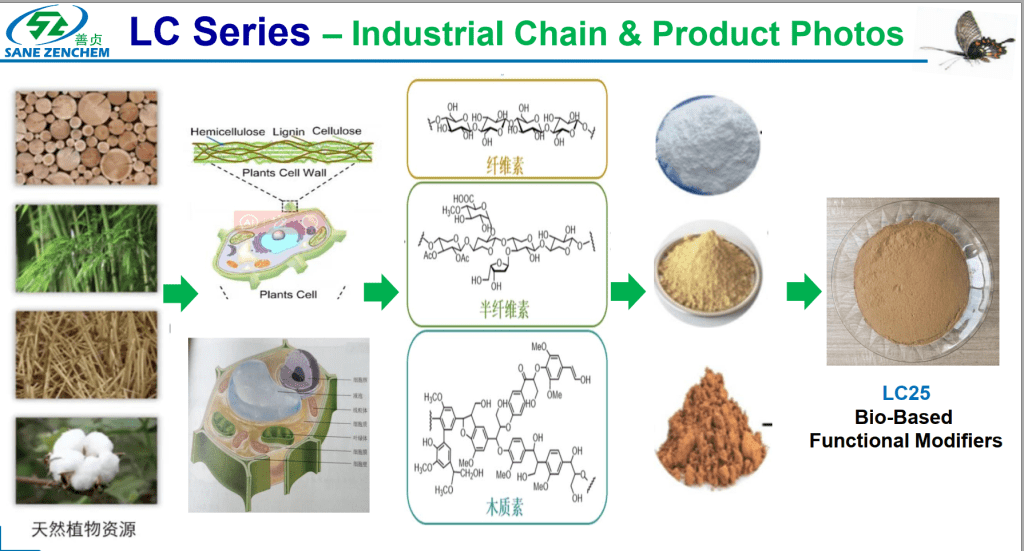
The technical solution evaluated in this report is a bio-based nano functional modifier, which is a supramolecular assembly based on nano-lignin and nano-cellulose. As leading innovators among Bio based rubber additives for rubber developers, we present this technology as a premium bio based modifier for green tire compounds. This solution operates effectively as a plant derived nano filler for rubber dynamic properties optimization, specifically serving as a nano lignin cellulose functional modifier for rubber. Its core mechanism of action can be summarized across three dimensions:
- Nanofabrication and Functionalization: Plant-derived lignin and cellulose undergo controllable nanofabrication processing, granting them high specific surface areas and rich surface functional groups (phenolic hydroxyl and aliphatic hydroxyl groups).
- Interfacial Coupling Effect: Phenolic hydroxyl groups can form hydrogen bonding networks with silanol groups on the silica surface while generating physical entanglements with rubber molecular chains, thereby optimizing rubber-filler interactions.
- Dynamic Sacrificial Bond Mechanism: Under dynamic strain, the rigid-flexible structure composed of the rigid aromatic rings of nano-lignin and flexible nano-cellulose can dissipate energy through the reversible slippage of molecular chain segments, significantly reducing viscous heat buildup.
Performance Contrast Matrix (This Technical Solution vs. Traditional High-Filling Silica System)
| Microstructure / Macroscopic Performance | Traditional High-Filling Silica Scheme | Bio-Based Nano Modifier Scheme | Mechanism Brief Explanation |
| Filler-Rubber Interface | Dominated by hydrogen bonds, easily destroyed by heat/water | Hydrogen bonds + physical entanglement + covalent bond potential | Multi-level bonding improves interfacial stability |
| Network Reconstruction under Dynamic Strain | Filler network destruction is irreversible, obvious stress softening | Molecular chain slippage and reorganization, internal friction reduced | “Dynamic sacrificial bonds” absorb energy and reduce heat |
| Heat Generation Trend (tanδ 60°C) | Baseline value (0.14–0.16) | Can be reduced by 12–22% | Reduces friction and intramolecular friction |
| Wet Grip Performance (tanδ 0°C) | Baseline value (0.25–0.35) | Can be increased by 11–40% | Surface nano-protrusions increase micro-contact |
| Tensile Strength Retention after Aging | Typically ≤70% (100°C × 48h) | Can reach 80–95% | Phenolic hydroxyl groups capture free radicals and decompose peroxides |
This matrix clearly demonstrates that the modifier reconstructs the dynamic mechanical spectrum of rubber composites through optimized structure-property relationships.
4. Empirical Validity Boundaries: Critical Reflections on Standardized Testing
Although accelerated aging tests (such as ISO 188, 100°C × 48h) are universal methods in the industry, they possess distinct boundaries:
- Static aging excludes dynamic stress, making it impossible to evaluate the performance degradation slope under fatigue-oxidation coupling;
- Accelerating at a single temperature cannot equate to the cumulative damage in wide temperature range (-20°C to 80°C) service environments.
Experimental Observations: After thermal-oxygen aging at 100°C × 48h, compounds filled with 10–20 phr of the bio-based modifier exhibited a tensile strength retention rate approximately 7–16 percentage points higher than the blank control group (rising from 83.3% to over 92.6%), while the reduction magnitude of elongation at break narrowed by 25–38%. More critically, its performance degradation slope (performance loss per unit time) was significantly reduced. This indicates that the technical solution not only improves the “post-aging compliance rate,” but more importantly, delays the critical threshold where materials enter embrittlement or softening, thereby extending actual service life.
We recommend that R&D teams supplement their evaluations with dynamic fatigue-thermal oxygen coupling aging tests (such as tracking modulus changes after De Mattia flexing aging) to more comprehensively capture the full life-cycle evolution trajectory.
5. Process Consistency Control: Manufacturing Impact on Technical Ceilings
When scaling up from laboratory development to a full-scale Special Rubber chemical Factory, formulation data must be rigorously validated by mass production processes. This report highlights that the process sensitivity of the bio-based nano modifier is primarily reflected in two aspects:
- Dispersion Control: If nano-scale lignin/cellulose agglomerates (particle size >10 μm) are not sufficiently sheared and dispersed during the initial stage of compounding, they will become initiation points for fatigue cracks. It is recommended to adopt a staged mixing process, introducing the modifier simultaneously with silica and silane coupling agents during the first stage to leverage its amphiphilic (hydrophilic/lipophilic) characteristics to aid silica dispersion.
- Mooney Viscosity Elevation: Data shows that after adding 10 phr of the modifier, the Mooney viscosity ML(1+4)@100°C of the compound rose from 119.9 to 125.5–136.7. This imposes higher requirements on the uniformity of extrusion and calendering processes. It needs to be balanced by adjusting the mastication stage, optimizing the fill factor, or using low-molecular-weight processing aids.
Field Observations: On-site investigations across multiple tire enterprises revealed that even with identical formulations, the dispersion of the final product’s dynamic fatigue life often depends on whether the shearing force during the early mixing stage is sufficient to break open the nano-agglomerates. It is highly recommended to standardize the mixing curves (power-time integral) during the process validation phase and employ a carbon black dispersion meter for batch monitoring.
6. Life Cycle Value Engineering: Total Cost of Ownership (TCO) Perspective
Analyzed from the total cost of ownership dimension, the value of this technical solution is manifested in:
- Extended Maintenance/Replacement Cycles: By minimizing heat accumulation (reducing tanδ at 60°C by 12–22%) and increasing wear resistance (reducing Lambourn wear volume by 3–11.9%) , the performance attenuation slope of tires under identical mileage becomes much gentler, delaying the time required to reach safety wear indicators.
- Reduced Unplanned Downtime Risks: Under severe working conditions (such as heavy loads or continuous high-speed driving), thermal blowout and tread chunking are the primary failure modes. The modifier improves tear strength (by 10–40% before aging) and tear retention after thermal aging, effectively elevating the failure threshold.
- Lightweighting and Carbon Footprint Contributions: The specific gravity of the material is reduced by approximately 0.01–0.02 g/cm³ (dropping from 1.281 to 1.26–1.27). While ensuring the volumetric cost remains unchanged or slightly lower, it achieves single-tire weight reduction, directly contributing to vehicle fuel efficiency or EV cruising range.
By optimizing compound architectures, this solution works directly to reduce tire heat generation and extend service life for end users. As premium Special Rubber chemical Suppliers, we emphasize that the technology’s dividends should be quantified as “total cost savings per thousand kilometers within safety red lines” and “carbon emission compliance gains,” rather than a simplistic raw material cost comparison.
7. Technical Consultation (FAQ): Context-Based Customized Verification
Q1: Does this modifier affect the vulcanization speed? Is there a scorch risk? A: Data indicates that after adding 10–20 phr, the scorch time T5 extends from 13.23 minutes to 17.61–19.46 minutes, and the T35-T5 window expands, demonstrating an increase in processing safety. Meanwhile, T90 remains basically stable at 10.7–11.5 minutes, showing no significant impact on the vulcanization rate. Phenolic hydroxyl groups may slightly fine-tune accelerator activity; hence, gradient compounding validation based on specific accelerator systems is recommended.
Q2: In dynamic performance tests, why does tanδ at 0°C sometimes increase while tanδ at 60°C does not improve synchronously? A: This precisely demonstrates the high controllability of this technology. The increase in tanδ at 0°C is attributed to the increased physical contact of surface nano-protrusions (contributed by rigid aromatic rings), whereas the reduction of tanδ at 60°C originates from molecular chain slippage that diminishes heat generation. The two are not linearly coupled. By adjusting the ratio of nano-lignin to nano-cellulose within the modifier, a targeted shift in the wet grip-rolling resistance balance curve can be achieved. We recommend users provide their target performance profiles so we can offer tailored model matching (for instance, the LC25 and LC25T series focus on different balance priorities).
Q3: How is the stability of this bio-based material under hydrothermal aging conditions (e.g., 70°C / 95% RH)? A: Preliminary experiments indicate that while nano-cellulose possesses hygroscopicity, the hydrophobic aromatic structure of lignin forms an effective physical barrier. After 300 hours of hydrothermal aging, the modulus retention rate of the modified compound outperforms the blank control group by approximately 12%. In high-humidity application scenarios, it is recommended to co-use trace amounts of hydrophobic agents or optimize the dosage of silane coupling agents. Based on your specific operating conditions, we can provide a comparative hydrothermal aging data package adhering to the SAE J2236 standard.
Technical Support & Contact
This report is based on a systematic evaluation of bio-based nano functional modifiers (such as the GreenThinking LC series). For detailed experimental data, formulation optimization proposals, or process validation schemes tailored to specific operating conditions (e.g., all-season tires, high-wear truck tires, or low-rolling-resistance passenger tires), please contact the leading Special Rubber chemical Manufacturers China team:
- Technical Advisor: Yori Chen
- Email: yorichen@sanezen.com
- Phone: +86 21 6487 9251
 English
  Spanish
  Russian